U.S. flag

An official website of the United States government

Official websites use .gov
A .gov website belongs to an official government organization in the United States.

Secure .gov websites use HTTPS
A lock ( ) or https:// means you’ve safely connected to the .gov website. Share sensitive information only on official, secure websites.

NIST Metric Recipes (SP 1290)

Black and White graphic.  Left side has black images of scales, rulers, SI logo.  Right side has white images on black background of same items.  The middle of image has a gray cirle with EDUCATION in black letters.
Metric Recipe Thumbnail
Credit: NIST

Metric Recipe (SP 1290)

Edition: 2026

Download this publication, which includes the printable companion resources located at the end of the publication.

Companion Videos

Keywords:Bake, classroom, cook, food, gram, mass, measure, metric system, recipe, STEAM.
Audience:Formal and Informal Educators, Parents and Families.
Grade Level:K to Higher Education
Subjects:Biology, Chemistry, Earth Science, Engineering, Environmental Science, Life Science, Mathematics, Physical Science, Physics, and STEAM.
Metric Education Activity Summary Section Banner
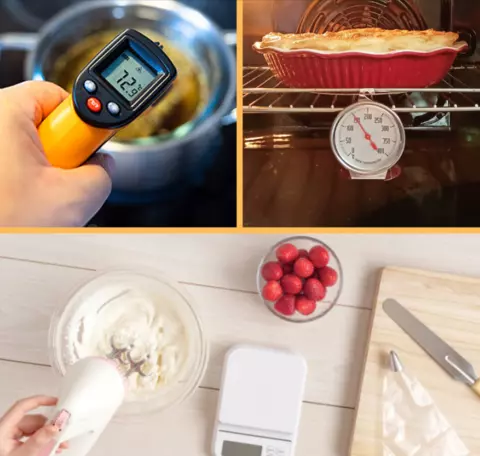
Metric Recipes Measurement tools
Credit: Adobe Stock

Cooking and baking using a kitchen scale are fun ways to build metric system abilities and apply measurement techniques. This recipe series is ideal for both new and experienced chefs.
Transform your K-12 classroom or home kitchen into a hands-on culinary laboratory by swapping volume cups for a digital scale. Explore this metric recipe series, hands-on activities, printable 
worksheets, and videos to build and reinforce interdisciplinary math, science, engineering, art, and mathematics (STEAM) skills. Apply the metric system in daily life to build confidence, develop proportional reasoning, and practice measurement techniques. Companion resources are available on the NIST Metric Kitchen website. 

Did you know that you can obtain a free set of metric education resources for use in your classroom? Contact the NIST TheSI [at] nist.gov (Metric Program) at TheSI [at] nist.gov (TheSI[at]nist[dot]gov) and include your name, school, subject, grade level, phone number, and U.S. mailing address. Publication requests may also be made using the OWM Contacts System. The NIST SI Teacher Kit contains a curated collection of instructional measurement resources. A metric ruler is a valuable tool for science, technology, engineering, art, and math (STEAM) classrooms.

Learning Objectives

The culinary arts are a fun hands-on way to learn how to apply the International System of Units (SI), commonly known as the metric system. Students prepare recipes using mass, length, area, volume, time, and temperature measurements.

Participants will be able to:

  • List and interpret SI measurement units used in a recipe.
  • Interpret a metric recipe.
  • Describe the relationship between grams and kilograms.
  • Measure ingredients accurately.
  • Develop a metric version of a recipe.
  • Critique a poorly converted recipe.
  • Explain how doubling or halving affects the recipe quantities.
Materials
  • Recipe Cards & Worksheets: Explore our printable NIST Metric Kitchen Recipe Cards, complete hands-on activities and use the classroom worksheets to reinforce core math and science skills. 
  • Kitchen Hardware & Tools: Set up digital scales, plunge cooking thermometers into ingredients, and arrange raw bakeware from the Metric Kitchen: Cookware and Tools catalog to launch your culinary laboratory.
  • Activity Supplies: Resealable snack-size plastic bags and permanent markers.
  • Technology: Computer or projector to stream companion recipe demonstration videos.
Vocabulary

Accuracy – How close a measured value is to the true value.

Area – The size of a surface. The amount of space inside the boundary of a flat shape or the surface of an object. Measured in square units. 

Bake – Cook by dry heat, usually in the oven. 

Batch – A group of food made at the same time. 

Batter – A mixture containing flour and liquid, thin enough to pour. 

Beat – To mix rapidly in order to make a mixture smooth and light by incorporating as much air as possible. 

Blend – Incorporate two or more ingredients thoroughly. 

Boiling Point (Water) – The specific temperature (at sea level) where water changes from a liquid into a gas (steam). 

Capacity – The maximum amount that an object can contain, measured in cubic units. 

Chop (Medium) – Cut solids into 13 mm to 25 mm pieces with a sharp knife or other chopping device. Pieces can be irregular, but size should be reasonably uniform. 

Consistency – How thick, thin, or uniform a mixture is. 

Cut – Incorporate cold butter into a dry mixture to create a crumbly texture. 

Data – Information collected from a measurement process. 

Degree Celsius – A temperature measurement unit. Diced – To cut into small uniform pieces about 1 cm x 1 cm x 1 cm.

Fold – Incorporate a delicate substance, such as whipped cream or beaten egg whites, into another substance of different weight in a way that minimizes loss of volume. Cut down through mixture with spoon, whisk, or fork; go across bottom of bowl, up and over, close to surface. The process is repeated, while slowing rotating the bowl, until the ingredients are thoroughly blended. 

Freezing Point (Water) – The specific temperature (0 °C) where liquid water turns into solid ice. Greased – Apply a thin layer of butter, shortening or vegetable oil to the surface of a pan to prevent food from sticking. 

Ingredient – A food item used to make a recipe. 

International System of Units – A measurement system abbreviated SI (from the French Le Système International d’Unités). Also known as the metric system of measurement.

Length – Measurement of the distance between two points measured in meters. 

Liter – A volume measurement unit. 

Magnitude – Size or extent of an object. 

Mass – The amount of matter in an object measured in grams. 

Measure – To determine the dimension, quantity, or capacity. Meter – A length measurement unit. 

Metrology – The science of measurement. 

Mise en place – A French culinary technique meaning “to put in place” that refers to the practice of preparing and organizing all equipment and ingredients before preparing a recipe. 

Mixture – Two or more ingredients combined together. 

Proportion – The relationship between ingredient amounts in a recipe. 

Precision – How close a series of repeated measurements are to one another. 

Puree – To mash foods until smooth by hand, by rubbing through a sieve or food mill, or by whirling in a blender or food processor. A puree should be completely smooth. 

Quantity – A measurable amount, characteristic, or property of an object or collection of objects. 

Recipe – A set of instructions for making food. Scale (Kitchen) – A device used to accurately measure the weight of solid and liquid recipe ingredients and other food.

Stir – To mix ingredients with a circular motion until well blended or of uniform consistency. 

Tare – To reset a scale to zero. 

Thermometer (Kitchen) – A device that measures temperature measured in degree Celsius. 

Toss – To combine ingredients with a lifting motion. 

Volume – The measurement of the amount of space occupied inside the three-dimensional space, measured in cubic units. 

Weight – How heavy something is because of gravity. 

Whip – To beat rapidly to incorporate air and produce expansion, as in heavy cream or egg whites. 

Yield – The amount of food made from a recipe.

Safety
  • Adult Supervision: Adults will closely supervise, observe, and evaluate learners' skills before permitting independent kitchen work.
  • Hazard Avoidance: Prior to undertaking a recipe, collaborate to identify, discuss, and avoid kitchen hazards, such as safely applying heat using an oven and adopting food hygiene best practices.
  • Allergy Check: Discuss allergy info (eggs, gluten, dairy) before handling food items.
  • Personal Prep: Tie back long hair and roll up long sleeves.
  • Burn and Spill Mitigation: Use oven mitts, handle cooking tools carefully, use caution around hot surfaces, and wipe up spills immediately to prevent slipping.
  • Cleanup Safety: Clean as you go to keep the area safe, and cool hot tools completely before washing.
Teaching Tips

One recommended education best practice is to teach the SI by using the SI. Participants must build proficiency and confidence working with metric measurements before they can effectively make comparisons with other measurement systems. Use the Top 10 Tips for Teaching the Metric System.

  • Integrate Mise en Place: Introduce this foundational French culinary technique ("to put in place") to teach students how to sequence tasks, prepare all equipment, and organize individual ingredients before combining them to save time and improve accuracy.
  • Utilize Proportional Reasoning: Use recipe scaling tasks (doubling or halving ingredient yields) to reinforce base-10 multiplicative relationships and unit factor conversions, such as dividing by 1 000 to convert grams to kilograms.
  • Maintain Scale Precision: Instruct students never to mix ingredients while the bowl is actively resting on the kitchen scale, as it can interfere with the sensor. Bowl contents should be mixed only when resting on a separate, stable counter surface.
  • Enforce SI Writing Conventions: Reinforce the exact technical Writing with the SI style used by STEM professionals. 
  • Focus on Key Culinary Parameters: Break down lessons into single measurement variables during a kitchen session, isolating ingredient training specifically to Mass, Volume, Length, Area, Time, or Temperature.
  • Optimize Resources for Reuse: Print individual recipe cards single-sided in portrait orientation on standard office size cardstock (215.9 mm x 279.4 mm) and scale fit to page. Use lamination for easy cleaning, kitchen spill protection, and multi-session classroom reuse.
Metric Education Activity Games Section Banner

Activity

Delivery Method

Grade Level

K to 2nd

3rd to 5th

6th to 8th

9th+

Facilitator Guided

Classroom


X

X

X

Family Guided

Home

X

X

X

X

Contacts

Created June 22, 2026, Updated August 4, 2026
Was this page helpful?