An official website of the United States government
Here’s how you know
Official websites use .gov
A .gov website belongs to an official government organization in the United States.
Secure .gov websites use HTTPS
A lock (
) or https:// means you’ve safely connected to the .gov website. Share sensitive information only on official, secure websites.

Formal and Informal Educators, Parents and Families.
Grade Level:
K to Higher Education
Subjects:
Biology, Chemistry, Earth Science, Engineering, Environmental Science, Life Science, Mathematics, Physical Science, Physics, and STEAM.
Credit:
Adobe Stock
Cooking and baking using a kitchen scale are fun ways to build metric system abilities and apply measurement techniques. This recipe series is ideal for both new and experienced chefs. Transform your K-12 classroom or home kitchen into a hands-on culinary laboratory by swapping volume cups for a digital scale. Explore this metric recipe series, hands-on activities, printable worksheets, and videos to build and reinforce interdisciplinary math, science, engineering, art, and mathematics (STEAM) skills. Apply the metric system in daily life to build confidence, develop proportional reasoning, and practice measurement techniques. Companion resources are available on the NIST Metric Kitchen website.
Did you know that you can obtain a free set of metric education resources for use in your classroom? Contact the NIST TheSI [at] nist.gov (Metric Program) at TheSI [at] nist.gov (TheSI[at]nist[dot]gov) and include your name, school, subject, grade level, phone number, and U.S. mailing address. Publication requests may also be made using the OWM Contacts System. The NIST SI Teacher Kit contains a curated collection of instructional measurement resources. A metric ruler is a valuable tool for science, technology, engineering, art, and math (STEAM) classrooms.

Learning Objectives
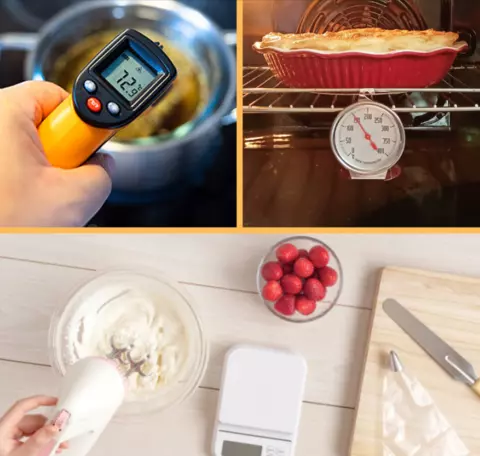
The culinary arts are a fun hands-on way to learn how to apply the International System of Units (SI), commonly known as the metric system. Students prepare recipes using mass, length, area, volume, time, and temperature measurements.
Participants will be able to:
List and interpret SI measurement units used in a recipe.
Interpret a metric recipe.
Describe the relationship between grams and kilograms.
Measure ingredients accurately.
Develop a metric version of a recipe.
Critique a poorly converted recipe.
Explain how doubling or halving affects the recipe quantities.
Materials
Recipe Cards & Worksheets: Explore our printable NIST Metric Kitchen Recipe Cards, complete hands-on activities and use the classroom worksheets to reinforce core math and science skills.
Kitchen Hardware & Tools: Set up digital scales, plunge cooking thermometers into ingredients, and arrange raw bakeware from the Metric Kitchen: Cookware and Tools catalog to launch your culinary laboratory.
Activity Supplies: Resealable snack-size plastic bags and permanent markers.
Technology: Computer or projector to stream companion recipe demonstration videos.
Safety
Adult Supervision: Adults will closely supervise, observe, and evaluate learners' skills before permitting independent kitchen work.
Hazard Avoidance: Prior to undertaking a recipe, collaborate to identify, discuss, and avoid kitchen hazards, such as safely applying heat using an oven and adopting food hygiene best practices.
Allergy Check: Discuss allergy info (eggs, gluten, dairy) before handling food items.
Personal Prep: Tie back long hair and roll up long sleeves.
Burn and Spill Mitigation: Use oven mitts, handle cooking tools carefully, use caution around hot surfaces, and wipe up spills immediately to prevent slipping.
Cleanup Safety: Clean as you go to keep the area safe, and cool hot tools completely before washing.
Teaching Tips
One recommended education best practice is to teach the SI by using the SI. Participants must build proficiency and confidence working with metric measurements before they can effectively make comparisons with other measurement systems. Use the Top 10 Tips for Teaching the Metric System.
Integrate Mise en Place: Introduce this foundational French culinary technique ("to put in place") to teach students how to sequence tasks, prepare all equipment, and organize individual ingredients before combining them to save time and improve accuracy.
Utilize Proportional Reasoning: Use recipe scaling tasks (doubling or halving ingredient yields) to reinforce base-10 multiplicative relationships and unit factor conversions, such as dividing by 1,000 to convert grams to kilograms.
Maintain Scale Precision: Instruct students never to mix ingredients while the bowl is actively resting on the kitchen scale, as it can interfere with the sensor. Bowl contents should be mixed only when resting on a separate, stable counter surface.
Enforce SI Writing Conventions: Reinforce the exact technical Writing with the SI style used by STEM professionals.
Focus on Key Culinary Parameters: Break down lessons into single measurement variables during a kitchen session, isolating ingredient training specifically to Mass, Volume, Length, Area, Time, or Temperature.
Optimize Resources for Reuse: Print individual recipe cards single-sided in portrait orientation on standard office size cardstock (215.9 mm x 279.4 mm) and scale fit to page. Use lamination for easy cleaning, kitchen spill protection, and multi-session classroom reuse.