

Official websites use .gov
A .gov website belongs to an official government organization in the United States.

Secure .gov websites use HTTPS
A lock (
) or https:// means you’ve safely connected to the .gov website. Share sensitive information only on official, secure websites.


Nitrogen-Vacancy (NV) Center Magnetometry
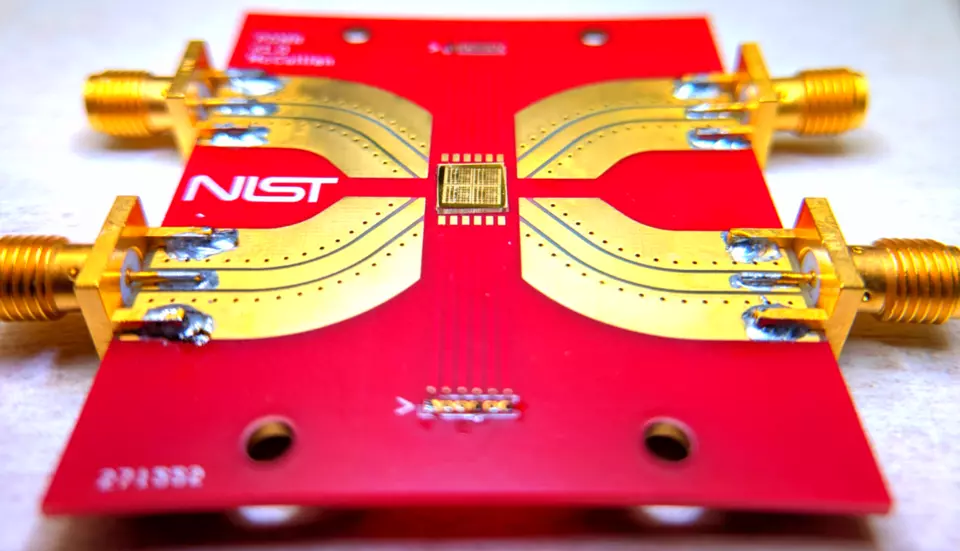
A prototype NV-center magnetometer being developed by NIST. This device uses the photoelectric effect to electrically measure magnetic fields.
The Technology
NV-center magnetometers are quantum rulers for measuring magnetic fields. Sensitive, compact and robust, these sensors’ unique capabilities can enable powerful and transformative applications.
NV-center magnetometers measure magnetic fields using electrons trapped inside tiny diamonds. They do this using a quantum magnetism that is intrinsic to some fundamental particles, like electrons. This quantum mechanical magnetism is known as “spin.”
To make an NV-center magnetometer, scientists begin by introducing defects into the regularly spaced lattice of carbon atoms in a diamond crystal. The density of the defects and the chemical elements that form them give the diamond a unique color. These defects are often referred to as “color centers.” The “nitrogen-vacancy” color center, or NV center, is a defect consisting of one nitrogen atom that replaces a carbon atom in the diamond structure and an adjacent vacancy where a carbon atom is missing.
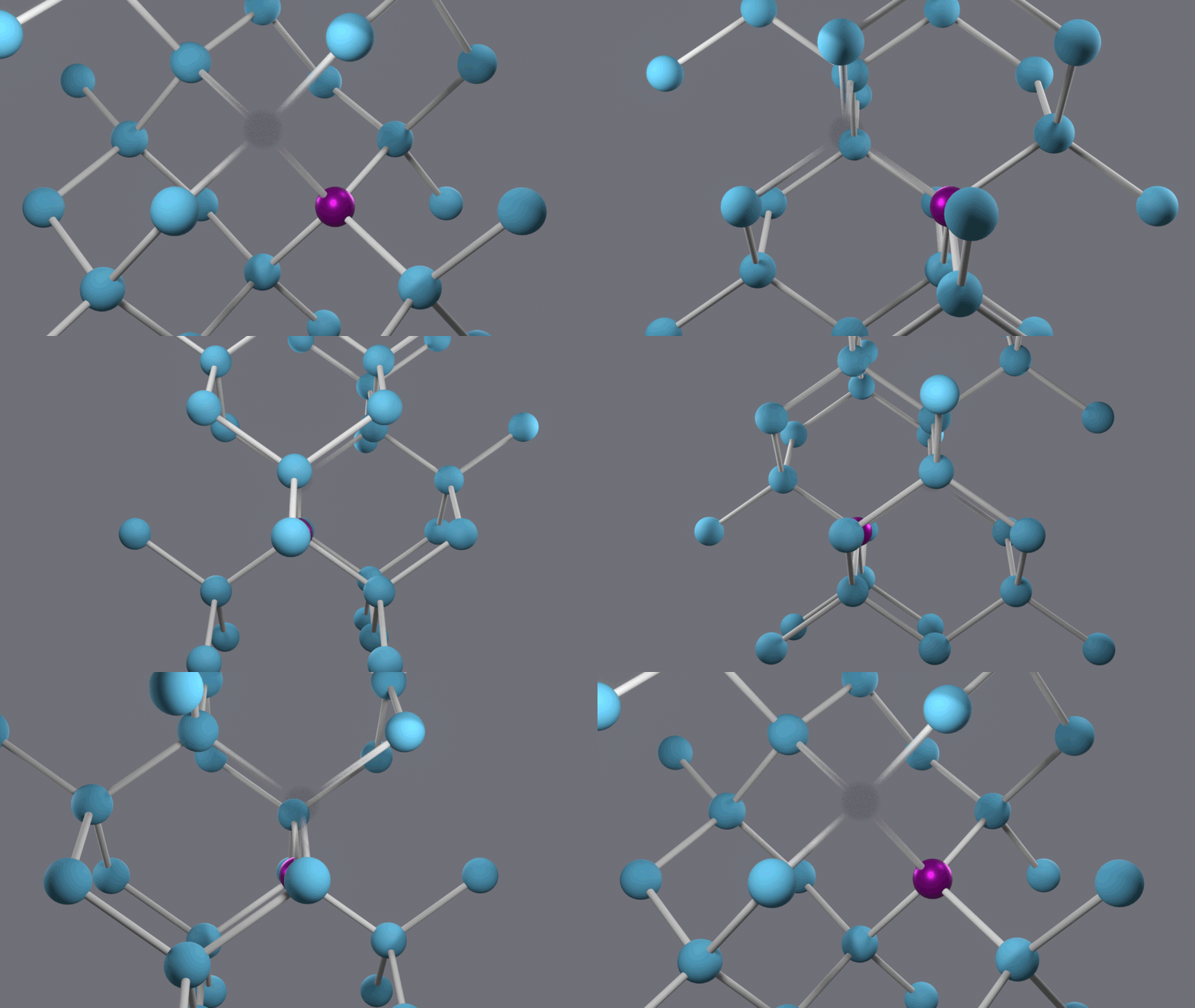
The NV-center electron spin can be in one of several quantum energy states, similar to the quantized energy levels of electrons in atoms. The difference in energy between any two spin states depends on the magnitude and direction of the magnetic field that the diamond is in. This magnetic sensitivity enables an NV center to function as a magnetic sensor.
To perform a measurement, scientists first place a diamond with NV-center defects inside a magnetic field of interest. Then they shine green light on the diamond. This light puts the NV centers into a certain quantum spin state and causes the NV centers to emit red light, which scientists measure using a photodetector.
Next, scientists apply microwave energy of varying frequency to the NV-center spins. When the microwave energy matches the energy spacing between spin states, the NV center absorbs it and changes spin state. This change in spin state diminishes the amount of red light that the NV centers emit. By measuring the applied microwave energy that causes the NV-center spin state to change, known as the transition frequency, scientists can determine the magnetic field.
NV-center magnetometers can be made with a single NV center for extreme spatial resolution or with many NV centers for high magnetic sensitivity. The NV center’s transition frequency depends only on the magnetic field, fundamental physical constants and diamond-specific constants. Thus, the sensor does not need to calibrated and can be made straightforwardly traceable to the International System of Units (SI).
NIST aims to improve several aspects of NV-center magnetometers, including how magnetic field measurements are read out. Today’s devices measure magnetic fields by detecting the red light that NV centers emit. NIST researchers are developing a next-generation device that uses the photoelectric effect — the emission of electrons from a material under illumination with light — to perform NV-center magnetometry with electrical readout.
This new detection scheme converts the spin state of the NV-center electrons directly into an electrical signal within the diamond. NIST researchers will design and fabricate state-of-the-art photoelectrically detected magnetic resonance devices and electronics to maximize device sensitivity and other key performance metrics while driving down power consumption, weight and cost. Complementing this effort, the NIST team will develop and use machine learning to read out NV-center magnetometers as quickly as possible.
NIST researchers will also develop metrology and benchmarking for the structural, optical and spin properties of diamonds. This will help to bridge the gap in quality and consistency between the diamonds currently produced by commercial vendors and those needed for sensors applications. In addition, NIST will make precision measurements of the magnetic response of many diamonds, establishing the sample-to-sample uncertainty for an important diamond-specific constant called the g-factor. This can help establish the uncertainty of magnetic field measurements made with similar diamonds — an important step in the development of this technology.
The NIST team will also study how materials processing affects sensor performance and will develop standardized materials-processing practices.
Advantages Over Existing Methods
NV-center magnetometers can measure a wide range of magnetic field strengths with ease. And unlike other types of quantum magnetic sensors, they can measure a field’s direction, not just its strength.
NV-center magnetometers also excel at measuring magnetic fields over a wide range of frequencies, from static to gigahertz frequency oscillating fields. NV centers can therefore self-calibrate the microwave magnetic fields used in magnetometry applications.
Unlike sensors based on ultracold superconducting circuits and atomic vapor cells — two of the most common types of quantum magnetometers in use today — NV centers can handle a large range of temperatures and pressures, from cryogenic to above-room temperatures and from vacuum pressures to gigapascals.
NV-center magnetometers can be made compact and robust, allowing them to be deployed in many environments, including extreme ones. They are also potentially cheaper than other quantum magnetometers to operate. And because diamonds are extremely durable, sensors made from them should last a long time.
Applications
NIST’s current effort focuses on using the unique advantages of NV centers to create a new technology for precision navigation. A magnetometer in an airplane or drone can measure the magnetic field of Earth’s crust. Those measurements are compared with known magnetic maps and combined with data from onboard inertial sensors to determine the craft’s direction of travel.
Unlike satellite-based positioning systems such as GPS, which can be spoofed or jammed, magnetic sensors do not rely on external electrical signals and are difficult to jam. This makes them attractive to military and aviation companies that need a backup navigation method for when GPS and similar systems are compromised. Other kinds of magnetometers have not yet delivered the positioning accuracy needed for commercial adoption, but NV centers’ vector-sensing capabilities may enable them to succeed where other technologies have come up short.
Key papers
M. Kelley and R. McMichael. Weighing unequal parameter importance and measurement expense in adaptive quantum sensing. Journal of Applied Physics. Published Feb. 21, 2025. DOI: 10.1063/5.0251881
S. Blakley, T. Mai, S. Moxim, J. Ryan, A. Biacchi, A. Hight Walker and R. McMichael. Spectroscopy of photoionization from the 1E singlet state in nitrogen-vacancy centers in diamond. Physical Review B. Published Oct. 17, 2024. DOI: 10.1103/PhysRevB.110.134109
R. McMichael, S. Blakley and S. Dushenko, S. Optbayesexpt: Sequential Bayesian Experiment Design for Adaptive Measurements. Journal of Research of the National Institute of Standards and Technology. Published Feb. 3, 2021. DOI: 10.6028/jres.126.002