

Official websites use .gov
A .gov website belongs to an official government organization in the United States.

Secure .gov websites use HTTPS
A lock (
) or https:// means you’ve safely connected to the .gov website. Share sensitive information only on official, secure websites.


Single-Photon Sources
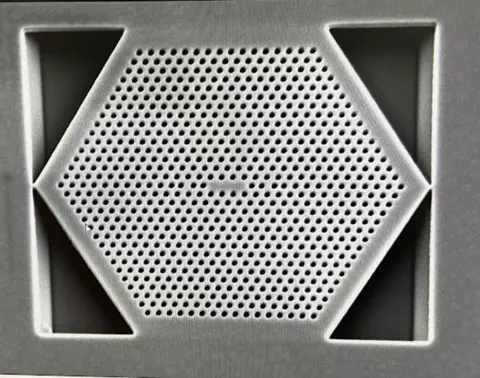
A quantum dot is positioned at the center of this periodic array of holes. The array functions as a three-dimensional nanocavity that collects and delivers single photons with high efficiency.
The Technology
NIST researchers are developing ways to generate single photons with near-perfect efficiency and on demand. The photon is the fundamental quantum unit of light, and the ability to reliably produce and capture individual photons is a long-held goal that could give a major boost to emerging quantum technologies and fundamental metrology.
To accomplish this, scientists use quantum dots: tiny three-dimensional chunks of semiconducting material. Quantum dots for photon generation are made with a common industrial technique called molecular beam epitaxy, which involves depositing thin films of crystals on a substrate. This method is known for producing ultrapure material with atomic-level precision.
The quantum dots used in this project are made from indium arsenide (InAs), an example of a material based on chemical elements with three or five electrons in their outer shell that have desirable properties for semiconductors (so-called III-V semiconductors). The InAs quantum dots are embedded in a matrix of gallium arsenide (GaAs).
Although the dots are composed of around 100,000 atoms, they resemble individual atoms in that their electrons occupy discrete energy levels whose values are determined by quantum mechanics — the physics of the very small and the very cold. When hit by a carefully shaped laser pulse, a dot absorbs light and one of its electrons jumps to a higher energy level. The electron then returns to its original level by emitting a single photon.
To capture and control that photon, scientists place the quantum dot inside a cavity with mirrors made of semiconductor and dielectric materials. Researchers are currently working to engineer the cavity so that it captures more than 90% of the emitted photons. (To date, NIST researchers have captured more than 40% of emitted photons; the best cavities reported in the scientific literature capture 72% of emitted photons.)
Once they emerge from the cavity, the photons are collected by a highly efficient optical fiber that can transport them for use in quantum processing, communication or other applications.
Advantages Over Existing Methods
Quantum dots have the potential to generate photons more efficiently than current state-of-the-art methods. Today’s techniques — for example, using faint lasers with filters that block most photons — emit photons at random times rather than on demand. They are not very efficient because they create significant numbers of multi-photon events and zero-photon events. And they are often not bright enough to meet the needs of emerging quantum technologies.
Applications
A highly efficient source of on-demand photons will unleash capabilities beyond those of today’s most advanced classical light sources.
Some of the most important potential applications involve quantum computers, an emerging technology that could someday help solve problems beyond the reach of today’s computers. For example, scientists believe that quantum computers could eventually enable scientists to precisely simulate complex molecules, potentially leading to new drugs and materials.
Some quantum computing companies use photons as qubits — the fundamental unit of quantum computation. To reach their full potential, these photonic qubits need to be indistinguishable from one another, and scientists needs to be able to generate them on demand. These stringent requirements also apply to quantum networks that would link quantum devices over large distances.
Other potential applications involve quantum sensing. Researchers envision using quantum dots to create complex, multi-photon quantum states of light. Such states can be used, for example, to precisely estimate phase differences in optical interferometry, enabling measurements beyond the standard quantum limit. Potential applications include gravitational wave detection, high-precision atomic clocks, quantum imaging and sensor networks.
In metrology, single-photon sources could improve how scientists measure the candela — the fundamental unit within the International System (SI) that quantifies the brightness of a light source. Currently, the candela has the largest uncertainty of the SI’s seven fundamental units — greater than one part in a thousand. Scientists hope to redefine the candela by combining near-perfect single photon sources with frequency metrology that provides the exact energy of each photon. A so-called quantum candela would be more accurate and could help industry develop new and improved lighting designs.
A related long-term goal is to measure optical power by counting single photons. Currently, optical power is connected indirectly to the SI, and optical power calibrations require large, power-hungry cryogenic radiometers. If scientists can excite quantum dots at precise rates and capture nearly every photon, that would reduce uncertainty and create a compact, chip-scale source of optical power, which could help industry with precision calibration.
Key papers
R.A. DeCrescent, Z. Wang, P. Imany, S.W. Nam, R.P. Mirin and K.L. Silverman. Monolithic polarizing circular dielectric gratings on bulk substrates for improved photon collection from InAs quantum dots. Physical Review Applied. Published Dec. 7, 2023. DOI: 10.1103/PhysRevApplied.20.064013
Key patents
P. Imany, K.L. Silverman, Z. Wang, F. Mahdikhany. Configuring layers of optical devices. U.S. Patent Application Number 63/845,595 (2025) Provisional.
P. Imany, K.L. Silverman, R.P. Mirin, Z. Wang, R.A. DeCrescent, R.C. Boutelle. Quantum light source with dual optical cavities. International Application No. PCT/US2023/021226 (2023) Pending.
Contacts
-
(303) 497-7948