

Official websites use .gov
A .gov website belongs to an official government organization in the United States.

Secure .gov websites use HTTPS
A lock (
) or https:// means you’ve safely connected to the .gov website. Share sensitive information only on official, secure websites.


Measuring Small Masses and Forces
The Technology
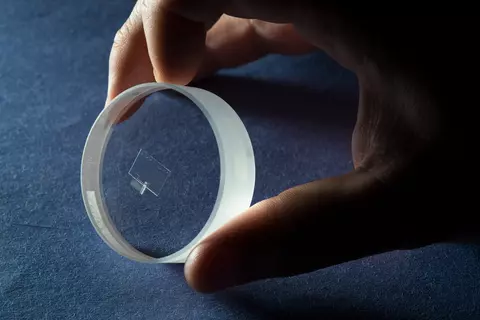
NIST scientists have devised a highly accurate method for measuring extremely small masses and forces. By using the radiation pressure that a weak laser beam exerts as it reflects from a mirror attached to a 1 mm glass cantilever platform, a self-calibrating mass and force sensor is realized.
The sensor operates by measuring the displacement caused by the radiation pressure force using a dual optical-cavity system. One optical cavity is mounted on the top surface of the cantilever with a mirror pointing up. It reflects the laser light coming down from above to provide a reference force from photon pressure. The second optical cavity is used as an interferometer to measure the distance between the cavity mirrors, which is proportional to the applied light force, typically in the range of micronewtons to femtonewtons.
This configuration can be used to measure an unknown optical power (or radio frequency electromagnetic field power) from a force calibration or, the other way around, to measure a small unknown mass or force using a calibrated laser power. A built-in self-calibration routine provides an independent reference, ensuring the accuracy of all measurements.
NIST scientists are also pioneering an electrostatic force balance (EFB). The EFB has been used to measure mass in the milligram range with the lowest uncertainty in the world, but it can also act as a laser power meter. It measures how much force a laser exerts on an attached high-reflectivity mirror by balancing this photon pressure force against an electrostatic force on a capacitor. Mass, force and laser power traceability is ensured through electrical metrology, providing a portable primary reference balance that does not require calibration weights. In addition to a large balance used as a calibration reference, a chip-scale balance has been developed that allows the same physics to be used in a compact and inexpensive form factor.
Advantages Over Existing Methods
Very small masses and forces have traditionally been measured using sets of carefully calibrated metal weights. That method, however, has two inherent problems. First, the lightest weights available are typically 1 milligram, a quantity not small enough for numerous modern uses in manufacturing, medicine, pharmaceutical development and more.
Moreover, although the international standard prototype metal kilogram — which until recently was the world standard of mass — can be measured with uncertainties in the range of 10 parts per billion, the uncertainties grow rapidly as mass standards become smaller than 1 milligram. That situation has prompted an urgent search for a more accurate method of gauging masses at the submilligram level and forces of less than 10 micronewtons.
NIST’s chip-scale instruments provide scalability to very small quantities and, in the case of the EFB, traceability to the SI.
Applications
These innovations — which permit measurements on the scale of grams to nanograms with up to 100 times better accuracy — could be of great importance to commercial laser users who need exact force and mass measurements, or a self-contained SI-traceable reference force or mass.
Eventual commercial uses could include sensors that use laser light as a built-in reference, allowing scientists to ensure their devices really are measuring force correctly. But the potential applications go beyond force, into cheap field-portable balances for near-instant measurement of masses of a milligram or less, and into compact laser power meters that make their measurements in real time.
The NIST devices could also serve as a calibration reference for very small forces such as those exerted by the probe tip in atomic force microscopes.
Key Papers
K. Arumugam, S. Schlamminger and G.A. Shaw. Electrostatic force method to determine flexure stiffness with an integrated fiber-optic displacement interferometer. Measurement Science and Technology. Jan. 7, 2026. DOI: 10.1088/1361-6501/ae2afd
B.J. Simonds, K.A. Rigers, S. Schulze, D. Newell, G. Shaw, J. Wahl, P.A. Williams and J.H. Lehman. Practical realization of the watt from Planck’s constant using radiation pressure. Metrologia. Oct. 28, 2024. DOI: 10.1088/1681-7575/ad844b
J. Cripe, K. Arumugam, Y. Gerbig and G. Shaw. A static stiffness reference artifact for instrumented indentation with integrated fiber Fabry-Perot displacement measuring interferometer. Measurement Science and Technology. Sept. 8, 2023. DOI: 10.1088/1361-6501/acf237
R.S. Gates, W.A. Osborn, M.J. McLean, G.A. Shaw and J.J. Filliben. Certification of Standard Reference Material 3461: Reference cantilevers for AFM spring constant calibration. NIST Special Publication 260-227. August 2022. DOI: 10.6028/NIST.SP.260-227
L. Keck, G.A. Shaw, R. Theska and S. Schlamminger. Design of an electrostatic balance mechanism to measure optical power of 100 kW. IEEE Transactions on Instrumentation and Measurement. Feb. 19, 2021. DOI: 10.1109/TIM.2021.3060575
P. Williams, M. Spidell, J. Hadler, T. Gerrits, A. Koepke, D. Livigni, M. Stephens, N. Tomlin, G.A. Shaw, J. Splett, I. Vayshenker, M. White, C. Yung and J. Lehman. Meta-study of laser power calibrations ranging 20 orders of magnitude with traceability to the kilogram. Metrologia. Published online Dec. 20, 2019. DOI: 10.1088/1681-7575/ab4641
G.A. Shaw, J. Stirling, J.A. Kramar, P. Williams, M. Spidell, R.P. Mirin. Comparison of electrostatic and photon pressure force references at the nanonewton level. Metrologia. Feb. 8, 2019. DOI: 10.1088/1681-7575/aaf9c2
C.L. Holloway, M.T. Simons, M.D. Kautz, A.H. Haddab, D. Novotny, J.H. Lehman, P.A. Williams and G.A. Shaw. Using radiation pressure to develop a radio-frequency power measurement technique traceable to the redefined SI. Applied Physics Letters. Oct. 15, 2018. DOI: 10.1063/1.5052258
R. Wagner, F. Guzmán, A. Chijioke, G.K. Gulati, M. Keller and G. Shaw. Direct measurement of radiation pressure and circulating power inside a passive optical cavity. Optics Express. Aug. 28, 2018. DOI: https://doi.org/10.1364/OE.26.023492
G.A. Shaw. Current state of the art in small mass and force metrology within the International System of Units. Measurement Science and Technology. July 2018. DOI: 10.1088/1361-6501/aaac51
G.A. Shaw, J. Stirling, J.A. Kramar, A. Moses, P. Abbott, R.L. Steiner, A. Koffman, J.R. Pratt and Z.J. Kubarych. Milligram mass metrology using an electrostatic force balance. Metrologia. Sept. 28, 2016. DOI: 10.1088/0026-1394/53/5/A86
J. Melcher, J. Stirling, F.G. Cervantes, J. Pratt, and G. Shaw. A self-calibrating optomechanical force sensor with femtonewton resolution. Applied Physics Letters. Dec. 10, 2014. DOI: 10.1063/1.4903801
Key Patents
G. Shaw et al. Optomechanical reference. United States Patent US 10352837. July 16, 2019.
Contacts
-
(301) 975-6614