

Official websites use .gov
A .gov website belongs to an official government organization in the United States.

Secure .gov websites use HTTPS
A lock (
) or https:// means you’ve safely connected to the .gov website. Share sensitive information only on official, secure websites.


Compact Ultrastable Laser Systems
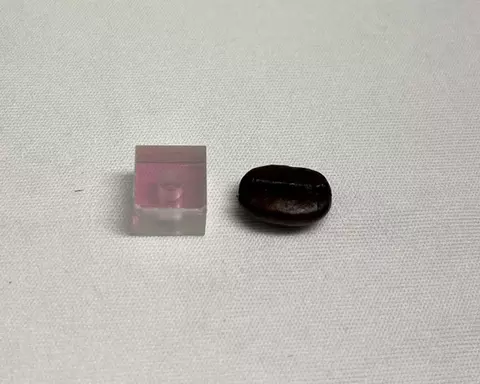
An optical resonator containing a micromirror is pictured next to a coffee bean for scale. Measuring just 9 mm by 9 mm by 7 mm, the resonator establishes a precise set of optical reference frequencies.
The Technology
NIST, in collaboration with colleagues at Yale University and the University of Colorado Boulder, is developing tiny devices that create laser light with a remarkably stable color (frequency). These compact ultrastable lasers can be deployed in remote locations for a range of new and improved applications. Researchers have shrunk these lasers from laboratory scale to about the size of a coffee bean.
Advantages Over Existing Methods
To create an ultrastable laser, researchers bounce light between two curved mirrors that are housed in an optical component called a “resonator.” The mirrors form an enclosure (cavity) with a fixed distance between them. Light waves that fit perfectly into this space — spanning an exact number of complete peaks and valleys from mirror to mirror — will resonate and build up inside. Each of these specific wavelengths corresponds to a precise, well-defined resonant frequency. Left to themselves, laser frequencies will fluctuate due to temperature changes, vibrations or other disturbances. To compensate, ultrastable lasers use electronic systems that continuously nudge the light back to the desired resonant frequency of the cavity.
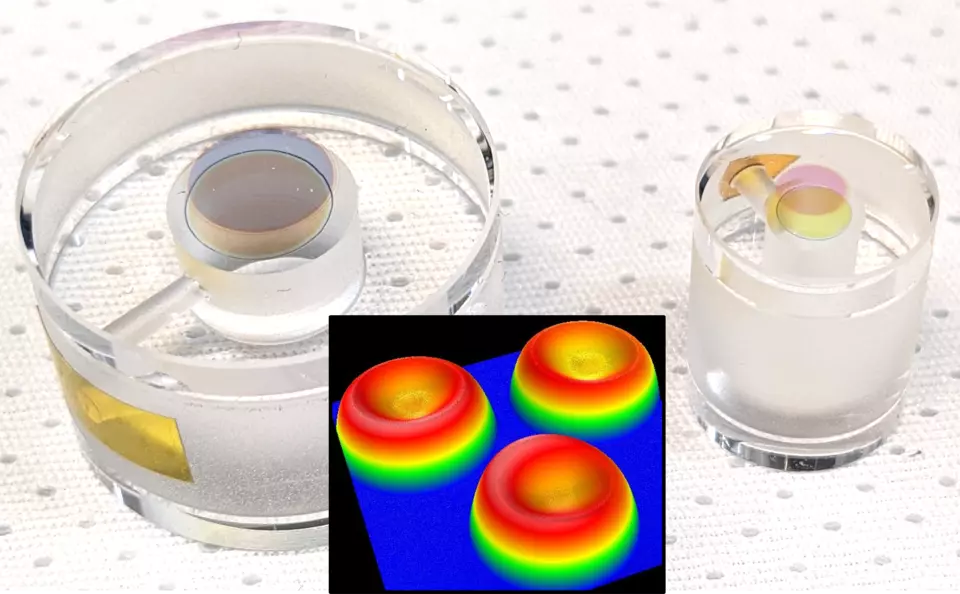
Conventional ultrastable lasers use large glass resonators housed inside bulky high-vacuum systems. These vacuum systems remove air that can cause the resonant frequency to shift. NIST researchers and their collaborators have created miniature versions that do not require an active vacuum system. They use conventional chip-manufacturing techniques to create tiny micromirrors. Because the glass pieces are directly bonded together inside a vacuum, the cavity becomes its own vacuum seal, removing the need for an electrically powered vacuum system.
Applications
Compact ultrastable lasers have helped make possible portable versions of optical atomic clocks, which provide time and frequency signals far more precise than those of conventional atomic clocks. Portable optical clocks are now being explored for applications ranging from mineral discovery to early detection of earthquakes.
Compact ultrastable laser systems can greatly improve the accuracy of outdoor ranging systems, which measure the distance of faraway objects and detect changes in their positions. Space missions such as the Gravity Recovery and Climate Experiment (GRACE) utilize ultrastable lasers for greater precision in satellite ranging to better map global water and mass movements.
Compact and portable ultrastable lasers can enable femtosecond-level synchronization across fiber interconnects for quantum networks. They are also used to turn global fiber optic networks into a vast sensing platform, detecting everything from temperature fluctuations to vibrations along the optical fiber. More stable compact lasers can improve photonic radar systems, which can detect everything from enemy drones to a vehicle’s blind spots on a busy highway.
Key Publications
T. Nakamura, et al. Low-noise microwaves from free-running frequency combs and electrical feed-forward phase noise compensation. Nature Photonics. April 28, 2026. DOI: 10.1038/s41566-026-01905-3
N.V. Nardelli, D.V. Reddy, M. Grayson, D. Sorensen, M.J. Stevens, M.D. Mazurek, L.K. Shalm and T.M. Fortier. Phase-stable optical fiber links for quantum network protocols. Optica Quantum. March 31, 2026. DOI: 10.1364/OPTICAQ.582298
Y. Liu, et al. Ultrastable vacuum-gap Fabry-Perot cavities operated in air. Optica. Aug. 21, 2024. DOI: 10.1364/OPTICA.532883
M. Mazur, et al. Advanced Distributed Submarine Cable Monitoring and Environmental Sensing using Constant Power Probe Signals and Coherent Detection. March 12, 2023. Preprint DOI: 10.48550/arXiv.2303.06528
C.A. McLemore, et al. Miniaturizing Ultrastable Electromagnetic Oscillators: Sub-10^-14 Frequency Instability from a Centimeter-Scale Fabry-Perot Cavity. Physical Review Applied. Nov. 17, 2022. DOI: 10.1103/PhysRevApplied.18.054054
N. Jin, et al. Micro-fabricated mirrors with finesse exceeding one million. Optica. Aug. 22, 2022. DOI: 10.1364/OPTICA.467440
G. Marra, et al. Ultrastable laser interferometry for earthquake detection with terrestrial and submarine cables. Science. June 14, 2018. DOI: 10.1126/science.aat4458
B.S. Sheard, G. Heinzel, K. Danzmann, D.A. Shaddock, W.M. Klipstein and W.M. Folkner. Intersatellite laser ranging instrument for the GRACE follow-on mission. Journal of Geodesy. May 8, 2012. DOI: 10.1007/s00190-012-0566-3
Contacts
-
(303) 497-4580