

Official websites use .gov
A .gov website belongs to an official government organization in the United States.

Secure .gov websites use HTTPS
A lock (
) or https:// means you’ve safely connected to the .gov website. Share sensitive information only on official, secure websites.


SI Learning Hub
The SI Learning Hub includes background information to support student Metric Estimation Game (SP 1336) play in the classroom.
SI Basics | Writing with the SI | Communicate | Estimation Results | U.S. Metrication
SI Basics
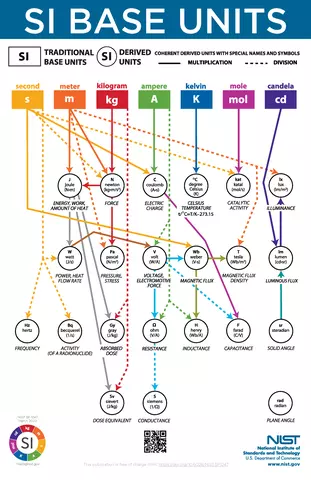
Play activities are an easy way to motivate students to learn, build self-confidence, and transfer SI measurement skills to new situations. Familiarity with the elements and structure of the International System of Units (SI), commonly known as the metric system, will prepare students to successfully make measurements in science, technology, engineering and mathematics (STEM) applications.
- Seven defining constants: the cesium hyperfine splitting frequency (ΔVCs), speed of light in vacuum (c), the Planck constant (h), elementary charge (e) (i.e., the charge on a proton), Boltzmann constant (k), Avogadro constant (NA), and luminous efficacy of a specified monochromatic source (Kcd). More information on the defining constants is available on the Meet the Constants.
- Seven SI base units: the meter (m), second (s), mole (mol), ampere (A), kelvin (K), candela (cd), and kilogram (kg). The 7 base units of the SI are used to define 22 derived units with special names and symbols.
- Twenty-two derived units with special names, defined as products of powers of the base units (Figure 1).
- Together the base units and derived units with special names (twenty-nine units) form the core set of SI units. All other SI units are combinations of some of these twenty-nine units. Any of the base units and derived units with special names can be constructed directly from the seven defining constants. Derived units with generic names reflect their mathematical derivation, such as area (m2), volume (m3), velocity (m/s), and acceleration (m/s2).
- Twenty-four prefixes ranging from 1030 to 10−30, are currently recognized for use. Values of quantities are expressed using Arabic symbols for numbers paired with a unit symbol, often prefix symbol that modifies unit magnitude.
Writing with the SI
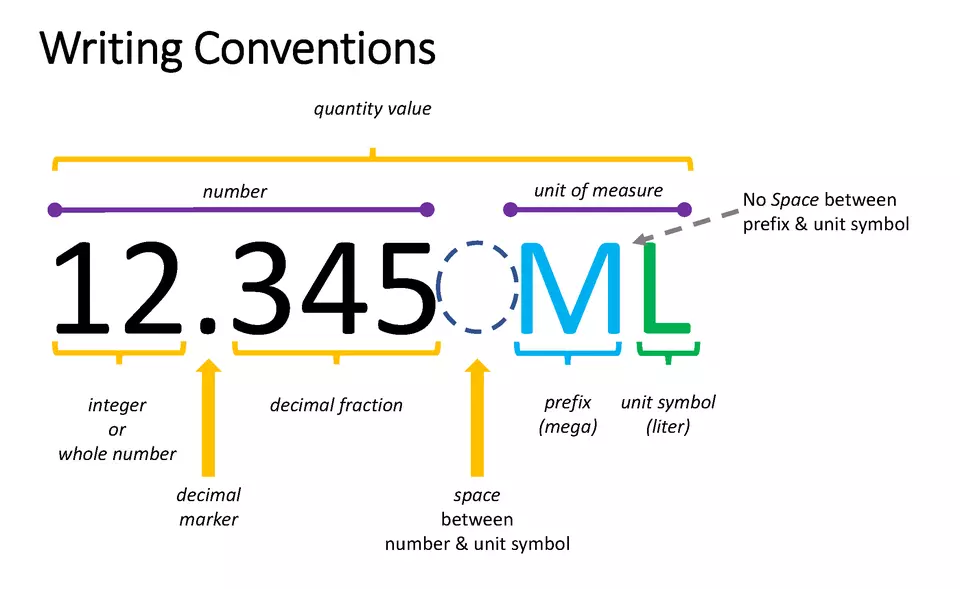
A benefit of the SI is that written technical information is effectively communicated, transcending the variations of language – including spelling and pronunciation. Arabic numerals describe the quantity. A quantity is then paired with a unit symbol, often with a prefix symbol that modifies unit magnitude (Figure 2).
During the game, students will apply units of mass, length, area, and volume (Table 1). Learn more tips about Writing with SI (Metric System) Units.
Mass | Length | Area | Volume |
|---|---|---|---|
kg | m | m2 | m3 |
g | dm | dm2 | L (dm3) |
| cm | cm2 | mL (cm3) |
Communicate Like a Scientist, Technologist, Engineer, and Mathematician
SI writing style is an essential literacy skill used by STEM professionals and the public to interpret, evaluate, synthesize, communicate, and apply measurement information. For STEM professionals, SI skills are necessary to plan investigations, collect and document research data observations, analyze results, clearly communicate, share research, gain new information by interpreting the findings of others, develop technological solutions to improve the quality of life, design and build critical infrastructure, and develop new products for the marketplace. Using SI writing style helps prevent miscommunication, misinterpretation of data, and calculation errors. SI writing style is also important for consumers who will interpret and use quantities to make daily life decisions.
Review the similarities between the U.S. monetary systems and the SI prefixes (Table 2). The U.S. monetary system is decimal based like the SI.
Dollars & Cents | Meters & Centimeters |
|---|---|
$1.00 = 100¢ | 1 m = 100 cm |
$0.10 = 10¢ | 0.1 m = 10 cm |
$0.01 = 1¢ | 0.01 m = 1 cm |
Meters & Millimeters | Centimeters & Millimeters |
|---|---|
| 1 m = 1000 mm | 100 cm = 1000 mm |
| 0.1 m = 100 mm | 10 cm = 100 mm |
| 0.01 m = 10 mm | 1 cm = 10 mm |
| 0.001 m = 1 mm | 0.1 cm = 1 mm |
Learning new concepts requires building new vocabulary in context. Expand the Metric Estimation Game Vocabulary accordion below to explore and terminology used in game play. This activity provides an opportunity for learners to apply, practice, and reinforce writing quantity values, unit symbols, prefixes and capitalization rules frequently within a short period of time.
Communicating Estimation Results
Measurement estimation results must be clearly reported to earn game points. SI writing conventions are important to ensure the comprehension of quantitative information and understandability of quantity values. A quantity is a property that often consists of an Arabic number paired with a unit of measure. For example, megaliter (ML) is made up of the prefix “mega” (M) and unit “liter” (L). When used in a sentence, “megaliter” becomes one word without a space between the prefix and unit symbol.
Similarly, the prefix symbol and the unit symbol are written without any space between to form a single symbol.
SI unit symbols are the same in every language. Because word spelling varies among different languages, abbreviations may also vary. For this reason, abbreviations are not used in technical communications (Table 3). For example, the permitted unit symbol for the second is s, but the unacceptable abbreviation sec should not be used.
Unit | Symbol (permitted) | Abbreviation (unacceptable) |
|---|---|---|
second | s | sec |
ampere | A | amp |
cubic centimeter | cm3 | cc |
U.S. Metrication
What countries have not adopted the SI? Many mistakenly think of countries like the United States, Liberia, and Myanmar (Burma). Some are surprised to learn that all countries have adopted the SI, including the U.S.; metric use is either mandatory or permissible. The U.S. has a long history using the metric system, including being one of the original 17 countries that signed the Treaty of the Meter in 1875, which is now celebrated as World Metrology Day (May 20th). It has been legal to use the metric system in the U.S. since 1866. The SI later became the preferred system of weights and measures for U.S. trade and commerce in 1988. Becoming metric is not a one-time event that has either happened or not. It is a process that happens over time. Every international economy is positioned somewhere along a transition continuum represented by various stages of the metric transition journey. In nearly all countries, people often use traditional units, at least in colloquial expressions. Processes and legacy infrastructure designed with U.S. customary measurement practices often continue to be maintained and supported until the product life cycle ends or it is no longer fit for purpose. For instance, municipal utility infrastructure requires maintenance over many years, and replacement represents considerable financial investment. Learn more information about U.S. metrication can be found in the NIST Taking Measure blog, Busting Myths about the Metric System.
EXPLORE THE METRIC PROGRAM
Becoming Familiar with SI | Everyday Estimation | Metrication FAQs | Prefixes | Metric Kitchen | SI Education and Training | SI Publications | Understanding Metric | Writing with Metric Units | National Metric Week | NEST-R (STEM Registry) | NIST Education Resources
Contacts
-
Metric Program