

Official websites use .gov
A .gov website belongs to an official government organization in the United States.

Secure .gov websites use HTTPS
A lock (
) or https:// means you’ve safely connected to the .gov website. Share sensitive information only on official, secure websites.


SI Units - Volume
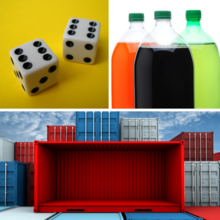
Volume is the measure of the 3-dimensional space occupied by matter, or enclosed by a surface, measured in cubic units. The SI unit of volume is the cubic meter (m3), which is a derived unit.
- Liter (L) is a special name for the cubic decimeter (dm3). The symbol for the liter is uppercase letter “ell” (L) is preferred to avoid the risk of confusion between the lowercase letter “ell” (l) and the number one (1). The script letter l (l) is not an approved symbol for the liter.
- Milliliter (mL) is a special name for the cubic centimeter (cm3).
1000 cubic millimeters (mm3) | = 1 cubic centimeter (cm3) |
1 cm3 | = 1 milliliter (mL) |
10 mL | = 1 centiliter (cL) |
10 cL | = 1 deciliter (dL) |
1 dL | = 100 milliliters (mL) |
1000 cm3 | = 1 cubic decimeter (dm3) |
1 dm3 | = 1 liter (L) |
10 dL | = 1 L |
1000 mL | = 1 L |
10 L | = 1 dekaliter (daL) |
10 daL | = 1 hectoliter (hL) |
1 hL | = 100 L |
1000 dm3 | = 1 cubic meter (m3) |
1000 L | = 1 m3 |
1000 L | = 1 kL |
1 kL | = 10 hL |
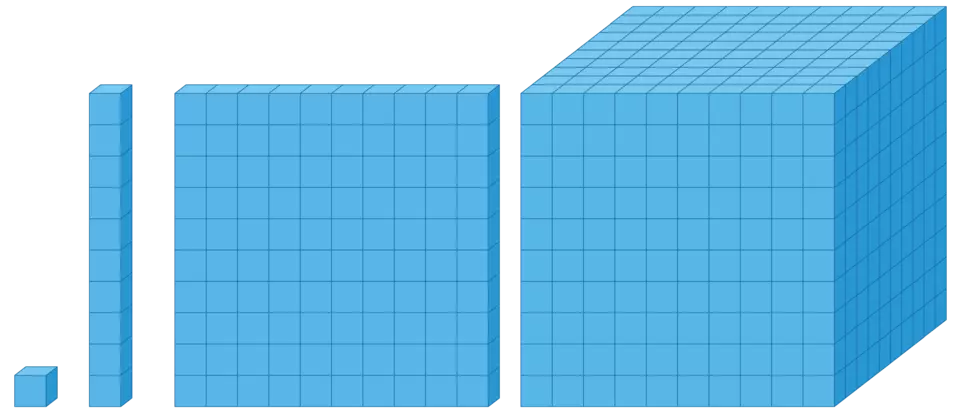
Use the visual Liter Cube Model to explore common SI volume units as they increase by powers of ten (from left to right). The smallest cube represents 1 cm3 (or 1 mL). The rod of 10 cubes represents 10 cm3 (or 10 mL). The flat square of 100 cubes represents 100 cm3 (or 100 mL). The large cube of 1 000 small cubes represents 1 000 cm3 (1 dm3 or 1 000 mL or 1 L).
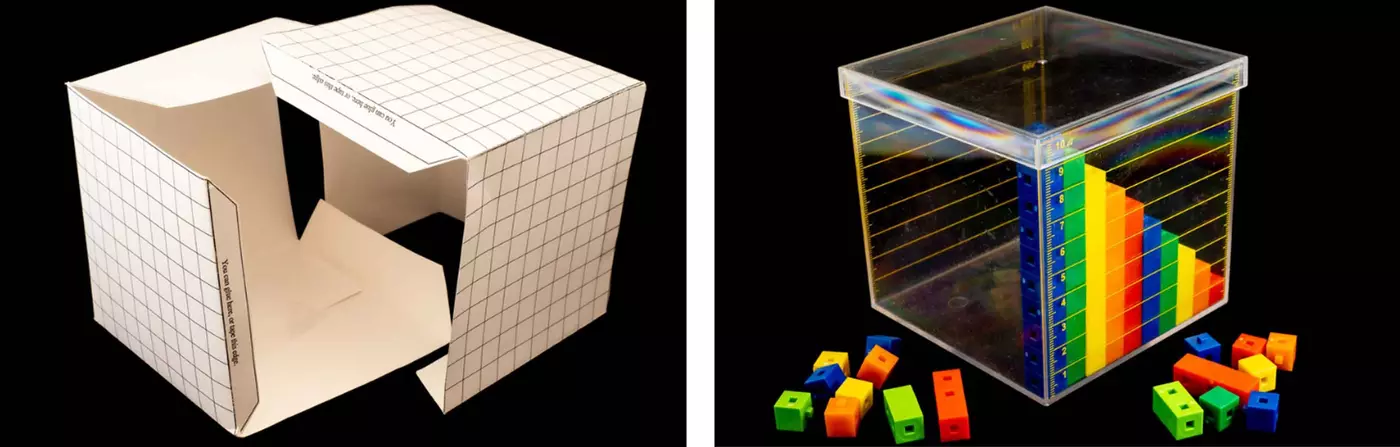
Visualize one cubic decimeter (dm3) or one liter (1 L) as a cube where each side is:
- 100 mm;
- 10 cm;
- 1 dm; or
- 0.1 m.
Visualize one liter (1 L) as:
- 1 m2 area that 1 mm deep
A key advantage of the SI is that volume (capacity) is defined the same way for solids, liquids, and gases. The SI uses the same units, like cubic meters (m3) or liters (L) and the simple power of ten. For example, a 10 cm × 10 cm × 10 cm cube has a volume of 1 000 cm or 1 L.
This makes learning and teaching easier because you don’t need to consider if it’s a “dry,” “liquid,” or “fluid” volume measurements. In contrast, non-SI (U.S. customary) measurements use different units for “dry,” “liquid,” or “fluid” volume measurements (like bushels for dry commodities or gallons for liquids). Learn more about Unit Conversion resources.
15 mL | Eye Drop Bottle |
80 mL | Empty Human Stomach |
200 mL | Juice Box |
355 mL | Soda Pop Can |
4 L | Full Human Stomach |
5 L | Blood in Human Body |
235 L | Bathtub |
1 ML | Olympic Swimming Pool |
| Bodies of Water | Continent | Volume of Water (estimated) |
|---|---|---|
| Caspian Sea | Asia | 78 700 km3 |
| Lake Baikal | Asia | 23 600 km3 |
| Lake Superior | North America | 12 100 km3 |
| Lake Michigan | North America | 4 920 km3 |
| Lake Huron | North America | 3 540 km3 |
| Lake Victoria | Africa | 2 700 km3 |
| Lake Ontario | North America | 1 700 km3 |
| Lake Lodoga | Europe | 908 km3 |
| Lake Erie | North America | 484 km3 |
| Lake Maracaibo | South America | 280 km3 |
| Lake Tahoe | North America | 151 km3 |
| Lake Mead | North America | 35 km3 |
Resources for Teachers and Students
Student classroom vocabulary:
- Capacity – The maximum amount that an object can contain measured in cubic units.
- International System of Units – The dominant measurement system used in science and international commerce, abbreviated SI (from the French Le Système International d’Unités). Also known as the metric system of measurement.
- Liter – A volume measurement unit.
- Measure – To determine the dimension, quantity, or capacity.
- Volume – The measurement of the amount of space occupied inside the three-dimensional space. Measured in cubic units.
Teachers: Top 10 Tips for Teaching the Metric System. (NIST)
Navigate to more SI information:
EXPLORE THE METRIC PROGRAM
Becoming Familiar with SI | Everyday Estimation | Metrication FAQs | Prefixes | Metric Kitchen | Metric Estimation Game | SI Education and Training | SI Publications | Understanding Metric | Writing with Metric Units | National Metric Week | NEST-R (STEM Registry) | NIST Education Resources