

Official websites use .gov
A .gov website belongs to an official government organization in the United States.

Secure .gov websites use HTTPS
A lock (
) or https:// means you’ve safely connected to the .gov website. Share sensitive information only on official, secure websites.


Economies of Scale
Go To: Advancing Competitiveness Homepage

Lead Researcher: Douglas S. Thomas
A Conceptual Framework for Economic Decision Making in Advancing Manufacturing Industry Competitiveness: Economies of Scale
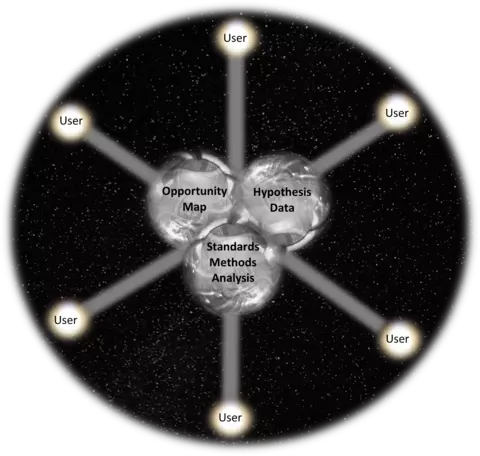
For more information, see NIST AMS 100-80.
The last part of the framework, described on the Advancing Competitiveness homepage, is Enterprise-Wide Utilization. This can generally be seen as harnessing economies of scale and standardizing metrics. As more change agents collaborate, there is more data being shared moving away from episodic learning that happens in silos to enterprise-wide learning that compounds. This results in a sharing of the costs for collecting information and sharing knowledge, resulting in more knowledge per dollar of expenditure.
Achieving enterprise-wide utilization is likely to require a centralized hub that maintains data (see descriptions of the opportunity map and hypotheses data) and maintains the standard classifications and methods with the result being a hub-and-spoke model where the spokes feed and extract data via the hub. The hub includes logistics management and a centralized economics office that develops and maintains methods, platforms, data, data classifications, guidance, and conducts research to advance impact. The spokes are operating units that develop projects for advancing manufacturing competitiveness. They feed data into and pull data out of the hub while adhering to standards and methods.
The consequence of the framework replicates approaches in other highly impactful programs such as those discussed in Section 1 where they increase forecast accuracy to realize high impact/returns. The potential growth in impact is likely substantial for R&D programs that do not track impact or generate feedback loops for impact.
Framework Components, Logic, and Implementation

Credit:
Pixabay
The Framework |

Credit:
Pixabay
Framework Logic |

Credit:
Pixabay
Implementation Infrastructure |
The Framework's Process | Background: Impact Forecasting | Notes and Cautions |
Data Layers and Feed Back Loops | Supporting Logic and Evidence | Standards and Platforms |
Metrics and Units of Observation | Economies of Scale | Modular Adoption |

Collaboration is a key component to reducing change agent costs and enabling compound learning. If you are considering adopting this framework, consider reaching out to the project lead Douglas Thomas, Economist: douglas.thomas [at] nist.gov (douglas[dot]thomas[at]nist[dot]gov)