

Official websites use .gov
A .gov website belongs to an official government organization in the United States.

Secure .gov websites use HTTPS
A lock (
) or https:// means you’ve safely connected to the .gov website. Share sensitive information only on official, secure websites.


Fire Protection
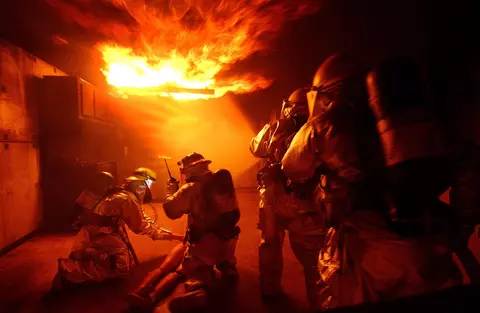
Fire protection is critically important for reducing human casualties, property loss, and economic damage caused by destructive fires in buildings and communities. Comprehensive fire protection involves a multi-faceted approach, integrating active systems like smoke alarms and sprinklers, passive measures like fire-rated construction, and human factors such as behavior in home fires. The ability to effectively measure the effectiveness and utilization of these technologies, as well as quantify the hazard posed by different fire protection design alternatives, is essential for informing building codes and national risk reduction strategies. Ultimately, continuous assessment of fire risk and the strategic roadmap for fire risk reduction ensures that resources are allocated toward impactful and innovative fire safety solutions along with protection for the public and firefighters alike.
- Towards a Process to Quantify the Hazard of Fire Protection Design Alternatives
- Reneke, P. A., Bruns, M. C., Gilbert, S. W., MacLaren, C., Peacock, R. D., Cleary, T. G., & Butry, D. T. (2019). Towards a process to quantify the hazard of fire protection design alternatives (NIST Technical Note 2041). National Institute of Standards and Technology.
- Link: https://doi.org/10.6028/NIST.TN.2041
- Proceedings of the 2009 Workshop on Innovative Fire Protection
- Reneke, P. A., Butry, D. T., Bryner, N. P., & Hamins, A. (2010). Proceedings of the 2009 workshop on innovative fire protection (NIST Special Publication 1109). National Institute of Standards and Technology.
- Link: https://tsapps.nist.gov/publication/get_pdf.cfm?pub_id=905084
- Reducing the Risk of Fire in Buildings and Communities
- Hamins, A., Averill, J., Bryner, N., Gann, R., Butry, D., Davis, R., Amon, F., Gilman, J., Maranghides, A., Mell, W., Madrzykowski, D., Manzello, S., Yang, J., & Bundy, M. (2012). Reducing the risk of fire in buildings and communities: A strategic roadmap to guide and prioritize research (NIST Special Publication 1130). National Institute of Standards and Technology.
- Link: https://doi.org/10.6028/NIST.SP.1130
- Human Behavior in Home Fires
- Gilbert, Stanley. (2021). Human behavior in home fires (NIST Technical Note 2191). National Institute of Standards and Technology.
- Link: https://doi.org/10.6028/NIST.TN.2191
- Response Time Impact of Smoke Alarms
- Gilbert, S., Cleary, T., Reneke, P., Peacock, R., & Butry, D. (2021). Response Time Impact of Smoke Alarms. NIST Technical Note (NIST TN) 2174, National Institute of Standards and Technology, Gaithersburg, MD.
- Link: https://doi.org/10.6028/NIST.TN.2174
- Estimating Smoke Detector Effectiveness and Utilization in Homes
- Gilbert, S. (2018). Estimating smoke detector effectiveness and utilization in homes (NIST Technical Note 2020). National Institute of Standards and Technology.
- Link: https://doi.org/10.6028/NIST.TN.2020
- Measuring the Impact of 16 CFR Part 1633 on Bed Fire Fatalities and Injuries in the United States
- Gilbert, S. W., Butry, D. T., Davis, R. D., & Gann, R. (2021). Measuring the Impact of 16 CFR Part 1633 on Bed Fire Fatalities and Injuries in the United States. International Fire Protection Magazine.
- Link: https://tsapps.nist.gov/publication/get_pdf.cfm?pub_id=931909
- Development of Tools to Evaluate the Impact of New Residential Fire Protection Technology
- Reneke, P., Bruns, M., Peacock, R., Cleary, T., & Gilbert, S. (2018). Development of Tools to Evaluate the Impact of New Residential Fire Protection Technology. SUPDET 2018, Cary, NC.
- Link: https://tsapps.nist.gov/publication/get_pdf.cfm?pub_id=926520
- A Fire Prevention Effectiveness Assessment for Multiple Ownerships
- Abt, K. L., Goodrick, S. L., Prestemon, J. P., Abt, K. L., Goodrick, S. L., Prestemon, J. P., Scranton, S., Mothershead, P., Haimes, T., Marzec, S., Owens, J., Romero, S., Shelley, R., Walker, L., & Yearwood, A. (2012). A Fire Prevention Effectiveness Assessment for Multiple Ownerships. JFSP Research Project Reports.
- Link: https://digitalcommons.unl.edu/jfspresearch/17/?utm_source=digitalcommons.unl.edu