

Official websites use .gov
A .gov website belongs to an official government organization in the United States.

Secure .gov websites use HTTPS
A lock (
) or https:// means you’ve safely connected to the .gov website. Share sensitive information only on official, secure websites.


Data Layers and Feedback Loops
Go To: Advancing Competitiveness Homepage

Lead Researcher: Douglas S. Thomas
A Conceptual Framework for Economic Decision Making in Advancing Manufacturing Industry Competitiveness: The Data Layers
For more information, see NIST AMS 100-80.
Data Layers: In contrast to the framework's process for projects, one might consider how the data interacts. The data system starts with data on hypotheses and moves through deeper economic impact analyses. The data system includes the following layers:
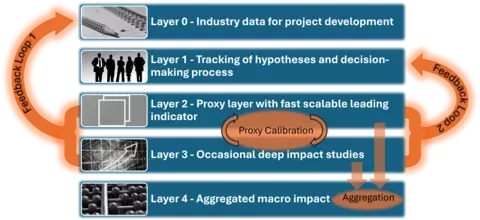
- Layer 0 - Industry data for hypothesis generation and project development: This layer guides project development and is used to develop predictions of impact. This creates a standardized source of data for prediction. In NIST AMS 100-80, it is referred to as a data-cube.
- Layer 1 - Tracking of hypotheses and decision-making process: This layer tracks the decision-making process and the predictions on which they are based, creating a referenceable trail for improvement. Predictions are to be testable and at a granular level to facilitate improvement in prediction and decision accuracy. It enables a decision system with continuous improvement.
- Layer 2 - Proxy layer with fast scalable leading indicators: Layer 2 includes a proxy layer of fast scalable leading indicators. Accurate impact assessments are costly and time consuming; thus, there is a limitation on the extent to which they can be made at a granular level and used for decision making. As a result, it is necessary to utilize lower-cost higher-frequency metrics with the tradeoff being that there is a loss in accuracy for estimating impact.
- Layer 3 - Occasional deep impact studies: Layer 3 addresses the loss in accuracy associated with proxy metrics by implementing impact studies that link proxies with measured impact. This enables translating proxy metrics into approximated impact estimates in a common unit. Over time, this approach supports increasingly accurate, timely, lower-cost, and decision-relevant impact estimates at a sufficiently granular level. It provides ground truth calibration for proxy metrics. These might be conducted by independent third-party assessments for increased credibility.
- Layer 4 - Aggregated macro impact: Layer 4 aggregates impact estimates at a high-level view of performance to facilitate overall accountability. Indirect effects can be estimated using IO or CGE models
The system enables near real-time aggregatable impact estimates, forming a growing layered body of evidence that supports drilling down to underlying data. This system can be implemented to create an interoperable impact accounting system at the Layer 3 and Layer 4 levels. The system supports improvements in impact and performance by tracking components of the decision-making process, formalizing the assumptions underlying decisions (i.e., the predictions of impact), and generating testable impact hypotheses. These characteristics facilitate identifying when alterations in decision-making components increase performance.
Framework Components, Logic, and Implementation

Credit:
Pixabay
The Framework |

Credit:
Pixabay
Framework Logic |

Credit:
Pixabay
Implementation Infrastructure |
The Framework's Process | Background: Impact Forecasting | Notes and Cautions |
Data Layers and Feed Back Loops | Supporting Logic and Evidence | Standards and Platforms |
Metrics and Units of Observation | Economies of Scale | Modular Adoption |

Collaboration is a key component to reducing change agent costs and enabling compound learning. If you are considering adopting this framework, consider reaching out to the project lead Douglas Thomas, Economist: douglas.thomas [at] nist.gov (douglas[dot]thomas[at]nist[dot]gov)