

Official websites use .gov
A .gov website belongs to an official government organization in the United States.

Secure .gov websites use HTTPS
A lock (
) or https:// means you’ve safely connected to the .gov website. Share sensitive information only on official, secure websites.


Framework Process
Go To: Advancing Competitiveness Homepage

Lead Researcher: Douglas S. Thomas
A Conceptual Framework for Economic Decision Making in Advancing Manufacturing Industry Competitiveness: The Process
For more information, see NIST AMS 100-80.
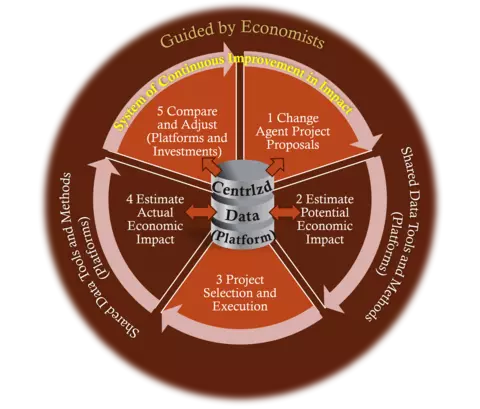
Process: There is some complexity in the framework due to the many inherent challenges, including data interoperability, timeliness, and applicability along with behavioral frictions and incentive misalignment. As a result, the framework is presented from different aspects, both from the process perspective and data layer perspective. Below is a description of the project process that starts with the development of proposed research followed by the execution of research and moving through to completion and post-evaluation:
- Step 1 - Change Agent Project Proposals: The process for continuous improvement starts with the development of change agents’ project proposals and incorporating those things learned from previous project.
- Step 2 - Estimate Potential Economic Impact: This step includes predicting or estimating the potential economic impact or return. Both steps 1 and 2 utilize outside economic data that has been previously assembled. The impact prediction (i.e., hypothesis) information, including methods, is collected in a centralized location for later comparing to actual impacts and to guide future investments.
- Step 3 - Project Selection and Execution: The estimated economic impacts are used to select projects which are then executed.
- Step 4 - Estimating Actual Economic Impact: Following the completion of projects, there is an estimate made of the actual or realized impacts.
- Step 5 - Compare and Adjust: The predicted impacts are compared to the measured realized impacts to adjust the platforms for economic assessment.
This process creates a double feedback loop where feedback loop 1 applies to the prediction metrics (Note: both the predictions and prediction methodology is tracked). This feedback loop advances an organizations ability to predict and identify high impact projects. Feedback loop 2 applies to the project performance, enabling the identification of project configurations that potentially result in higher impact. Data is collected using shared tools, methods, and platforms and stored centrally.
Framework Components, Logic, and Implementation
Credit:
Pixabay
The Framework |

Credit:
Pixabay
Framework Logic |

Credit:
Pixabay
Implementation Infrastructure |
The Framework's Process | Background: Impact Forecasting | Notes and Cautions |
Data Layers and Feed Back Loops | Supporting Logic and Evidence | Standards and Platforms |
Metrics and Units of Observation | Economies of Scale | Modular Adoption |
Collaboration is a key component to reducing change agent costs and enabling compound learning. If you are considering adopting this framework, consider reaching out to the project lead Douglas Thomas, Economist: douglas.thomas [at] nist.gov (douglas[dot]thomas[at]nist[dot]gov)