

Official websites use .gov
A .gov website belongs to an official government organization in the United States.

Secure .gov websites use HTTPS
A lock (
) or https:// means you’ve safely connected to the .gov website. Share sensitive information only on official, secure websites.


Everything you want to know about Commercial Grain Analyzers
The following provides links to the NIST OWM website for all information pertaining to the Inspection and testing of commercial grain moisture meters, along with frequently asked questions.
HANDBOOKS
These handbooks contain laboratory preparation of grain standards used to examine grain analyzers, field examination procedures, specifications and tolerances, and U.S. and OIML type evaluation procedures.
Newsletter Articles
NIST OWM newsletter articles on Grain Moisture Meters were primarily written to provide additional information to inquiries or comments received on this topic. As such, the articles provide information on several topics and similar topic areas are grouped together.
Frequently Asked Questions
What are commercial grain analyzers?
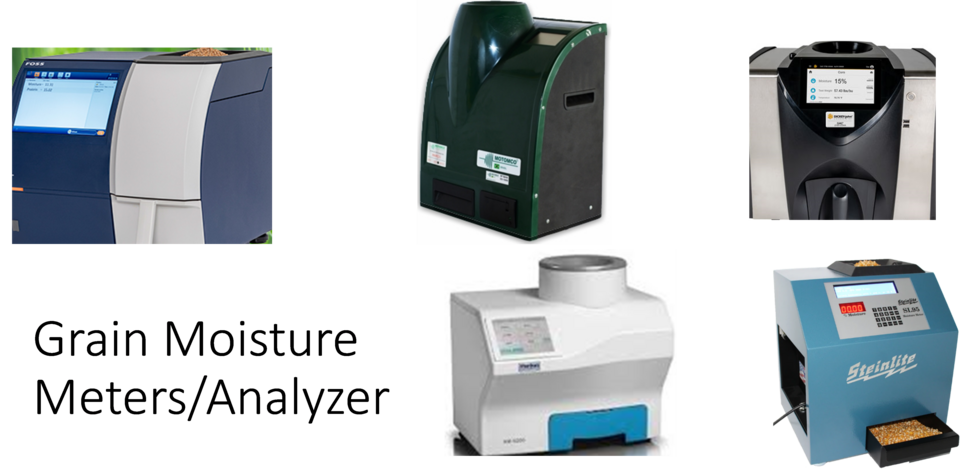
Commercial grain analyzers are devices that measure the dielectric or near-infrared response of grain to determine various constituent values, such as moisture and protein content. They provide percentage measurements for moisture, protein, and other factors. These analyzers are deemed commercial because they play a crucial role in pricing grain; the measurements they yield, such as moisture and protein levels, are used to calculate discounts applied to the price per bushel, ultimately affecting the price the seller receives. Below are pictures of grain analyzers:
How do discounts affect the price per bushel of grain?
Commercial grain analyzers measure various grain constituents, such as moisture and protein content. Discounts on the price per bushel of grain are applied at the time of sale based on these measurements, as well as other factors. Discounts are reductions in the price per bushel that the seller ultimately receives.
Two common types of discounts are drying discounts and shrinkage discounts. A grain buyer often needs to dry grain above the desired moisture content to prevent mold during storage. The cost of drying the grain, or the drying discount, is determined by the moisture measurement at the time of sale. For example, if a buyer intends to purchase corn at $4.00 per bushel, targeting a moisture content of 15%, they will reduce the price per bushel if the grain's moisture level exceeds that target.
Additionally, grain that is too moist may be stored with aeration, which will experience shrinkage during storage. The cost associated with this shrinkage, or shrinkage discount, is also calculated based on the grain's moisture content at the time of sale.
Errors in measuring moisture, protein, and other grain characteristics can lead to significant financial losses for either the seller or the buyer.
Which U.S. states have a program for testing and inspecting commercial grain analyzers?
According to the June 1997 Grain Moisture Meter Questionnaire and state reports of subsequent changes, 19 states have implemented such programs. These states are Arkansas (AR), Colorado (CO), Florida (FL), Georgia (GA), Illinois (IL), Indiana (IN), Iowa (IA), Kentucky (KY), Louisiana (LA), Maryland (MD), Mississippi (MS), Missouri (MO), Nebraska (NE), North Carolina (NC), Pennsylvania (PA), South Carolina (SC), Tennessee (TN), Virginia (VA), and Wisconsin (WI).
How can a state develop a test and inspection program for commercial grain analyzers?
Typically, official tests and inspections of commercial devices are managed within a state's weights-and-measures program. Some states permit other entities to conduct official tests and inspections of these devices, while providing oversight for those entities. The methods by which a state performs tests and inspections of commercial devices are detailed in its specific state laws.
States interested in establishing a commercial grain analyzer test and inspection program are encouraged to reach out to neighboring states with existing programs. This can provide valuable information regarding costs, space, and equipment needs. Additional details on laboratory and field equipment can be found in the NIST Handbook 159, "Examination of Grain Moisture Meters Using Air Oven Reference Method Transfer Standards."
Furthermore, newsletter articles on various test procedures are available on the OWM website under the "Pages by Topics" section.
What are the technical requirements for testing and inspecting commercial grain analyzers?
The requirements can be found in NIST Handbook 44, specifically in Sections 5.56a and 5.56b, which cover grain moisture meters, and Section 5.57, which addresses near-infrared grain analyzers. These sections outline the specifications, tolerances, and other technical requirements necessary for testing and inspecting these devices.
For more information, visit: NIST Handbook 44 - Current Edition
What are the U.S. and international requirements for the type evaluation of grain analyzers?
In the United States, the National Type Evaluation Program (NTEP) is the designated evaluation program. Most states have adopted NTEP into their laws and regulations, which means that manufacturers of commercial grain analyzers must have their devices evaluated by a type evaluation laboratory before they can be installed in any state. The NTEP requirements for grain analyzers are detailed in NCWM Publication 14, "Grain Moisture Meters and Near Infrared Grain Analyzers."
For more information, you can visit: https://www.ncwm.com/publications/ncwm-publication-14-grain-moisture-me…
The International Organization of Legal Metrology (OIML) oversees the international type evaluation program. Many countries require that a manufacturer's device undergo an evaluation before it can be sold in their markets. As a result, manufacturers of commercial grain analyzers must have their products evaluated prior to selling them in many of those countries.
The United States has participated in technical committees to help develop international type evaluation requirements, leading to a harmonization of grain analyzer standards with U.S. requirements.
The OIML requirements for grain analyzers are outlined in two documents: OIML TC17/SC1 R59, “Moisture Meters for Cereal Grains and Oilseeds,” and OIML TC17/SC8 R146, “Protein Measuring Instruments for Cereal Grains and Oilseeds.”
For more information, please visit: https://www.oiml.org/
Videos
The Impact of Grain Moisture Meter Measurements
A discussion on the importance of grain moisture meter measurements and their economic impact, which will include the system of grain moisture measurements in the U.S., the economic impact of grain moisture measurements, and resources for States with grain moisture meter programs. (June 25, 2024)
Contacts
-
General Information - OWM