Official websites use .gov
A .gov website belongs to an official government organization in the United States.

Secure .gov websites use HTTPS
A lock (
) or https:// means you’ve safely connected to the .gov website. Share sensitive information only on official, secure websites.


Deep Space Climate Observatory (DSCOVR)
Telescope Details
Location
The DSCOVR satellite launched in 2015 and orbits at Lagrange point 1, or L1, about 1.5 million kilometers (930,000 miles) from Earth. This unique vantage point allows the satellite to always “see” Earth’s entire sunlit side.
Purpose
DSCOVR does two main tasks. It monitors the flow of charged particles from the Sun, or solar winds, which are critical to space weather alerts and forecasts. It also measures radiation coming off Earth’s surface, to help determine whether our planet retains as much, more or less solar energy than it radiates back into space.
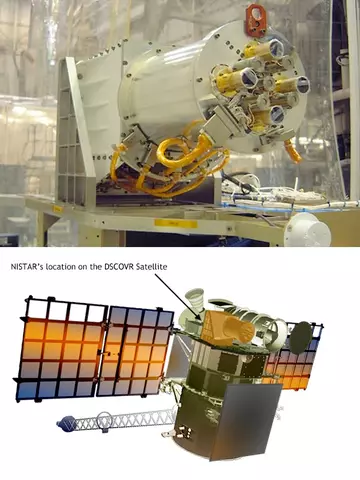
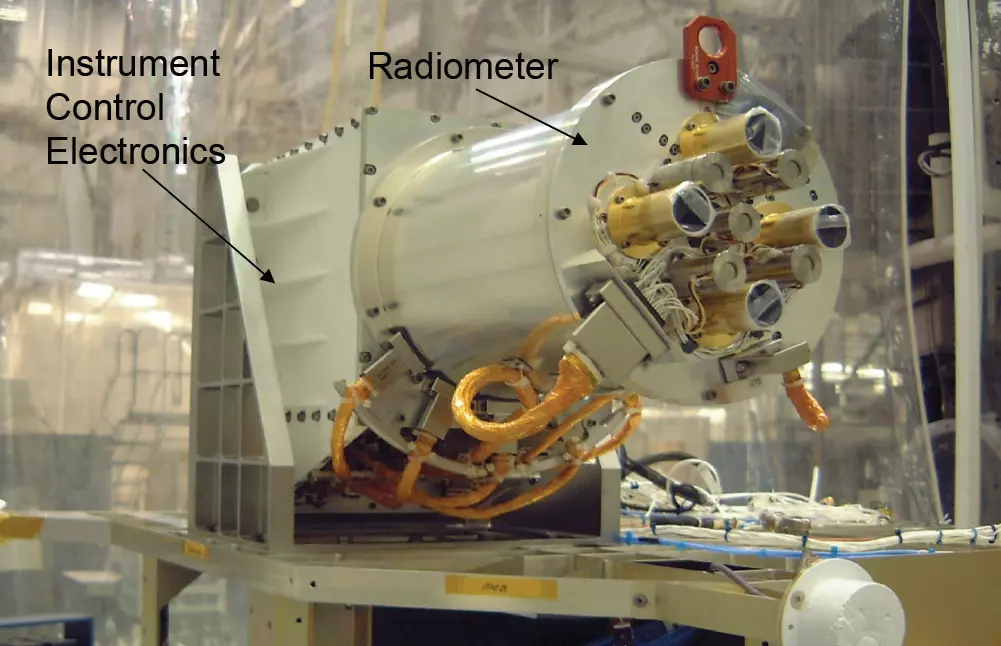
NISTAR, an instrument that measures the outgoing radiation from Earth, resides on DSCOVR and offers the first continuous daylight observations of Earth’s surface. (Other satellites taking similar measurements orbit much closer to Earth and collect radiation from small patches of the planet’s surface at any given time. From that data, scientists must extrapolate using models to estimate Earth’s total radiation.)
NISTAR measures the light reflected and emitted at infrared, visible and ultraviolet wavelengths to help monitor seasonal changes. The instrument observes the Earth as if it were a planet in another solar system, or exoplanet.
NIST’s role
From L1, Earth appears roughly as large as the Moon does from Earth. Scientists needed to design an instrument that could collect enough light from this distance to make a precise measurement.
NIST provided the instrument concept, test software development and calibration method for NISTAR. The instrument uses NIST’s very stable “electrical substitution” measurement approach, converting incoming radiant energy to heat inside an enclosure and then measuring the electric heat needed to maintain that space at a constant temperature. A series of components separate the Earth’s radiant power from reflected solar energy by making measurements in three overlapping wavelength bands in four channels every minute.
Learn more about NIST’s spectral irradiance calibration program.
Significant discoveries and current status
NISTAR has demonstrated the ability to make stable measurements with low uncertainties over years from the unique, distant vantage point of L1. It has measured Earth’s total radiation with an uncertainty of less than 1%.
The instruments’ measurements of cloud and surface reflections and effects of vegetation may help inform future exoplanet studies and searches for extraterrestrial life. They have also provided the scientific community with a new way to evaluate models of Earth’s radiant energy balance.
DSCOVR continues to orbit but was taken offline in July 2025 due to a malfunction.
Other interesting facts
DSCOVR is a refurbished version of the Triana satellite, first proposed in the late 1990s, which was controversial and never launched under that name. NISTAR was mothballed for more than a decade before being resurrected for DSCOVR.
Supported by
NOAA, NASA and the U.S. Air Force
NISTAR was built by Ball Aerospace and Technologies Corporation, NIST, Scripps Institute of Oceanography and NASA.
Operated by
NOAA
Media