Official websites use .gov
A .gov website belongs to an official government organization in the United States.

Secure .gov websites use HTTPS
A lock (
) or https:// means you’ve safely connected to the .gov website. Share sensitive information only on official, secure websites.


James Clerk Maxwell Telescope
Telescope Details
Location
Mauna Kea, Hawaii
Purpose
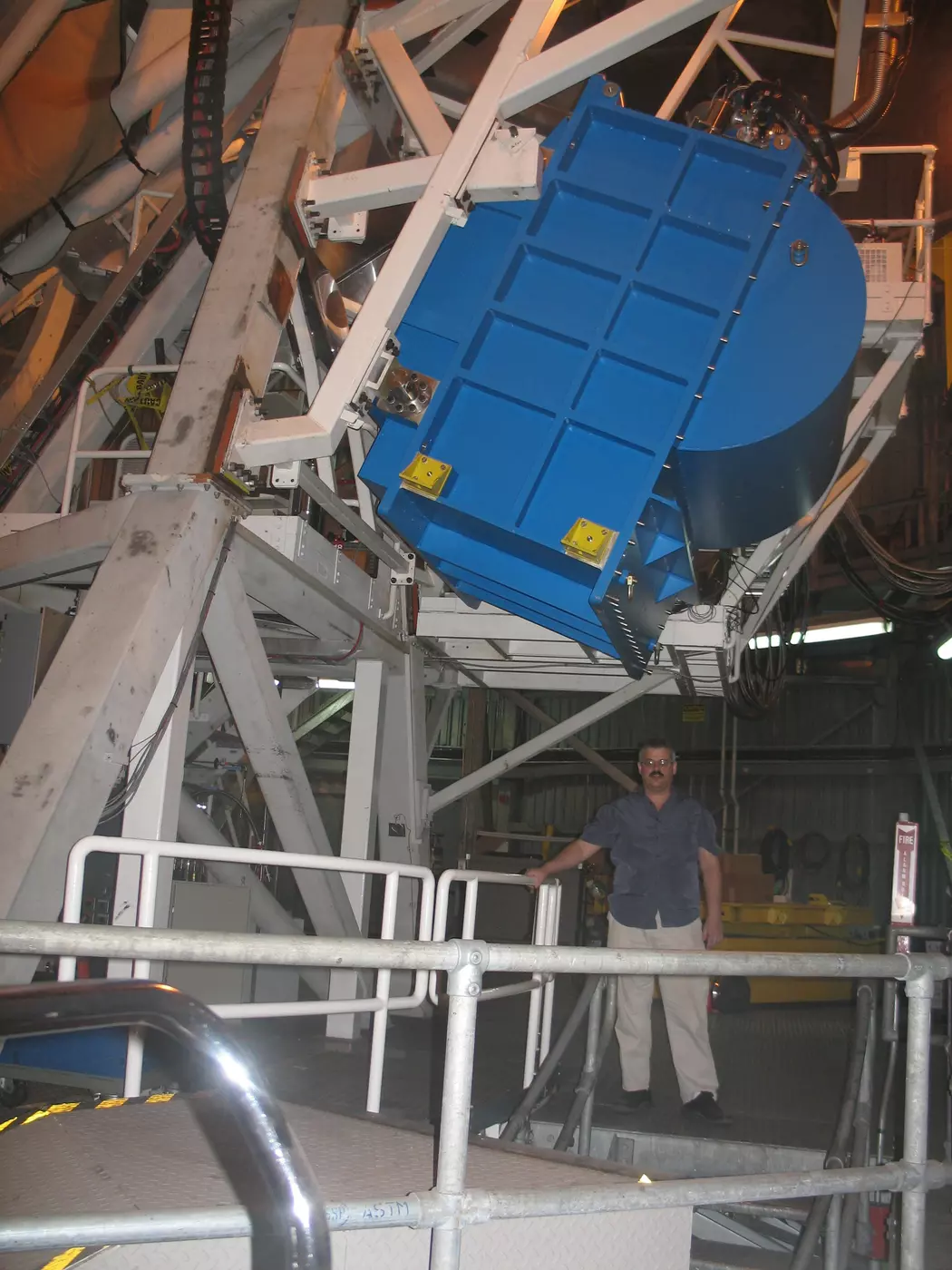
The James Clerk Maxwell Telescope is the largest single-dish telescope in the world dedicated to detecting submillimeter radiation, which is microwave light at wavelengths between 0.3 and 1.0 millimeters. The telescope’s Submillimeter Common-User Bolometer Array 2 (SCUBA-2) camera images objects ranging from comets in the solar system to galaxies at the far ends of the universe. The camera can carry out large-scale surveys of the sky to unprecedented depths.
Submillimeter wavelengths of light contain a lot of information about the universe. For instance, light from stars inside young galaxies is trapped in dust clouds and re-emitted in this band.
NIST’s role
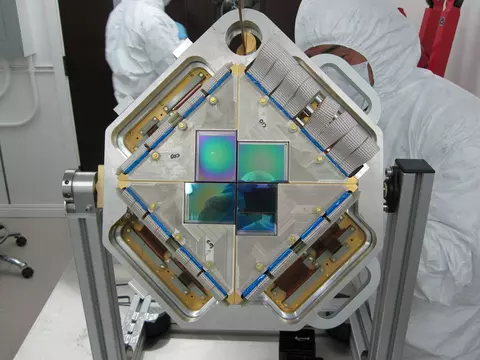
The SCUBA-2 camera is made of more than 10,000 NIST sensors. The tiny sensors precisely measure submillimeter radiated power using a superconducting metal that changes resistance in response to heat from radiation. Each sensor functions as a single pixel in the camera. By numbers of pixels, the NIST instrument was at the time of its creation the largest superconducting camera ever made, although its physical size is only about 30 square inches, divided into two areas measuring different wavelengths. SCUBA-2 can detect two colors, or wavelengths, of submillimeter light: 450 and 850 micrometers (millionths of a meter).
The NIST sensor arrays are packaged with superconducting amplifiers to boost signal strength. The sensors and amplifiers are cooled to cryogenic temperatures near absolute zero. NIST researchers found ways to greatly reduce the number of wires between the cryogenic instruments and the room-temperature electronics used to compile the data.
Significant discoveries and current status
SCUBA-2 has imaged thousands of galaxies, helping astronomers understand galaxy evolution and cosmic star formation. It continues to operate.
Other interesting facts
SCUBA-2 maps the sky hundreds of times faster than its predecessor camera.
Developed by
The SCUBA-2 camera is a result of a collaboration among the UK Astronomy Technology Centre, NIST and four British and Canadian universities.
Operated by
Media