Official websites use .gov
A .gov website belongs to an official government organization in the United States.

Secure .gov websites use HTTPS
A lock (
) or https:// means you’ve safely connected to the .gov website. Share sensitive information only on official, secure websites.


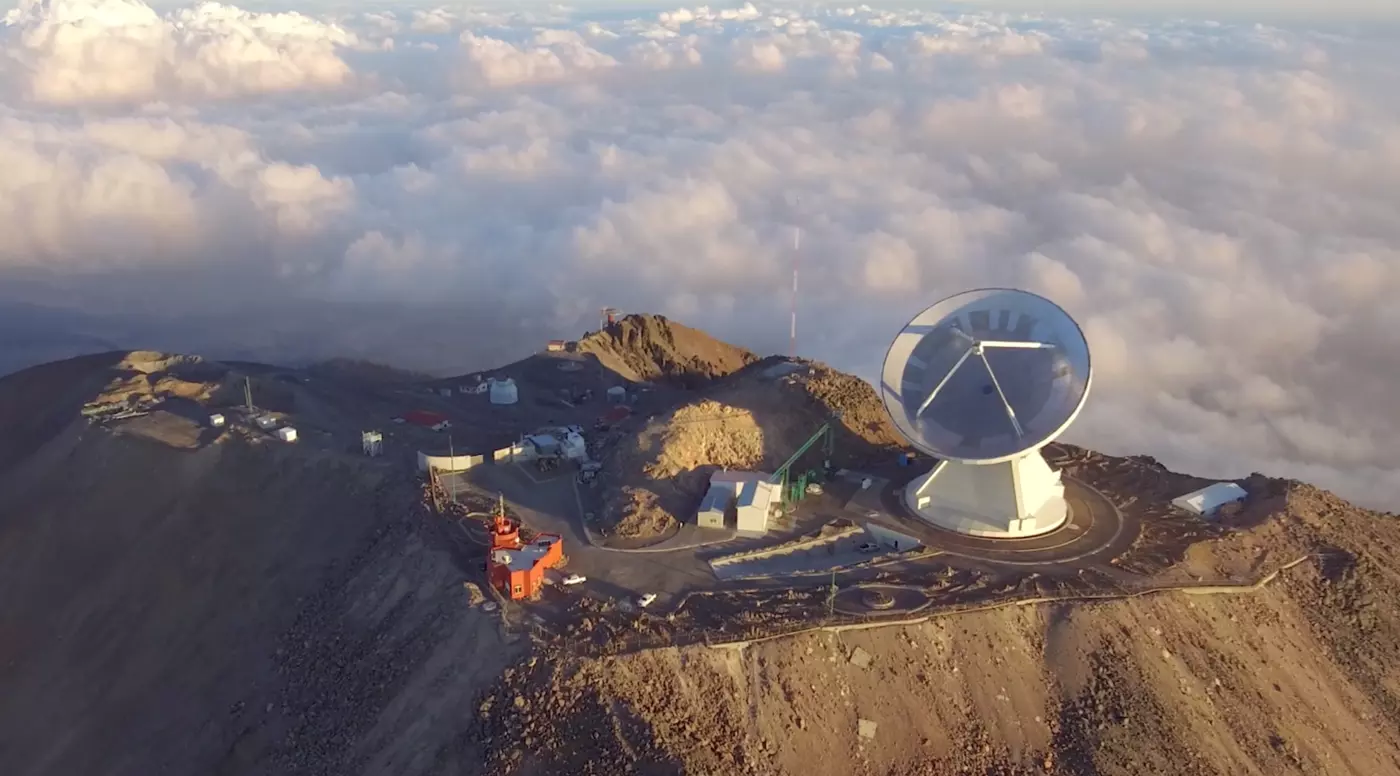
Large Millimeter Telescope
Telescope Details
Location
Sierra Negra, Mexico
Purpose
The Large Millimeter Telescope studies the universe on nearly all scales, from large-scale structure of matter in the early universe to individual cores of star formation. A new camera, TolTEC, will map the sky 100 times faster than the camera that it replaces.
NIST’s role
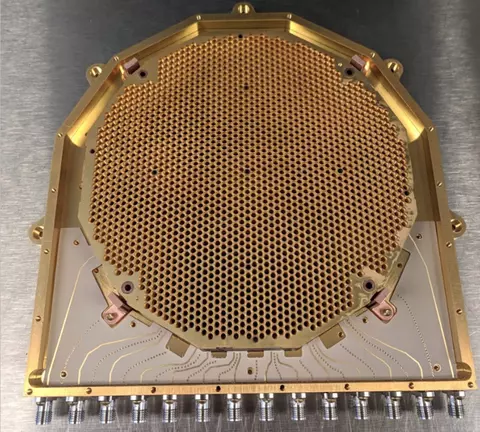
NIST researchers led the development of the TolTEC camera, which offers high sensitivity and mapping speeds in three colors. The use of multiple colors helps distinguish real signals from interfering noise.
For TolTEC, the NIST team designed and built arrays containing 7,716 magnetic kinetic inductance detectors, or MKIDs — a type of quantum sensor used to detect individual photons. In an MKID, an incoming photon disrupts the electron flow in a superconducting resonating circuit (which is like an electrical “bell” that “rings” at a single frequency), causing a change in the frequency at which an electric current sloshes back and forth. The change provides information about the energy of the photon.
The NIST team that developed the sensors for the TolTEC camera won a 2021 Department of Commerce Gold Medal Award for its work.
Significant discoveries and current status
TolTEC was installed on the Large Millimeter Telescope and saw first light in 2022. After technical delays, commissioning of the camera resumed in early 2025.
Other interesting facts
The Large Millimeter Telescope is situated on a mountain peak at an elevation of 4,572 meters (15,000 feet), providing excellent observing conditions during this region of Mexico’s dry season, which lasts from October to May.
Supported by
National Science Foundation
Developed by
A collaboration of seven institutions in three countries: NIST, Arizona State University, Northwestern University, University of Michigan, Cardiff University, the Instituto Nacional de Astrofísica, and Óptica y Electrónica
Operated by
Instituto Nacional de Astrofísica, Óptica y Electrónica and University of Massachusetts at Amherst
Media