Official websites use .gov
A .gov website belongs to an official government organization in the United States.

Secure .gov websites use HTTPS
A lock (
) or https:// means you’ve safely connected to the .gov website. Share sensitive information only on official, secure websites.


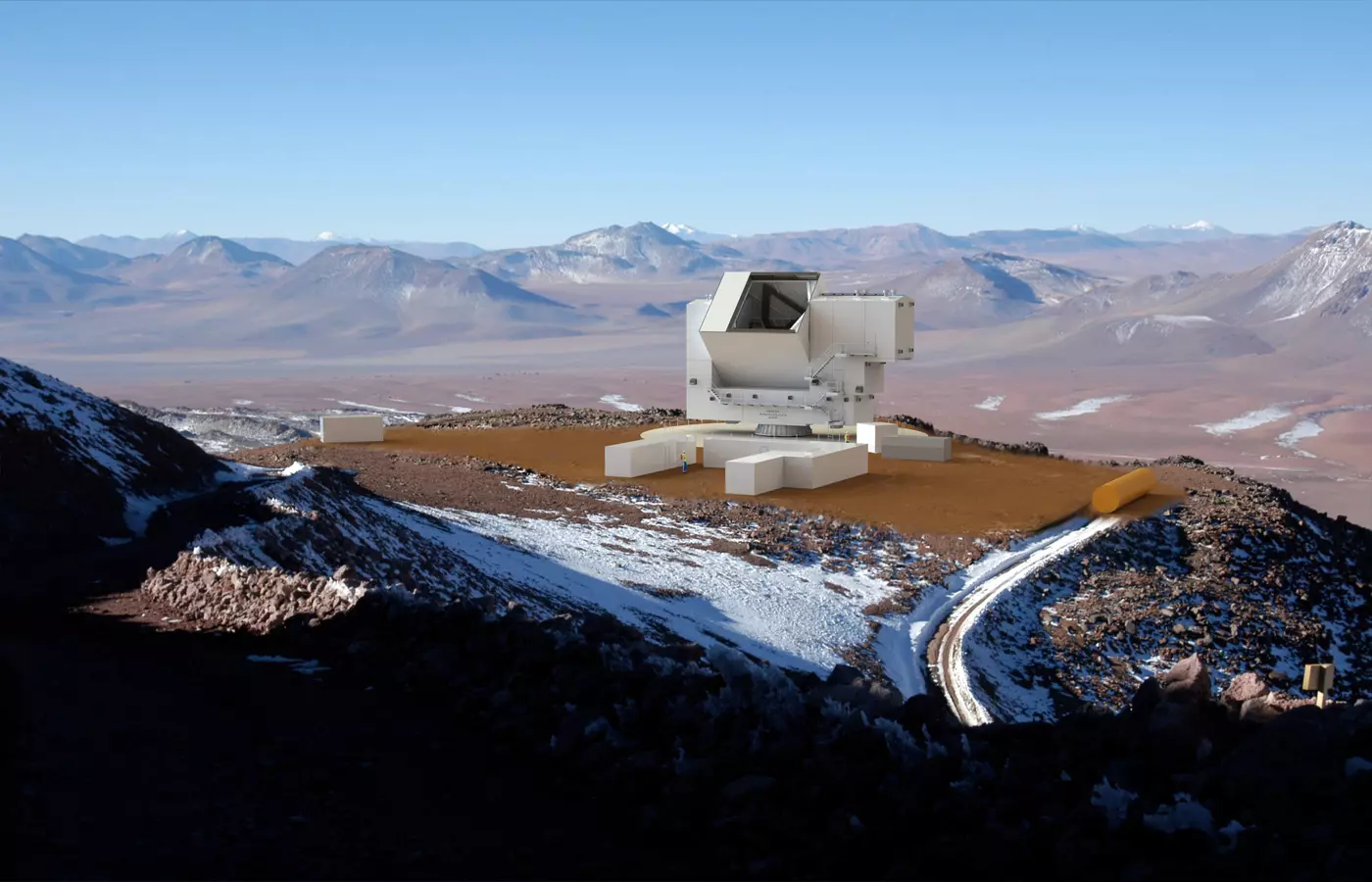
Fred Young Submillimeter Telescope
Telescope Details
Location
Cerro Chajnantor, Chile
Purpose
The Fred Young Submillimeter Telescope, or FYST, will be the most sensitive telescope ever built to observe microwave light at wavelengths between 0.3 and 1.0 millimeters. Astronomers hope to use the telescope to:
- Understand how the universe’s earliest star-forming galaxies came into being
- Study the dynamic interstellar medium in the Milky Way, the Magellanic Clouds and other nearby galaxies
- Collect measurements to place new constraints on dark energy and the sum of the neutrino masses
- Study distant dusty star-forming galaxies to understand galaxy evolution
- Map the distribution of matter in the universe during the time period when the first stars were born
NIST’s role
The cryogenic receiver that couples to the FYST is called CCAT and contains seven optics tubes. Each optics tube is unique, observing light at different wavelengths and supporting different scientific goals. Each tube accepts three large detector arrays, which operate at 0.1 degrees above absolute zero.
NIST is providing detector arrays for these optics tubes. One set of arrays has been delivered, and two more are in progress. The detectors are Microwave Kinetic Inductance Detectors or MKIDs, which measure light by shifting the resonant frequency of an electrical circuit made from a superconducting film. Each array contains thousands of detectors.
Significant discoveries and current status
This telescope is still under construction, with first light planned for 2026.
Other interesting facts
The telescope site is located at an elevation of 5,600 meters (18,400 feet), slightly higher than the base camp for Mount Everest. Being so high up in one of the driest places on Earth is necessary because in most places on Earth, atmospheric water vapor absorbs most submillimeter microwaves before they reach the surface.
Operated by
A partnership of Cornell University; a German consortium of the University of Cologne, the University of Bonn and the Max Planck Institute for Astrophysics; and the Canadian Atacama Telescope Consortium
Media