Official websites use .gov
A .gov website belongs to an official government organization in the United States.

Secure .gov websites use HTTPS
A lock (
) or https:// means you’ve safely connected to the .gov website. Share sensitive information only on official, secure websites.


NIST Stars
Telescope Details
Location
The site selected for this project is on Cerro Paranal, Chile, near the Very Large Telescope.
Purpose
Astrophysicists use “standard stars” to make measurements of flux — the amount of energy that a telescope receives from a given star — in order to calibrate instruments on ground- and space-based telescopes. Flux standards are stars that are stable and whose spectral energy distributions are well known. The accuracy of standard star fluxes is based on 1970s-era terrestrial measurements of the star Vega, with uncertainties of a few percent and a tenuous link to the International System of Units (SI). While this was a state-of-the-art measurement for its time, scientists today can achieve much greater accuracy.
The NIST Stars project aims to improve the accuracy of these data to meet requirements for modern astrophysics, cosmology and planetary science. Project leaders hope to reduce measurement uncertainty to less than 1% over the visible-to-near-infrared spectrum and provide robust traceability to the International System of Units, or SI.
The standard stars measured by NIST Stars will be used for various applications, such as making highly accurate measurements of special types of supernovae for studies of dark energy and searching for exoplanets (planets outside the solar system) that could harbor life.
NIST’s role
NIST developed an accurate technique for measuring the absolute flux of stars, with calibration traceable to the SI. NIST researchers piloted and tested this technique at the Mount Hopkins Observatory in Arizona to measure the light from Vega and Sirius.
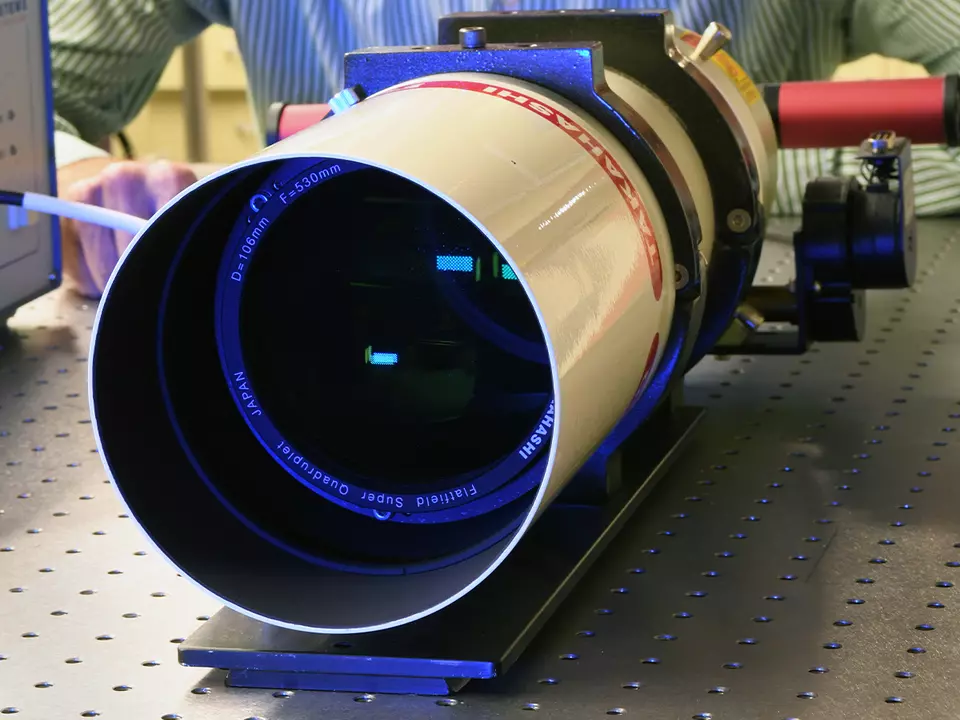
NIST staff designed a radiometric telescope that can be used at visible to near-infrared wavelengths (between 400 and 2500 nanometers) with a spectrometer to obtain absolute flux measurements of standard stars.
Significant discoveries and current status
At Mount Hopkins, NIST staff developed and deployed an accurate technique for measuring the absolute spectrum of flux from standard stars, with calibration traceable to the SI.
The NIST Stars experimental station, in addition to the telescope, includes an SI-traceable field instrument to calibrate the telescope, plus instruments to monitor atmospheric effects from water vapor and aerosols. This equipment, plus the dark and dry skies over Cerro Paranal, will allow for the high-accuracy measurement of the spectral irradiance of more than 10 standard stars in the visible-to-near-infrared spectrum.
Other interesting facts
Advances in recent decades have enabled NIST to measure the optical power of light with just 0.01% uncertainty in the lab — far better than the level required by modern astrophysics. This project will enable NIST to extend SI-traceable measurement scales into space.
Supported by
NIST Stars has received support from NIST, NASA and the European Southern Observatory.
Read more
Star Light, Star Bright … But Exactly How Bright?
Media