

Official websites use .gov
A .gov website belongs to an official government organization in the United States.

Secure .gov websites use HTTPS
A lock (
) or https:// means you’ve safely connected to the .gov website. Share sensitive information only on official, secure websites.


Compact Total Irradiance Monitor
Instrument Details
Location
Low Earth orbit (LEO), roughly 500 kilometers (310 miles) above Earth’s surface
Purpose
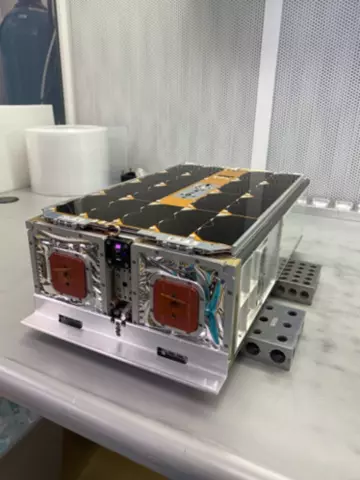
The Compact Total Irradiance Monitor (CTIM) was a small instrument squeezed into a CubeSat the size of a shoebox. The instrument measured total solar irradiance: the total amount of solar energy received by Earth across all light wavelengths. This quantity helps predict how Earth’s atmosphere responds to changes in solar output and can help scientists understand solar weather and forecast solar storms.
While other satellites also measure total solar irradiance, CTIM aimed to do so with equal or greater accuracy at a fraction of the size and cost.
NIST’s role
NIST researchers designed and built a novel chip-based bolometer to provide periodic on-board calibrations for the CTIM. While the CTIM bolometer is based on the same material as the Compact Spectral Irradiance Monitor, it is shaped differently. CTIM “looks” directly at the Sun with no optics in between, so NIST scientists chose a circular detector for maximum light absorption.
The chips consist of carbon nanotubes and metals patterned on silicon wafers. NIST scientists designed and fabricated them under an agreement with the Laboratory for Atmospheric and Space Physics at the University of Colorado Boulder, which built the CTIM with support from NASA.
Significant discoveries and current status
CTIM launched in 2022 and was decommissioned in 2023. Data from the observing run indicates that similar to its predecessor CSIM, CTIM achieved comparable accuracy to the Total and Spectral Solar Irradiance Sensor — the instrument currently used to measure total solar irradiance — at a fraction of the cost and size.
CTIM was less than one five-hundredth of the volume and less than one-fiftieth of the weight of the Total and Spectral Solar Irradiance Sensor.
Other interesting facts
Carbon nanotubes were discovered in the 1950s, but only in the early 1990s did scientists figure out ways to synthesize them efficiently. They are the blackest known material on Earth and efficiently absorb nearly all light across a broad span of wavelengths.
Collaborators
The Laboratory for Atmospheric and Space Physics at the University of Colorado Boulder
Media
