Official websites use .gov
A .gov website belongs to an official government organization in the United States.

Secure .gov websites use HTTPS
A lock (
) or https:// means you’ve safely connected to the .gov website. Share sensitive information only on official, secure websites.


Hubble Space Telescope
Telescope Details
Location
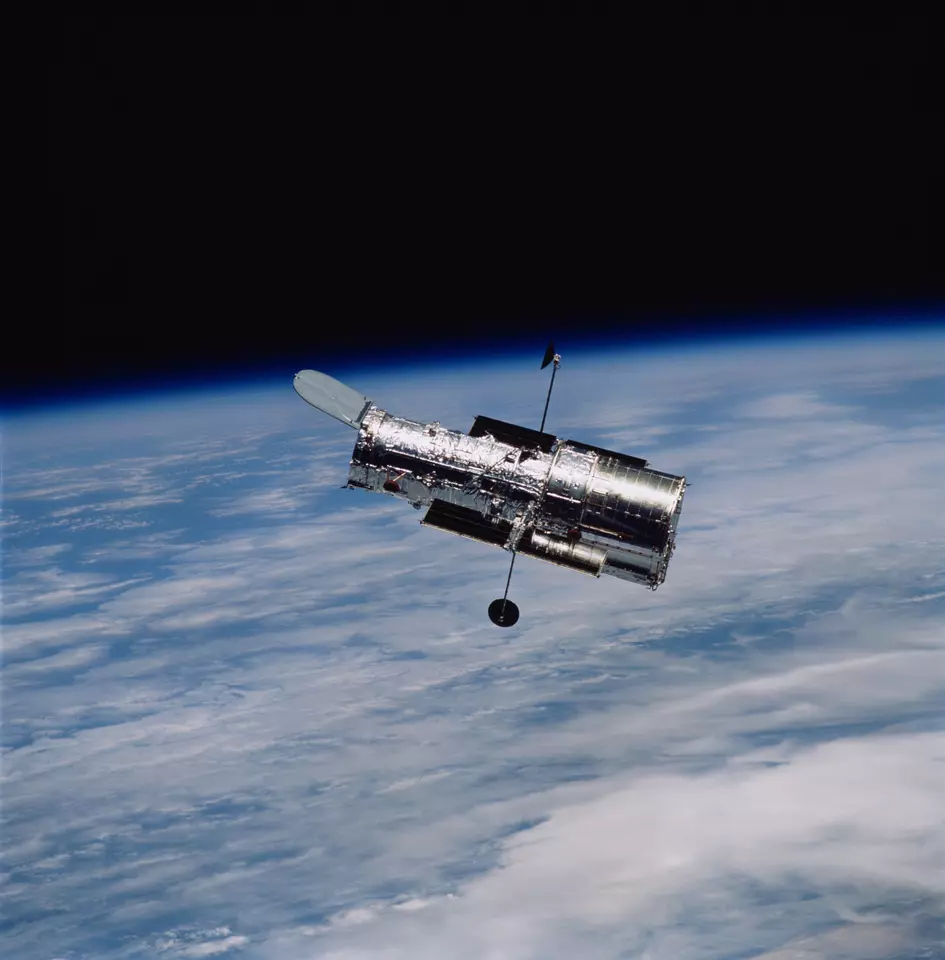
Low Earth orbit, 515 kilometers (320 miles) above Earth’s surface
Purpose
Observe and study the universe from space, avoiding the distorting influence of Earth’s atmosphere.
NIST’s role
NIST got involved with the Hubble Space Telescope in the early 1980s. The designers of the ambitious telescope, which would be far more powerful than any previous space-based instruments, needed onboard light sources to calibrate spectrometers that would measure the starlight Hubble collected.
Previous NASA missions had used specialized lamps based on light emitted by specific atomic elements. But Hubble’s resolution would be much higher, and the space agency’s existing lamps weren’t up for the job.
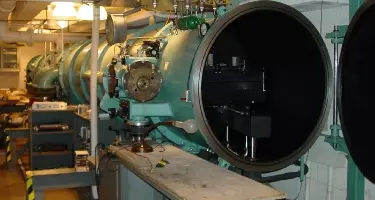
NASA sent NIST its platinum-neon lamp used to calibrate the Hubble telescope’s Goddard High Resolution Spectrograph. NIST scientists spent six years studying and characterizing the lamp’s spectrum using a normal incidence vacuum spectrograph, a highly specialized 10.7-meter-long (35-foot-long) instrument that was just one of two in existence anywhere the world.
Hubble launched in 1990, and thanks in part to NIST’s work, the telescope was able to measure light wavelengths with an accuracy of a few parts in 10 million. This achievement helped make Hubble a scientific powerhouse.
When it came time to upgrade the Hubble spectrometer during a servicing mission, NIST scientists characterized the lamps used to calibrate the new device. The upgraded spectrometer remains in service and continues to power Hubble’s science.
In 2005, NIST scientists measured two lamps that were replaced and returned from Hubble’s spectrographs during an earlier servicing mission. The researchers found that the lamps continued to serve as calibration sources despite years in space. This was a first-of-its-kind study of technical equipment brought back from extended operation in space.
One of these lamps, from the Goddard High Resolution Spectrograph, is now in the museum on NIST’s Gaithersburg campus.
Significant discoveries and current status
The Hubble Space Telescope has contributed to a vast array of discoveries, from the first detection of an exoplanet atmosphere to confirmation that supermassive black holes exist to the Nobel Prize-winning precision measurement of the expansion rate of the universe based on Type 1a supernovas.
NIST’s calibration work was particularly relevant to studies of the chemical composition of the universe and the examination of the gravitational redshift in the strong gravitational fields around white dwarf stars.
See NASA’s website for a longer list of Hubble-enabled discoveries.
The telescope launched in 1990 and continues to observe the universe.
Other interesting facts
Hubble’s location in low Earth orbit helps it avoid atmospheric interference while keeping it close enough for servicing missions. On the first and perhaps the most important of these missions, astronauts added optics to correct for a faulty mirror that caused the telescope’s first images to be blurry.
Supported by
NASA and European Space Agency, with support from other partners.
Operated by
Space Telescope Science Institute
Media