

Official websites use .gov
A .gov website belongs to an official government organization in the United States.

Secure .gov websites use HTTPS
A lock (
) or https:// means you’ve safely connected to the .gov website. Share sensitive information only on official, secure websites.


Thermoelectric Measurements
Summary
We develop Standard Reference Materials (SRMs), measurement methodologies, comprehensive data sets, and phase equilibrium data for bulk and thin film thermoelectric materials that enable the reliable inter-laboratory comparison of data and the confirmation of reported high efficiency thermoelectric materials. This project provides the underpinning measurement science needed to support the development, production and reliability of materials and devices related to advanced energy sources, energy storage and energy-harvesting.
Description
Thermoelectric effects enable the inter-conversion of thermal and electrical energy, with applications that include solid-state waste heat recovery in engines for automotive and industrial manufacturing; power generation for aerospace, non-terrestrial exploration, and remote sensing; and refrigeration for consumer products, optical components, and microelectronics. The United States industrial sector consumes approximately one third of all energy used in the United States, roughly 32 quadrillion Btu (1015 Btu) of energy annually. Between 5-13 quadrillion Btu/yr of this energy is ultimately lost as waste heat via streams of hot exhaust liquids and gases, as well as through heat conduction, convection, and radiation from manufacturing equipment and processes. To put this in perspective, if 15% of this heat could be effectively captured and converted into electricity, it would be enough to power over 20 million homes per year. The widespread use of thermoelectric converters for vehicular waste heat recovery could lead to a 10 % improvement in fuel efficiency, translating to a fuel savings of about $150 per year for every automobile. In addition, improved cooling of microelectronic devices would result in greater operational efficiency and reliability of integrated circuit chips, which are the major products of the $120B U.S. semiconductor industry. However, commercially available thermoelectric devices are only about 5 % to 8 % efficient.
Instrumentation
Materials and device producers require accurate measurements of the electrical and thermal transport properties to optimize and commercialize materials in both bulk and thin film form for use in thermoelectric and other semiconductor electronic devices. Our testing capabilities include both commercial and custom developed tools, comprising
- Electrical resistivity, Seebeck coefficient, and thermal conductivity on bulk and thin films (1.8 K to 390 K)
- High resolution impedance spectroscopy (1.8 K to 390 K)
- Hall effect/carrier concentration/carrier mobility (1.8 K to 390 K; superconducting magnet up to 9 T)
- Heat capacity under magnetic field (1.8 K to 390 K)
- Electrical resistivity and Seebeck coefficient, in 2- and 4-probe arrangement for bulk materials (300 K to 1000 K)
- Electrical resistivity and Seebeck coefficient, high-throughput xy-mapping for composition-spread films (300 K to 1000 K)

Our custom High Temperature Electrical Resistivity and Seebeck Coefficient (300 K to 1000 K, bulk) instrument is uniquely capable of in situ comparison of various characterization methodologies and probe arrangements. It has been used to develop optimal measurement protocols and recently to certify SRM 3452.

Our custom High-Throughput (Combinatorial) Screening Instrument that measures electrical resistivity and the Seebeck coefficient between 300 K and 800 K on thin film and composition spread materials. We can evaluate thousands of compositions within a relatively short measurement cycle.
Major Accomplishments
Thermoelectric Property Standards and validated measurement methods for transport properties allow for interlaboratory validation of data, thereby accelerating the selection and optimization of materials and devices for commercialization. The Seebeck coefficient is a widely measured transport property that provides fundamental information on charge carrier transport and the electronic structure of materials, as it can be related to the reduced Fermi level, band gap, carrier concentration, effective mass, and carrier scattering mechanisms. More specifically, the Seebeck coefficient is an important predictor of thermoelectric performance (materials and devices that can convert heat into electricity).
To provide the thermoelectric materials community the means to calibrate Seebeck coefficient measurement equipment for bulk materials (an essential indicator of the conversion efficiency and the most widely measured property specific to these materials), NIST certified and released for purchase in late 2011 SRM® 3451, “Low Temperature Seebeck Coefficient Standard (10 K to 390 K)”. Seebeck coefficient measurements are generally divided into the low (< 300 K) or the mid to high (> 300 K) temperature regime, due to different practical requirements in both instrumentation and sample contact methodology.

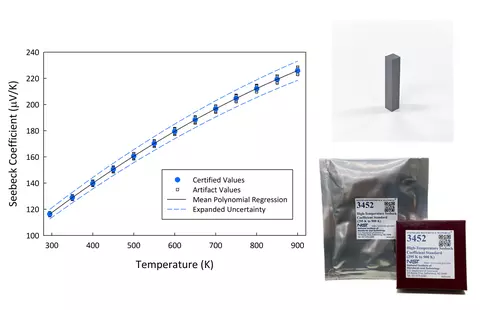
To enable instrument validation and interlaboratory data comparison at high temperatures relevant to thermoelectric waste heat recovery, we have completed the development and certification of Standard Reference Material (SRM) 3452: High-Temperature Seebeck Coefficient Standard (295 K to 900 K), now available to the public. SRM 3452, together with complimentary SRM 3451, now provide certified reference materials traceable to the International System of Units for Seebeck coefficient measurements within the temperature range 10 K to 900 K with a broad overlap region (295 K to 390 K).
Technology and Knowledge Transfer
Our project provides recommended practices to both mitigate and quantify sources of error that were previously ignored by researchers. We have released the design innovations and technical details of our custom instrumentation through publication. To identify optimal measurement practices and protocols, we have designed and constructed an experimentally flexible high temperature thermoelectric measurement apparatus uniquely capable of in situ comparison of different contact geometries and measurement techniques that are commonly employed in both commercially available and custom developed instrumentation. We have demonstrated that the probe arrangement is the crucial influence on measurement accuracy, especially at high temperature where the thermal errors inherent in measuring temperature by surface contact are exacerbated. Using our custom instrumentation and expertise, we have completed a comprehensive experimental study establishing recommended measurement practices and protocols, enabling the development of a thermal contact error model to guide researchers in designing improved instrumentation and in developing comprehensive uncertainty limits. Further, to identify errors that are not experimentally accessible, we developed a novel approach to simulate and model Seebeck coefficient measurements for the first time, using finite element analysis. These protocol studies complement our comprehensive analysis of 200 years of thermoelectric measurement literature, which created a resource for best measurement practices in the form of a widely accessible review paper. Material systems we have provided measurement data for include: chalcogenides, clathrates, skutterudites, oxides, antimonides, SiGe, half heuslers, stannites, nanocomposites, and flexible polymer films.