

Official websites use .gov
A .gov website belongs to an official government organization in the United States.

Secure .gov websites use HTTPS
A lock (
) or https:// means you’ve safely connected to the .gov website. Share sensitive information only on official, secure websites.


Instrumentation
Thermoreflectance Thermal Property Measurements
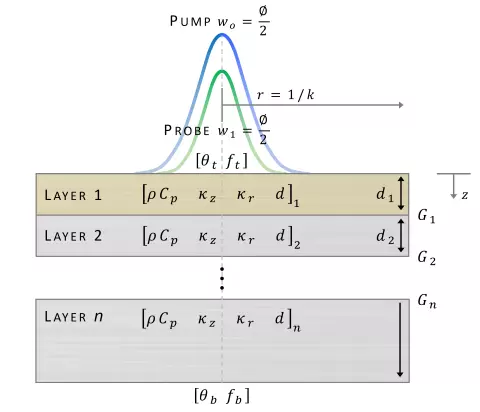
Thermoreflectance (TR) laser-based measurement techniques can measure the thermal properties of substrates, thin films, multilayer structures, and their interfaces. TR uses modulated laser heating and thermal models to probe thermal properties by relating a material’s change in temperature to the resulting change in optical reflectance (coefficient of TR):
- Non-contact and non-destructive
- Measures in situ thin film, embedded, and multilayer materials
- Large property range: ≈ 0.1 W/mK to ≈ 2400 W/mK
- Can simultaneously fit for in-plane and cross-plane thermal conductivity
- Simultaneously probe at variable depths (≈ 10's of nm to ≈ 10's of micron)
- Spatially resolved measurements: 2D property mapping
Although TR is a powerful technique, there are some challenges to wider adoption: traditionally, TR instruments are custom built, requiring experienced staff to design, operate, and maintain; the data fitting and uncertainty analysis can be complex; and finally, validation standards and improved protocols are needed. Leveraging our existing expertise and collaborations with instrument vendors and the semiconductor industry, we have built a suite of TR metrology tools to evaluate, improve, and refine TR thermal property measurement methods, protocols, and instrumentation. Together, these tools enable us to:
- Provide on-demand, impartial, and reliable thermal property measurements for industry and CHIPS projects
- Support commercialization by working with existing vendors to customize and develop new thermal measurement instrumentation and techniques
- Provide Independent Verification & Validation measurements for critical Interagency Programs
Instruments
TR can be categorized as Frequency Domain Thermoreflectance (FDTR), Steady State Thermoreflectance (SSTR), or Time Domain Thermoreflectance (TDTR). These techniques leverage sensitivity to different thermal properties and materials based on their characteristic thermal excitations and corresponding responses.


Thermoreflectance Resources
Instrumentation Guides
External Resources
Software
A Beta of our custom TR Analysis software will be provided as a free application, featuring:
- Thermal model fitting for FDTR and TDTR
- User-friendly GUI and workflow
- Global Fitting
- Monte Carlo simulation
- Input uncertainty propagation
- Asymmetric uncertainty analysis
- Parallel computing (multiparameter fits in minutes instead of hours)
- Sensitivity Explorer
- Temperature rise calculation
- Preset layer properties
- File format interpreter
Available in 2026
Custom LabVIEW VIs (coming soon!)
Thermal Conductivity Measurements


Contacts
-
(301) 975-3681