

Official websites use .gov
A .gov website belongs to an official government organization in the United States.

Secure .gov websites use HTTPS
A lock (
) or https:// means you’ve safely connected to the .gov website. Share sensitive information only on official, secure websites.


The Sun and the Earth: A Light-Mediated Balancing Act
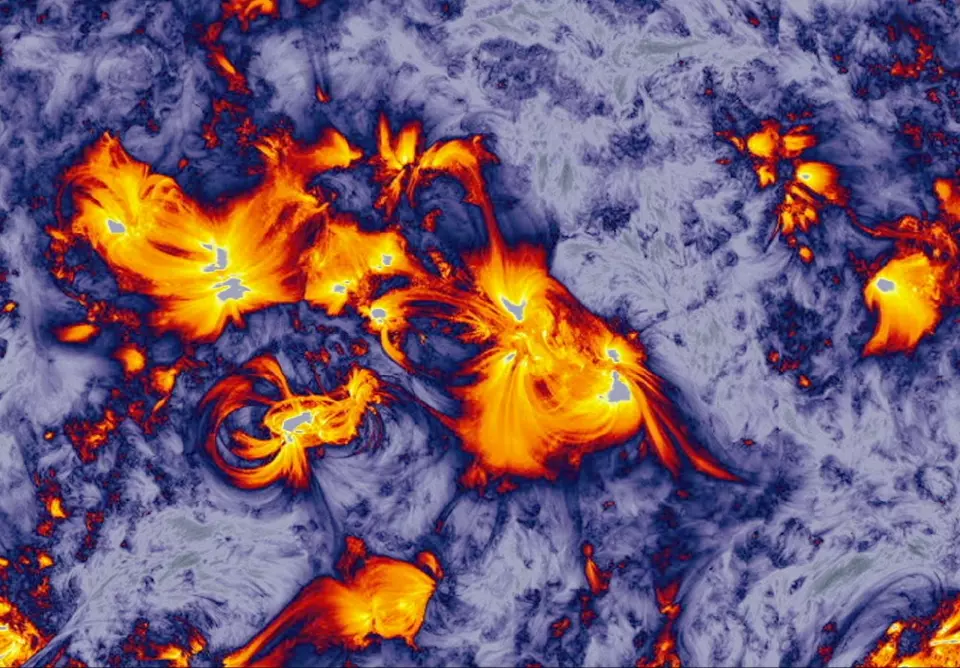
At any moment, light that left the Sun eight minutes earlier wallops into Earth. This immense input of radiated energy warms the planet and its atmosphere, affecting our lives in myriad ways.
Also at any moment, Earth reflects almost a third of the sunlight that hits it and emits another chunk of energy back into space in the form of infrared radiation.
Measuring the radiation from the Sun and Earth is crucial for scientists hoping to understand and predict Earth’s weather and long-term warming or cooling trends. The relationship between those two quantities is known as the planet’s energy budget.
Measuring the radiation coming from the Sun specifically is also important for understanding and predicting space weather. The Sun’s magnetic activity waxes and wanes on an 11-year cycle, and particularly at the most intense part of this cycle, the Sun can send out powerful blasts of charged particles and energy. These so-called solar storms can disrupt or knock out our weather satellites, communications infrastructure and other systems; scientists estimate that a severe solar storm could cause more than a trillion dollars in damage. Any information that can help predict these events so we can prepare for them could yield major benefits.
Scientists have measured incoming solar radiation for several decades using large, expensive satellites that cost tens of millions of dollars and take years to build. With modern sensor technology, researchers hope to build smaller, cheaper and simpler instruments that can make measurements of equal or greater accuracy.
In addition, scientists have so far been able to estimate Earth’s energy budget only to within around 50% accuracy. Improving that figure requires increasingly accurate, continuous measurements of both incoming and outgoing energy flows.
NIST Helps Out
NIST played a crucial role in the development of two spaceborne instruments that could pave the way to continuous low-cost solar irradiance measurement.
The first of these instruments, the Compact Spectral Irradiance Monitor, flew from 2018 to 2022 and measured solar energy reaching Earth at a range of wavelengths. The second, the Compact Total Irradiance Monitor (CTIM), flew from 2022 to 2023 and measured total solar irradiance — the sum of all the energy received at the top of Earth’s atmosphere. NASA funded both projects as demonstration missions.
For these instruments, NIST researchers developed purpose-built bolometers — devices that measure the power of incoming radiation using the heat the radiation produces. To capture sunlight, the NIST bolometers use carbon nanotubes — sheets of pure carbon rolled up into microscopic cylinders. Carbon nanotubes are among the best light-absorbing — aka the blackest — materials known, making them ideal for a detector that needs to measure many wavelengths of light.
To create the sensors, scientists deposited onto silicon wafers many thousands of nanotubes standing on end. Each nanotube was several microns (millionths of a meter) long. Packed together in an arrangement resembling a microscopic forest, the nanotubes absorbed more than 99% of light with wavelengths between 200 nanometers (ultraviolet) to 2500 nm (infrared).


NIST’s bolometers (patented in 2016) don’t measure optical energy directly. Instead, these devices typically use a technique called electrical substitution, which works as follows: A built-in electrical heater raises the temperature of an internal thermometer a certain amount. Then a shutter opens to expose the bolometers to sunlight. The energy in that light heats the nanotubes, and thus the thermometer, and a feedback mechanism reduces the heater exactly enough to keep the temperature constant. The decrease in the heater’s power indicates how much optical power from the Sun the sensor absorbed.
The instrument currently used to make these measurements has a large hand-crafted cavity to trap light. Because nanotubes themselves are so black, the NIST bolometers didn’t need such a cavity, so the NIST researchers were able to make their entire device one-tenth the size.
On the Earth side, NIST researchers built a radiometer for the Deep Space Climate Observatory satellite, which launched in 2015. The National Institute of Standards and Technology Advanced Radiometer (NISTAR) measures both sunlight reflecting off Earth’s surface and Earth’s infrared radiation. Similar to the Sun-measuring bolometers, NISTAR uses electrical substitution, but it does not rely on carbon nanotubes for light absorption.
The Future
NIST detectors could in the future play a major role in tracking Earth’s outgoing radiation in two different but related projects.
One is called Black Array of Broadband Absolute Radiometers — Earth Radiation Imager (BABAR-ERI). NASA’s Earth Sciences Instrument Incubator Program funded a development project for this instrument. Designed to fly on CubeSats, BABAR-ERI will measure the radiation reflected off the Earth’s atmosphere as well as radiation emitted by the planet’s surface. The development project, which brought the instrument closer to being ready for deployment, was completed in December 2023.
The other project is Libera, an instrument package that will fly on NOAA’s operational Joint Polar Satellite System-3 (JPSS-3) satellite scheduled for launch in 2027 .
Using NIST bolometers among other instruments, the Earth-facing Libera will take daily measurements of the radiation our planet emits. It will help scientists extend and improve the decades-long data record of the balance between incoming solar radiation and outgoing radiation from Earth.
The Telescopes
Read on to learn more about these instruments.