Official websites use .gov
A .gov website belongs to an official government organization in the United States.

Secure .gov websites use HTTPS
A lock (
) or https:// means you’ve safely connected to the .gov website. Share sensitive information only on official, secure websites.


James Webb Space Telescope
Telescope Details
Location
Second Lagrange point (L2), 1.5 million kilometers from Earth
Purpose
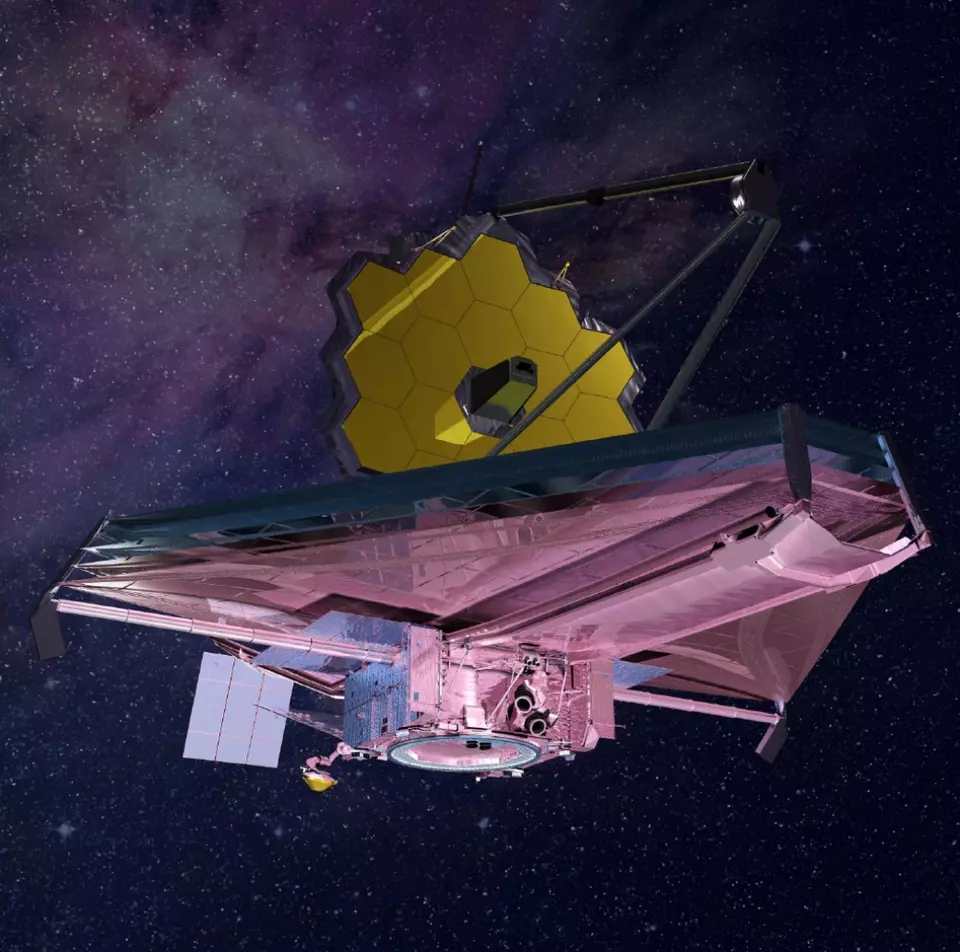
Observe and study the universe from space using infrared light, which provides information on early stars and galaxies, nearby dust clouds and exoplanet atmospheres, among other celestial objects.
NIST’s role
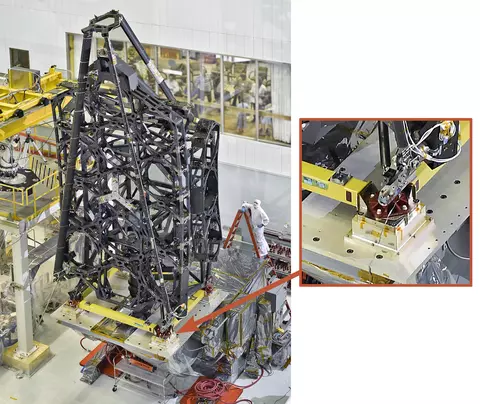
NIST scientists measured composite titanium and stainless steel parts that supported the skeleton for the telescope’s massive mirror during vibration tests. The measurements gave NASA researchers information they needed to position and orient the parts and components within them during the tests, which helped ensure that the telescope will operate properly in space. The ultimate goal was to identify and minimize the stresses the mirrors would experience during launch and orbit.
Read more about NIST’s work on the James Webb Space Telescope.
Significant discoveries and current status
In its first few years, the James Webb Space Telescope has, among other achievements, discovered new exoplanets outside the solar system (including evidence for a giant planet orbiting the closest star to us other than the Sun), revealed a new moon around Uranus, found galaxies from the early universe that were brighter, larger and more complex than predicted and confirmed Hubble Space Telescope observations used to estimate the expansion rate of the universe.
See NASA’s website for more information on Webb’s science.
The telescope launched in 2021 and continues to observe the universe.
Other interesting facts
The James Webb telescope has a five-layer shield the size of a tennis court that blocks infrared radiation of the Sun, Earth and Moon, which would otherwise interfere with the telescope’s observations. Temperatures on the hot side (the side facing the Sun) can be as high as 85 degrees Celsius (185 Fahrenheit), while the cold side is approximately minus 233 degrees C (minus 388 F). The telescope’s coldest instrument operates at just seven degrees above absolute zero.
Supported by
NASA, the European Space Agency and the Canadian Space Agency, with support from other partners.
Operated by
Space Telescope Science Institute
Media