Official websites use .gov
A .gov website belongs to an official government organization in the United States.

Secure .gov websites use HTTPS
A lock (
) or https:// means you’ve safely connected to the .gov website. Share sensitive information only on official, secure websites.


Laser Interferometer Gravitational-Wave Observatory (LIGO)
Instrument Details
Location
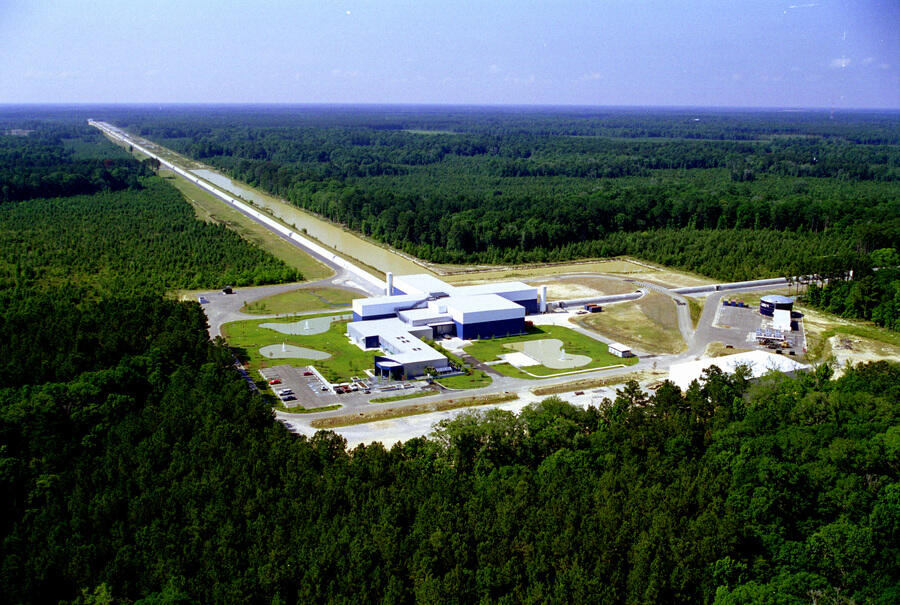
Livingston, Louisiana, and Hanford, Washington
Purpose
Detect ripples in space-time known as gravitational waves. In addition to confirming a major prediction of Einstein’s relativity theory, gravitational waves are among the few ways astronomers can study black holes, which don’t emit any light. LIGO specifically enables astronomers to detect gravitational waves from the moments before, during and after black holes and neutron stars merge. These mergers are some of the most energetic events in the universe.
NIST’s role
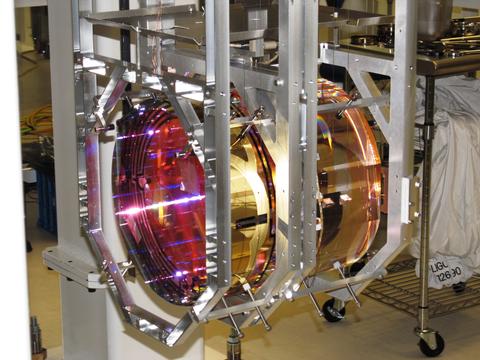
LIGO works by splitting an infrared laser beam and shooting the light down perpendicular 4-kilometer tunnels. Inside the tunnels, the light bounces back and forth off finely polished mirrors, and scientists record the interference patterns the beams make when they recombine.
As a gravitational wave passes by, the tunnels shrink and expand ever so slightly (by roughly one ten-thousandth of the diameter of a proton), causing distinct but subtle changes in the laser interference pattern.
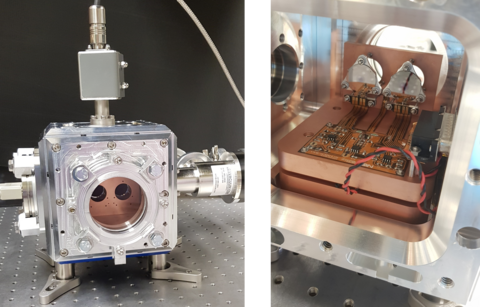
Making such a precision measurement requires an extremely well-calibrated way to measure how much the length of the detector arms change. LIGO scientists accomplish this using “photon calibrators”: auxiliary lasers (not the ones that shine down the long tunnels) whose light pushes ever so slightly on the mirrors, simulating the effect of a gravitational wave while the detector is running. The photon calibrators essentially provide a “ruler” against which LIGO can measure the minuscule distortions in space-time caused by passing gravitational waves.
To ensure accuracy, the power of those auxiliary lasers must itself be precisely calibrated. That’s where NIST comes in.
In 2014, the LIGO team sent NIST a detector they use to calibrate how much light — and therefore how much force — those auxiliary lasers provide. NIST scientists had previously developed a calibration system based on calorimetry that links optical power to the fundamental constants of nature, which by definition do not require calibration.
Using this system, NIST researchers calibrated the LIGO detector to 0.6% accuracy. Later, when LIGO scientists observed a signal consistent with a gravitational wave, the NIST calibration gave them confidence that their measurements were accurate.
NIST continues to help calibrate LIGO’s laser power, now with a radiometry-based system that has an accuracy of 0.16%. LIGO also sends its detector to the German metrology institute, the Physikalisch-Technische Bundesanstalt (PTB) in Braunschweig, Germany, for additional calibration. The Italy-based gravitational wave detector Virgo also participates in the calibration chain. As a result of these and other improvements, gravitational wave detectors have dramatically increased their signal-to-noise ratio while decreasing their measurement uncertainty since the first detection in 2015.
Significant discoveries and current status
LIGO detected gravitational waves for the first time on Sept. 14, 2015. The waves were sent coursing through the universe some 1.3 billion years earlier, when two black holes spiraled into each other and merged.
The detection confirmed two key predictions of Einstein’s 1915 theory of general relativity: that black holes exist and that gravitational waves exist. It validated a bold experimental approach pursued by LIGO’s designers, which required some of the most precise measurements ever made. Three of LIGO’s leaders were awarded the 2017 Nobel Prize in Physics.
Since the first detection, LIGO has made or been involved in the detection of around 300 black hole mergers, and one merger between neutron stars. In September 2025, LIGO announced that its sensitivity had increased enough to confirm a major prediction of the late theoretical physicist Stephen Hawking, that the total surface areas of black holes cannot decrease.
LIGO continues to operate and has been upgraded several times. Each upgrade increases both the frequency of detections and the amount of information scientists can extract from a detection.
Other interesting facts
LIGO’s two detectors have been joined by two other gravitational wave detectors: Virgo in Italy and KAGRA in Japan. All four use the same basic L-shaped design.
LIGO is so sensitive that it must account for sources of noise so tiny that most people would never think of them. For example, scientists at the Livingston detector must filter out the effect of waves hitting the coast more than 100 kilometers away.
Media