U.S. flag

An official website of the United States government

Official websites use .gov
A .gov website belongs to an official government organization in the United States.

Secure .gov websites use HTTPS
A lock ( ) or https:// means you’ve safely connected to the .gov website. Share sensitive information only on official, secure websites.

Projects/Programs

Displaying 1 - 25 of 28

Classification Methods for the NIST Biorepository

Ongoing
NIST has been archiving biological and environmental specimens, including marine animal and environmental samples, for over 40 years. Currently, these biospecimens are stored at cryogenic temperatures in the NIST Biorepository located at the Hollings Marine Laboratory in Charleston, SC. Various...

Connecting Thermodynamic and Dynamic Properties of Bulk and Confined Fluids

Ongoing
The dynamic properties of bulk fluids remain a challenge to predict. Predicting the dynamic properties of confined fluids represents a greater scientific and engineering challenge. Developing simple heuristics or even robust correlations will be helpful in developing and understanding technologies...

Consistency Analysis and Uncertainty in ‘omic Data

Ongoing
‘Omics is increasingly moving out of the laboratory and towards use in industrial and commercial applications. For instance, in biomanufacturing, there is a need for quality control when developing biotherapeutics, which will almost certainly require a machine-learning classifier to separate...

Data Tools for Environmental Metrology

Ongoing
A recent addition to operations in the NIST Biorepository, we seek out places where NIST scientists get bogged down by the complexity of their data. Research at NIST can generated some of the most complex data in the world, at times requiring six months or more of processing to get to the data...

Explosives Decomposition Chemistry

Completed
Intended Impact Computational modeling and simulation will help in the invention of new explosives, the design of compounded mixtures of existing materials, and the engineering of delivered systems such as military ordnance. Objective Detailed chemistry is a necessary part of computational...

Free Energy and Advanced Sampling Simulation Toolkit (FEASST)

Ongoing
Intended Impact While flat-histogram Monte Carlo simulations have been shown to be a promising method for the direct calculation of complex fluid phase behavior with a variety of applications, most open-source Monte Carlo simulation packages do not support this method. We have therefore made FEASST...

Machine Learning Fluid Equations of State

Ongoing
Understanding the thermodynamic properties of fluids and fluid mixtures is of central importance in many fields of science and engineering ranging from medicine to consumer products. The nature of the particles in a fluid can vary greatly depending on the type of interactions present, e.g., dipole...

Machine Learning to Predict Food Provenance

Ongoing
Adulteration of food and food products is a pernicious problem which is difficult to solve as supply chains and international trade routes become increasingly complex; yet agriculture contributed over $1 trillion to the US GDP in 2017, [1] illustrating the importance of protecting this and related...

Machine Learning to Predict Multicomponent Colloidal Crystals

Ongoing
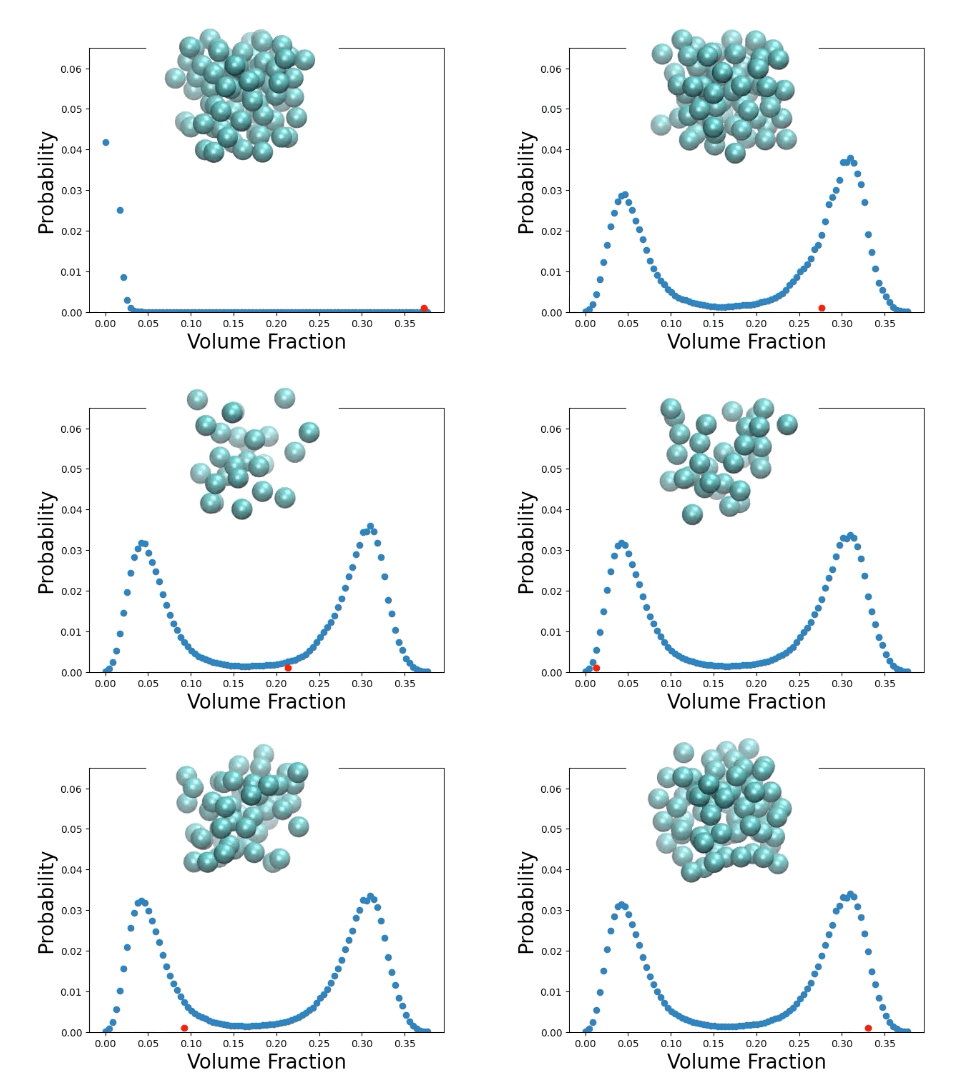
There is a direct link between a material’s macroscopic properties and its microscopic structure, which makes rational bottom-up self-assembly a powerful tool for engineering properties of materials. In general, colloids are facile material building blocks whose shape, charge, and surface...

Materials Informatics

Ongoing
To develop the need data infrastructure and informatics tools, NIST is focusing on three areas: data curation, data infrastructure, and data access. Data curation efforts include efforts to develop a phase-based materials ontology to ensure that the data is represented in a semantically...

METIS

Ongoing
A Metrology Exchange to Innovate in Semiconductors

The NIST Chemistry Webbook

Ongoing
Intended Impact It is part of NIST's mission to distribute Standard Reference Data to scientists, engineers, educators, and the general public. The NIST Chemistry WebBook is intended to help fulfill NIST's mission by distributing such data over the Internet. Objective Develop a web site...

NIST Data Resources for Adsorption

Ongoing
NIST/ARPA-e Database of Novel and Emerging Adsorbent Materials A centralized resource for the scientific community to find and compare single- and multi-component adsorption isotherms reported in the literature. The database sorts data according to adsorbent material, adsorbate species...

NIST Materials Resource Registry

Ongoing
The MRR is a comprehensive inventory of high-level data collections, repositories, databases, tools, software, and services useful to materials research and design but located anywhere in the world. Its specialization for Materials Science is in the domain-specific metadata and vocabulary it can...

NIST Standard Reference Simulation Website

Ongoing
Molecular simulations, in particular Monte Carlo Molecular Simulation and Molecular Dynamics Simulation, are methods for computing the properties of some kind of system, for which the intermolecular interactions are specified via mathematical relationships derived from statistical mechanics. Since...

Ontologies and Interoperability in Evolutionary Comparative Analysis

Completed
Intended impact Nearly all scientists who regularly use online resources on genes, proteins and genomes make use of comparative data to advance biomedical research. For instance, researchers often make useful inferences by comparing human genes (as well as proteins, reactions, interactions, pathways...

Prediction of Global Warming Potential

Ongoing
Goals Use ANN models to fit RF and .OH rate constant data k(.OH). Be able to predict RF, k(.OH), and GWP with reasonable accuracy using readily available information. Create a screening tool based on the ANNs.  Research Activities Improve the performance of rate constant prediction. Compare rate...

Reactivity of Nanoparticle Catalysts

Ongoing
Goals: Provide mechanisms for various prototypical electrocatalytic reactions on different metallic surfaces an nanoparticles. Validate the results of DFT calculations versus experimental data. Research Activities: Studying the methanol oxidation reaction on Pt and PtRu surfaces. Studying the effect...

Research Data Framework (RDaF)

Ongoing
What is the Research Data Framework? A map of the research data space: who, what, where, why, when? A dynamic guide for the various stakeholders in research data to understand best practices for research data management and dissemination A resource for understanding costs, benefits, and risks...

Solvation Thermodynamics

Ongoing
Solvation thermodynamics data are essential in the characterization and interpretation of any process carried out in the liquid phase. The data have application in the study of biochemical processes such as protein folding and protein-protein association in aqueous fluids and are useful as...

Theoretical Mass Spectrometry

Ongoing
No Description Intended Impact Unknown compounds will be identified more reliably. Quality control for the NIST Mass Spectrometry Database will be enhanced. Goals Develop software tools for predicting microcanonical branching fractions automatically. This is currently too laborious and too technical...
Was this page helpful?