

Official websites use .gov
A .gov website belongs to an official government organization in the United States.

Secure .gov websites use HTTPS
A lock (
) or https:// means you’ve safely connected to the .gov website. Share sensitive information only on official, secure websites.


Emerging Power Electronic Devices
Summary
The ubiquity of power electronics is driving efforts to improve the performance and reliability of wide and ultra-wide bandgap power devices. This program develops unique measurement instrumentation and methodology to quantify the salient physical properties of these materials and devices with respect to their potential for practical power conversion applications. We are establishing internal and external partnerships to disseminate results and new measurement methodologies that provide a foundation for standards development, innovation, and commercialization.
Description
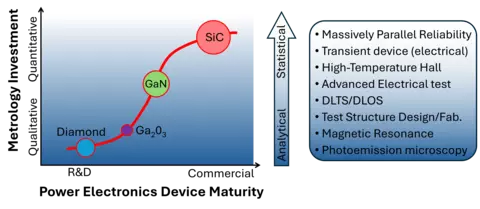
The program’s metrology efforts span from low volume analytical measurements through high volume statistical measurements depending on the commercial maturity of the candidate power electronic device material system.
The ongoing electrification of society has elevated the importance of electric transportation, renewable energy distribution, and data centers. It has also put new demands on the technologies -- called power electronics -- that control, interface, and transmit the electrical energy that powers our lives.
Today, power electronics typically rely on relatively inefficient silicon power devices and associated systems for switching, amplification, AC/DC conversion, and other purposes. The fundamental physical properties of silicon limit further improvements in efficiency and power handling capacity.
The growing ubiquity of power electronics has renewed focus on efforts to improve a class of immature electronic materials: wide and ultra-wide bandgap ((U)WBG) semiconductors. The wider bandgaps in these emerging devices provide a pathway for higher power handling and faster charging at greater overall efficiency. Collectively, adoption of this technology has the potential for substantial overall energy savings in the aggregate.
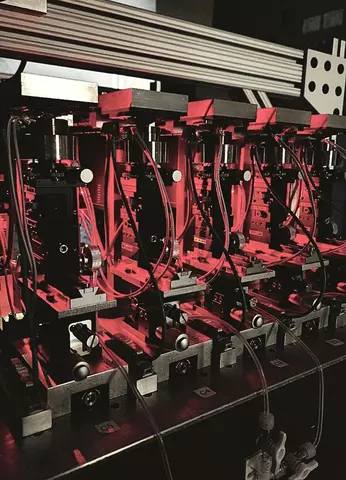
However, WBG and UWBG platforms are still immature and inadequately characterized so far. NIST's Emerging Power Electronic Devices program is developing unique measurement instrumentation and methodology to quantify the salient physical properties of these materials and devices to characterize their potential for practical high power handling applications.
In this program, specific emphasis is given to establishing critical links between specific morphological and intrinsic defects (chemical bonding errors) and overall power device performance and reliability. Moreover, many of the power electronics applications introduce extreme reliability requirements (zero failures in 10+ years) which demand the creation of new metrologies for assessment and mitigation.
These innovative measurements are key drivers to mature these (U)WBG materials for more widespread adoption and overall energy savings -- which can reduce the need for fossil-fuel based energy generation.