

Official websites use .gov
A .gov website belongs to an official government organization in the United States.

Secure .gov websites use HTTPS
A lock (
) or https:// means you’ve safely connected to the .gov website. Share sensitive information only on official, secure websites.


Squeezed Light for Detecting Gravitational Waves
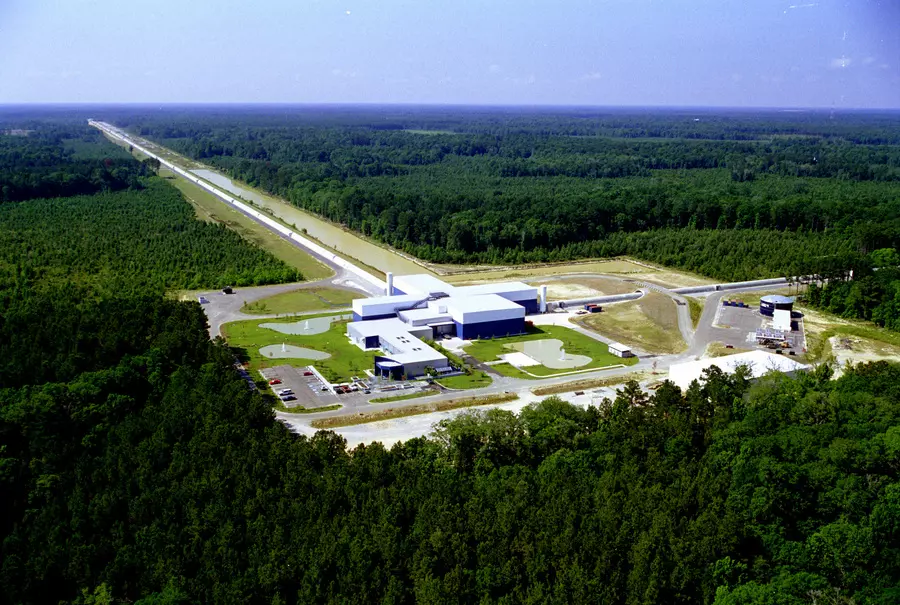
Perhaps the most spectacular quantum sensors of all are the massive, L-shaped structures that make up the Laser Interferometer Gravitational-Wave Observatory, or LIGO. In 2015, LIGO scientists announced they had detected gravitational waves — ripples in space-time predicted in 1915 by Einstein’s general relativity theory. The discovery made headlines around the world, and the scientists who led the effort went on to win a Nobel Prize.
The Earth-shaking waves resulted from two black holes spiraling into each other, creating a cataclysmic, cosmos-shaking collision more than 1 billion light-years away. Despite emerging from such a powerful event, by the time they reached Earth, the gravitational waves’ power had become so diluted that they tugged only ever so lightly on matter, stretching and compressing the kilometers-long arms of the LIGO detectors by one ten-thousandth of the width of a proton. The detection therefore required some of the most precise measurements ever made.
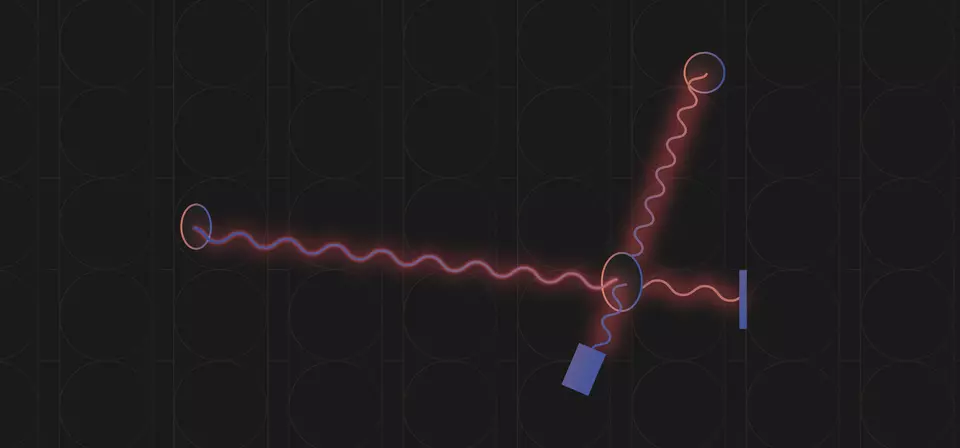
LIGO works by splitting a laser beam, shooting the light down 4-kilometer tunnels. The light bounces back and forth off finely polished mirrors, and scientists record the interference patterns the beams make when they recombine. As a ripple in space-time known as a gravitational wave passes by, the detector arms shrink and expand ever so slightly (by roughly one ten-thousand-trillionth of a human hair), causing distinct but subtle changes in the laser interference pattern.
A few years later, scientists upgraded LIGO to make it more sensitive still, by injecting into the beams something called “squeezed light.”
The idea of physically squeezing light like a sponge seems strange. But this quantum trick is an ingenious way scientists have found to push the limits of measurement precision.
To understand how it works, we need to consider what limits LIGO's sensitivity in the first place. Quantum physics tells us that particles such as photons will randomly pop in and out of existence in the vacuum inside the tubes, creating a background hum of quantum noise. These noisy photons mess with the more orderly photons in LIGO’s laser beams, making them hit the mirrors less regularly and adding uncertainty to the interference pattern measurement. It’s as if you were trying to measure the heights of waves on a lake during a rainstorm, and randomly timed raindrops were creating ripples that add uncertainty to your measurements.
The light squeezing trick involves not a physical squeezing but rather a quantum mechanical squeezing. It takes advantage of the Heisenberg uncertainty principle, one of the most famous rules in quantum mechanics, which states that pairs of quantities exist that cannot be simultaneously measured to infinite precision.
The best-known Heisenberg pair is position and momentum. In other words, the more precisely you measure the position of an object, the less precisely you can measure its momentum, and vice versa. For a light wave, the paired quantities are the wave’s amplitude — the height of its peaks — and its phase, or where in the cycle the wave is at a given moment. This creates a challenge for LIGO, because the phase carries key information for detecting gravitational waves.
Quantum squeezing offers a way to turn this challenge into an opportunity. Scientists realized they could reduce the uncertainty in their phase measurements if they were willing to tolerate a larger uncertainty in amplitude. Building on an idea first proposed in the 1980s, LIGO scientists in 2019 installed specialized crystals that convert a single photon (particle of light) into a pair of “entangled” photons with lower energy. Quantum entanglement is an important concept in quantum physics that enables particles separated in space to share a single quantum state.
The LIGO crystals don't directly squeeze the light in the laser beams. Instead they squeeze the randomly generated vacuum light, which then interacts with the laser light and squeezes it.
More precise measurements of the laser phase helped LIGO see more high-frequency gravitational waves produced just before two enormous black holes or neutron stars crashed into each other. But it had a cost: The increased uncertainty of the amplitude measurement made the detectors worse at spotting lower-frequency gravitational waves such as those produced by black holes and neutron stars orbiting at a distance. So LIGO scientists developed a further squeezing trick: a way to increase the precision of either the phase or the amplitude based on the frequency of the gravitational wave they want to detect. (Read more about this neat trick.)
Generating and maintaining fragile squeezed and entangled states is difficult and expensive. To date, LIGO and the gravitational wave detectors Virgo (in Italy) and KAGRA (in Japan) are among the few sensors to succeed at enhancing the precision of a measurement using entanglement, and certainly the grandest in scale. LIGO needed decades and millions of dollars in funding to pull off its light-squeezing breakthrough.
But scientists are starting to apply similar techniques to atomic clocks, dark matter detectors and other quantum technologies. If entanglement and squeezing can be made easier and cheaper, they could unleash a new generation of quantum sensors that push the frontiers of precision even further.