Official websites use .gov
A .gov website belongs to an official government organization in the United States.

Secure .gov websites use HTTPS
A lock (
) or https:// means you’ve safely connected to the .gov website. Share sensitive information only on official, secure websites.


Quantum Sensing Explained

Our world is full of sensors. Indoor thermostats keep our homes comfy while outdoor thermometers tell us what to put on for the day. Our cars sense fuel and oil levels, engine temperature, the pressure our foot exerts on the accelerator and more. The trusty bathroom scale tells us our weight, while our smart phones, watches and rings flood us with data about our physical activity and health.
These sensors generally operate according to the laws of classical physics, which describes the behavior of most everyday objects. For example, we can detect a change in a room’s temperature by monitoring the changing resistance of a wire or get our weight by measuring the compression of a scale’s spring or load cell. Most of today's sensors don’t use quantum mechanics, the strange, often counterintuitive rules that govern the universe at its smallest scales and coldest temperatures.
But some scientists believe we’re at the dawn of an age of widespread quantum sensors: devices that use quantum properties to gain an advantage. These emerging technologies could open up a vast range of new applications in biomedicine and health care, geology, materials research, mineral exploration, navigation, astronomy, computing and more.
What makes a quantum sensor quantum?
Physicists developed quantum mechanics in the early 1900s to explain results that seemed to contradict the physics of the time. Quantum theory tells us, for example, that matter and light come in tiny, fundamental particles such as electrons and photons. These particles cannot have just any amount of energy; rather, they are restricted to certain “allowed” energies, similar to how a ladder restricts us to individual rungs as we climb. In physics speak, matter and energy are “quantized.”
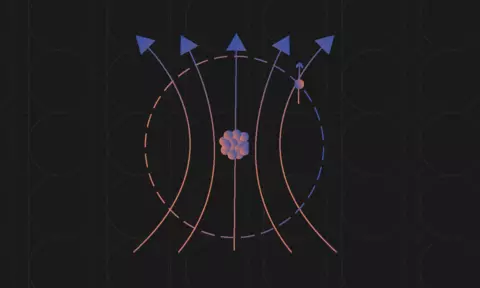
Quantum also tells us that fundamental particles have a property called spin, which can make them act as tiny magnets.
A quantum sensor uses these quantum properties to measure something in a way that would be impossible using classical physics alone.
Quantum sensors are already part of our world. The atomic clock, invented in 1949, harnesses atomic energy levels to tell time and can be considered a quantum sensor. Devices that use the spins of atoms to sense magnetic fields have existed since the 1950s; magnetometers that take advantage of the quantum phenomenon known as superconductivity emerged in the 1960s. Magnetic resonance imaging (MRI), which uses quantum spin to produce images of the body, dates to the 1970s.
Sensors using existing quantum technologies are constantly being improved. Now, they are being joined by a new generation of ultraprecise quantum sensors that promise better ways to measure some of the most important physical quantities, including light, gravity, temperature, and electric and magnetic fields.
What’s the big deal about being quantum?
Quantum sensors are often more, well, sensitive. They can detect extremely tiny changes, such as an increase in energy caused by a single particle of light. And they often give more precise readings than their classical counterparts because scientists know quantum properties — such as the energy it takes to boost an atom from one allowed energy state to another — very accurately.
Quantum sensors can also be self-calibrating and yield more consistent results than conventional instruments. For example, classical devices such as tape measures that are used for precision applications need to be calibrated at the factory and recalibrated periodically during their lifetimes — an expensive and time-consuming process. And because of variations in the manufacturing process, any two tape measures will always measure slightly different lengths.
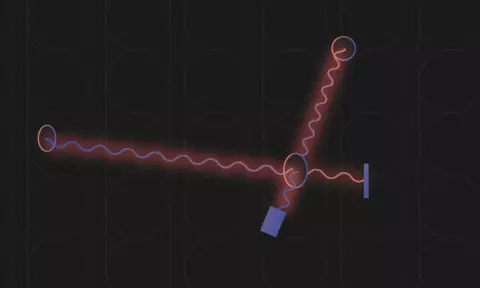
Devices that use the properties of atoms never need to be calibrated, because all atoms of a given type are identical and their properties never change. And a quantum quantity such as the wavelength of the red light used in a laser distance meter is known very precisely from calculations and experiment. As a result, all quantum devices should produce consistent results.
A third advantage of quantum sensors is, in many cases, their small size. Because they are based on tiny objects such as atoms and microscopic circuits, the entire sensor can often be miniaturized. The NIST on a Chip program specializes in building highly accurate sensors the size of a deck of cards or smaller.
Let's explore how these remarkable technologies work and how they’re already changing our world.