

Official websites use .gov
A .gov website belongs to an official government organization in the United States.

Secure .gov websites use HTTPS
A lock (
) or https:// means you’ve safely connected to the .gov website. Share sensitive information only on official, secure websites.


Turning Atoms Into Waves to Measure Gravity and Acceleration
Gravity. We experience it at every moment. And refining our ability to measure it has had immense impact on our world. Surveyors measure local gravity every time they go out in the field. The scientific field of geodesy, which maps the Earth’s shape and predicts where water will flow and minerals can be found, is built on a foundation of gravity measurements. Accurate measurements of gravity are also key to how the world defines the kilogram, the fundamental unit of mass.
Today’s most accurate gravity sensors use lasers and atomic clocks to measure how fast a macroscopic reflective object falls in vacuum. But scientists believe that a gravimeter based on the quantum properties of atoms could advance the frontier of precision and accuracy, potentially opening up new and powerful applications.
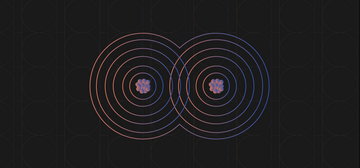
Quantum gravimeters measure gravity’s effect on falling atoms. To do so, they use the fact that quantum-scale objects such as atoms are not just particles but also waves. And just like waves on a pond combine to create a new, more complex wave pattern, atomic waves can be made to interfere with themselves.
To use this admittedly abstract-sounding idea to measure gravity, scientists start by cooling a group of atoms to near absolute zero, which accentuates their wave-like behavior. Using lasers, the scientists then place the atoms into a special state known as a superposition, essentially splitting the atomic wave into two pieces.
In this state, each atom can fall along two slightly different paths. Tiny differences in gravity between the paths cause the two pieces of the atomic wave to evolve slightly differently. After the atoms have fallen for a while, another laser pulse brings the two parts of the wave back together. As the waves recombine, they form an interference pattern that encodes information about the gravitational forces that acted on the atoms as they fell.
If quantum gravimeters become accurate enough, experts believe they could find a wide range of uses. For example, they could monitor the movement of lava underground, helping to predict volcanic eruptions. They could help discover mineral and oil deposits and perhaps also hidden tunnels or voids. They could help water managers track when underground aquifers are filling up or being depleted, providing vital information for agriculture. Possibly they could even measure the growth of forests and crops.
There is another, more fundamental reason to measure gravity better. In 2019, the kilogram — the fundamental unit of mass — was redefined based on fundamental constants rather than a metal cylinder housed in France. To obtain the exact value of the kilogram, scientists now use a tool called a Kibble balance to precisely weigh a test mass, then convert that weight to a mass by dividing by a measurement of local gravity.
Scientists must measure local gravity using classical gravimeters, limiting how accurately they can define the kilogram. A quantum gravimeter could therefore deliver a better kilogram, which in turn would help ensure that all countries are using a consistent definition of mass — and make weight and mass measurements around the world even more accurate.
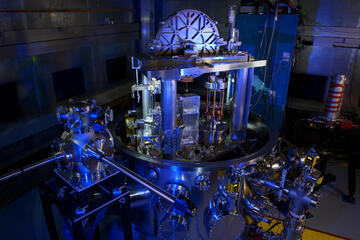
Atom interferometers can measure more than gravity. Einstein’s theory of general relativity tells us that there is no difference between being in a gravitational field and experiencing an acceleration. So atom interferometers can also be used to measure acceleration — making them quantum accelerometers — or rotation, making them quantum gyroscopes.
Measuring acceleration and rotation more accurately could help advance a long-sought goal: precision navigation without GPS. Inertial navigation units based on classical accelerometers are good enough to guide planes for the duration of a flight; a unit on the Apollo missions even guided astronauts to the Moon and back — a trip of over a week — with only minimal corrections needed. But for vessels making long-duration voyages in GPS-denied environments, such as nuclear submarines submerged for months at a time or a spaceship headed to Mars or beyond, current technology eventually requires corrections from GPS or another source. Paired with a sufficiently good atomic clock, a quantum accelerometer could enable any vessel to autonomously track its location for months or even years.
Countries around the world, and some companies, are developing atom interferometers in hopes that these quantum sensors can someday provide an alternative or backup to satellite-based navigation and classical inertial sensors. One such unit was recently launched into space.