

Official websites use .gov
A .gov website belongs to an official government organization in the United States.

Secure .gov websites use HTTPS
A lock (
) or https:// means you’ve safely connected to the .gov website. Share sensitive information only on official, secure websites.


Giant Atoms for Measuring Radiation

The invention of the radio just over a century ago transformed people’s ability to communicate. Suddenly, people could send and receive light-speed messages from thousands of miles away — a capability that continues to transform the world.
Soon, quantum scientists could usher in the next big advance in radio communication: compact, highly sensitive receivers based on atoms.
Atoms are typically far too small to interact with radio waves. But one of quantum theory’s stranger predictions is the possibility of gargantuan atoms with diameters up to the width of a human hair.
To understand how these oversize atoms can form, think of an atom’s quantum energy levels as a very tall ladder with many rungs. Usually, electrons cluster on the bottom rungs of the ladder near the atomic nucleus. By hitting an atom with a carefully chosen wavelength of light, however, it’s possible to boot one electron far up the “ladder” to a rung where it has almost — but not quite — left the atom, like a planet or comet wandering the edges of the solar system. This is known as a “Rydberg atom,” named after an early-20th-century physicist who developed the theory of atomic energy levels.
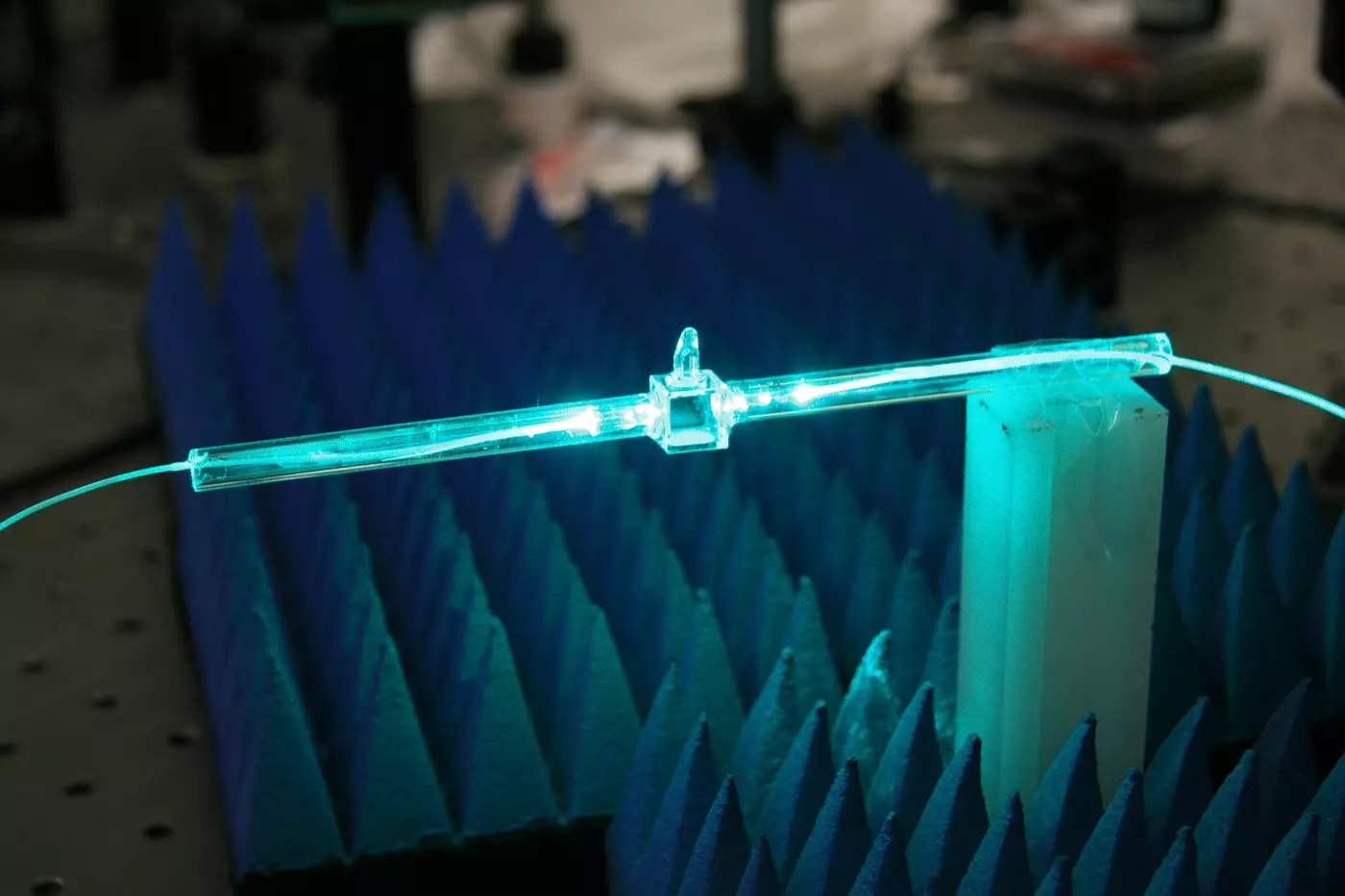
These far-flung electrons become exquisitely sensitive to any electric fields the atom is exposed to. Because oscillating electric fields are part of electromagnetic waves such as radio waves, Rydberg atoms can function as microscopic antennas.
Compared to traditional antennas, Rydberg atom sensors offer several advantages:
- Rydberg sensors are very broadband, with the capability to detect signals over much of the lower-frequency part of the electromagnetic spectrum. These sensors are sensitive to radio waves with frequencies from near zero to around 1 terahertz, or 1 trillion cycles per second.
- Rydberg sensors are compact. By contrast, to receive low-frequency waves such as radio waves, traditional antennas must be quite large.
- Rydberg sensors have a huge dynamic range — they can pick up both very weak and very strong signals.
- Rydberg sensors may be less susceptible to some types of interference and noise.
- The properties of Rydberg atoms, like those of other quantum sensors, are based on fundamental constants and quantum mechanics, providing a connection to the International System of Measurement (SI).
From atoms to antennas
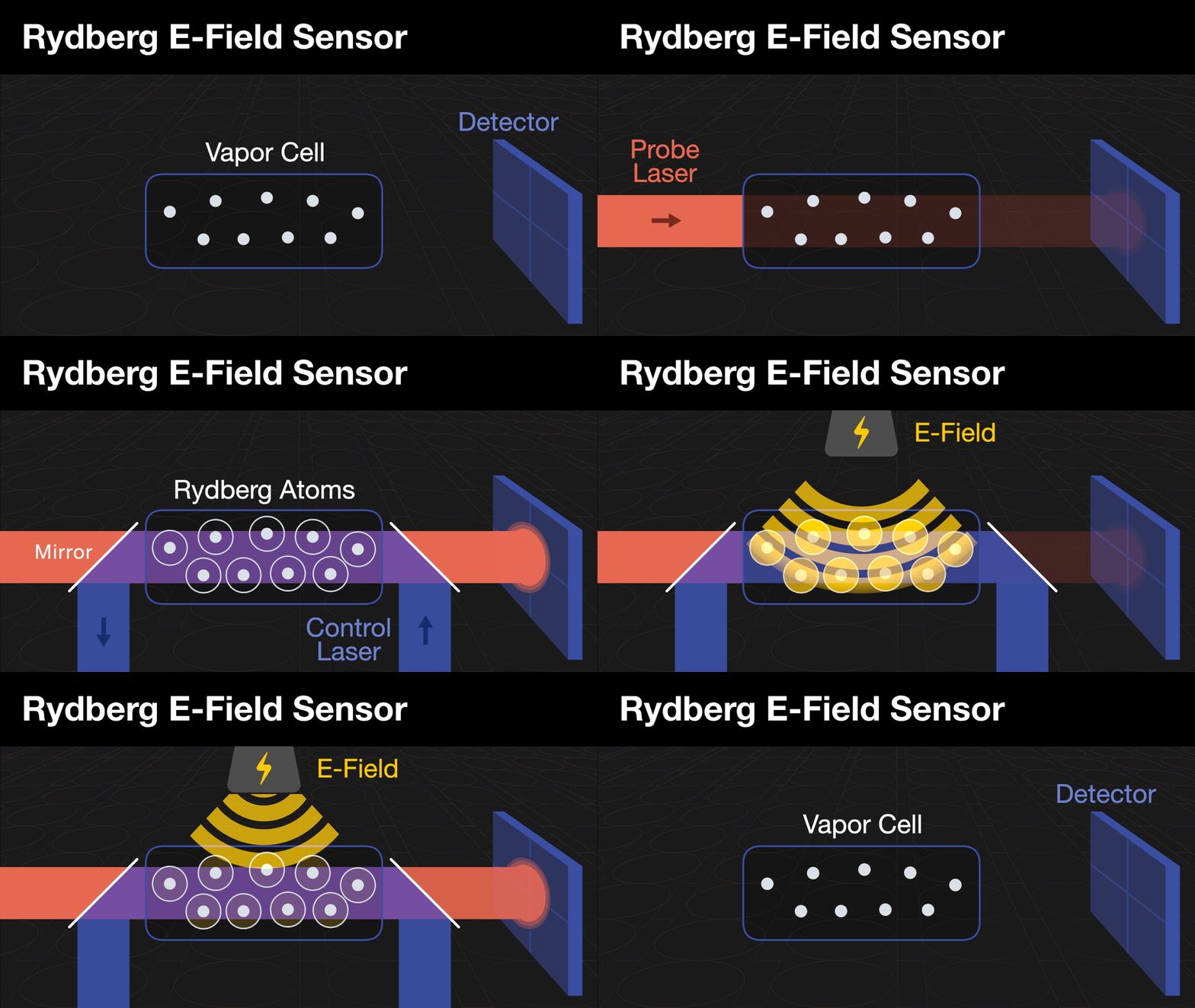
To make a sensor, scientists place millions of rubidium or cesium atoms inside a glass cell. A “probe” laser measures the quantum state of the atoms. Scientists choose a probe laser wavelength that’s strongly absorbed by the atoms in their low-energy state, so that little laser light passes through to a detector.
A second laser then adds energy to the atoms, turning them into Rydberg atoms. At this point, the atoms no longer absorb the probe laser light, allowing it to reach the detector. This phenomenon is known as “electromagnetically induced transparency.”
When the Rydberg atoms are then placed in an electric field, their internal energy changes again, in a way that increases or decreases how much of the probe laser light the atom absorbs — and therefore how much light reaches the detector. The change in the amount of light reaching the detector reveals the electric field’s strength.
Many possible uses
Rydberg atom sensors won’t replace the antenna in your cellphone or car radio any time soon. But scientists believe they could have an impact in a wide range of areas, including:
- Secure communication
- Quantum computing, communication and networking
- Remote sensing, including a NASA project to develop a “Quantum Rydberg Radar” to map Earth’s surface topography, vegetation and soils from satellites
- Imaging
- Development of radio-frequency safety probes used to monitor workplace exposure to radiation
- Testing, calibrating and troubleshooting automotive radar systems
- Ground-penetrating radar for imaging buried objects
- Weather forecasting
- Defense and surveillance
- Fundamental metrology: for example, new methods for electric field and power calibrations, temperature and DC and AC voltage standards