Official websites use .gov
A .gov website belongs to an official government organization in the United States.

Secure .gov websites use HTTPS
A lock (
) or https:// means you’ve safely connected to the .gov website. Share sensitive information only on official, secure websites.


Atomic Clocks: Exquisite Sensors for More Than Just Time
Atomic clocks use the quantum energy levels of atoms to tell time more accurately and precisely than any other kind of clock. (Learn more about how atomic clocks work.)
But atomic clocks can be used for more than timekeeping. They can serve as quantum sensors. Indeed, companies already use portable atomic clocks to detect oil deposits under the ocean. As these clocks become even more accurate and precise, their sensing capabilities become increasingly powerful.
To understand how atomic clocks work as sensors, we need to know a bit about Einstein’s theory of general relativity. Relativity tells us that time ticks more slowly in stronger gravity. Here on Earth, for example, a clock ticks slightly more slowly at sea level than it would on the top of a mountain, because gravity is stronger at sea level. For similar reasons, clocks in space speed up relative to those on Earth.
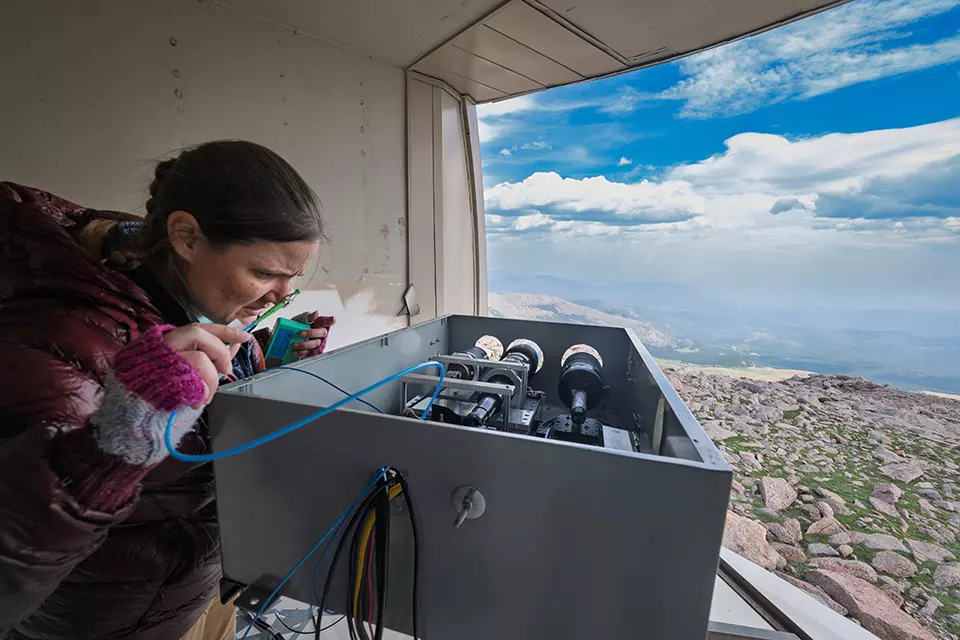
Scientists have used atomic clocks’ gravity-sensing capabilities to conduct astoundingly precise tests of Einstein’s theory. For example, researchers have measured how gravity causes tiny differences in the ticking rates of atoms separated by just a millimeter in height. More recently, scientists took an ultra-accurate atomic clock up a mountain and put others on the International Space Station to conduct even more powerful tests. But clocks could potentially do much more than confirm Einstein.
One example could involve an underground oil or mineral deposit. Such a deposit may create a slightly stronger gravitational field on the ground than if there were, say, a hollow cave or lower-density rock underneath. An atomic clock placed above the deposit would tick slightly more slowly than a reference clock somewhere else and could help prospectors pinpoint the oil or mineral.
Today’s most precise atomic clocks are not yet robust enough to be used to measure gravity differences outside the lab. But next-generation clocks could help detect not just minerals but also underground water movement, aquifer depletion and other hidden phenomena. They could sense subtle signs of impending volcanic eruptions and earthquakes, potentially powering early warning systems for these dangerous geological events.
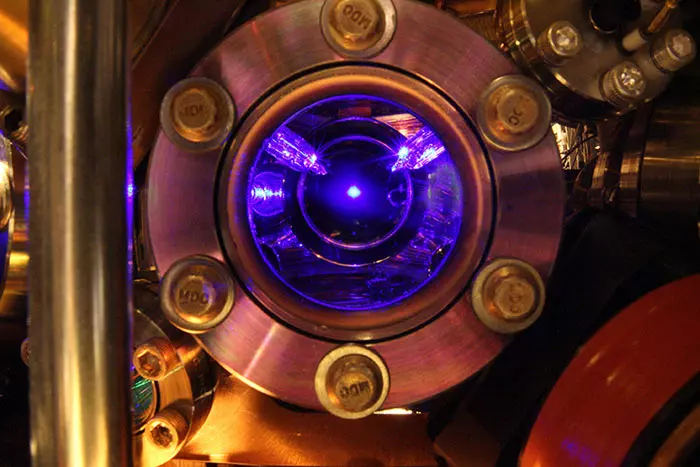
Ultimately, scientists believe the atomic clocks of tomorrow could revolutionize geodesy — the science of mapping the Earth’s shape. That could have major impacts on how surveying, engineering and planning are done.
Perhaps most profoundly, atomic clocks’ sensing abilities could reveal new information about the universe. That’s because the quantum energy levels inside atoms are determined by the fundamental constants of nature.
As far as physicists know, these constants are unchanging in time. But if they were found to vary by even a tiny amount, that deviation could open the door to new physics, for example by revealing the identity of dark matter.
These uses of clocks sound far-fetched, but scientists are already exploring them. Results so far have allowed physicists to rule out certain hypothesized forms of dark matter. Future clocks, including so-called nuclear clocks that use energy levels inside the atomic nucleus, could enable even more precise measurements and deeper searches.
Learn more about how atomic clocks can help scientists search for dark matter.