

Official websites use .gov
A .gov website belongs to an official government organization in the United States.

Secure .gov websites use HTTPS
A lock (
) or https:// means you’ve safely connected to the .gov website. Share sensitive information only on official, secure websites.


Cancer Genome in a Bottle
Summary
Part of the Genome in a Bottle Consortium hosted by NIST dedicated to comprehensive characterization of benchmark cancer genomes. Sign up for General GIAB and Analysis Team email lists.
Updates for August 2026
- Our manuscript about the (near-)complete assembly of the HG008 pancreatic cancer genome, as well as somatic variant benchmarks from this genome is available. Information about tumor cell line availability is in the pre-print on bioRxiv: "A complete human pancreatic cancer genome" https://doi.org/10.64898/2026.05.01.722316
- V0.5 HG008-T Draft Somatic Structural Variant and Copy Number Variant Benchmarks available on the GIAB FTP site. README describes the various benchmark files and how to use SV benchmarks with truvari for benchmarking. V0.5 is our first draft benchmark that includes the option for subclonal SVs and we have refined instructions for benchmarking, so we welcome feedback about these: https://ftp-trace.ncbi.nlm.nih.gov/ReferenceSamples/giab/data_somatic/HG008/Liss_lab/analysis/NIST_HG008-T_somatic-stvar-CNV_DraftBenchmark_V0.5-20260318/
- V0.3 HG008-T Draft Clonal/Truncal Somatic Small Variant Benchmark. V0.3 is our first public somatic small variant benchmark, which includes many challenging somatic variants that modify germline variants, particularly in homopolymers and tandem repeats. We welcome your feedback about best practices for using these as a benchmark: https://ftp-trace.ncbi.nlm.nih.gov/ReferenceSamples/giab/data_somatic/HG008/Liss_lab/analysis/NIST_HG008-T_somatic-smvar_DraftBenchmark_V0.3-20260425/
- New data for HG008 continues to arrive, including short and long read sequencing from bulk tumor cell line passages 2 to 100, as well as from 8 cell lines derived from single cell clones of the NIST HG008-T cell line (see below). We welcome collaborations to analyze these data.
- We have additional short and long read sequencing of a second broadly-consented tumor cell line (HG009-T) and several clonal cell lines. This cell line is from a PDAC liver metastasis. We have promising results from growing a matched normal HG009 T cell line, and have sequencing from normal T cells and engineered T cells.
Interested in collaborating with us? Contact justin.zook [at] nist.gov (Justin Zook).
View the GIAB FAQ here.
Description

Goals
This project is an extension of the Genome in a Bottle Consortium to develop the technical infrastructure (reference standards, reference methods, and reference data) to enable translation of cancer genome sequencing to clinical practice and innovations in technologies. The priority of GIAB is comprehensive characterization of human genomes for use in benchmarking, including analytical validation and technology development, optimization, and demonstration.
Reference Samples
NIST has been collaborating with Andrew Liss at MGH to develop new tumor cell lines with paired normal samples that are explicitly consented for fully public dissemination of genomic data and cell lines. The first tumor cell line (HG008-T) is from a primary pancreatic ductal adenocarcinoma, for which we have paired normal pancreatic (HG008-N-P) and duodenal tissue (HG008-N-D) for sequencing, but no normal cell line. See our preprint for availability of the tumor cell line. We have now added a second genome, which features a tumor cell line derived from a PDAC liver metastasis (HG009-T). For HG009, we have data from two types of CD4+ T cells: wild-type (HG009-N-WT) and an LVTert-engineered cell line (HG009-N-LVTert). In addition, NIST has developed clonal cell lines originating from single cells of both the HG008-T and HG009-T bulk tumor cell lines. We have been generating extensive genomic data described below, and are working towards making more of these cell lines available in public repositories. We also welcome additional collaborations for tumor and normal cell line pairs that are explicitly consented for fully public dissemination of genomic data and cell lines.
Benchmark (or "High-confidence") Variant Calls and Regions
We are working with the GIAB community to develop benchmark variants for the tumor and normal samples, using assembly-based and mapping-based approaches. We welcome collaborations in this new project.
Whole Genome Scale Data
Starting in Fall 2023, we began collecting a diverse array of whole-genome measurements for the GIAB HG008 reference samples. We are now expanding this effort by making data for the HG009 samples publicly available. Figure 1 illustrates the various data types we have been collecting. All datasets are released publicly and without embargo as they are collected. The specific data available for all samples as of July 30, 2026, are detailed in Figure 2. We actively welcome collaborations to analyze these datasets.

GIAB Matched Tumor-Normal Data Access
Contributed data can be accessed through the public GIAB FTP as it becomes available. Data can also be browsed through 42basepairs , which allows for high level exploration and preview of the sequencing data. The specific data available for all samples as of July 30, 2026, are detailed in Figure 2. We actively welcome collaborations to analyze these datasets. To navigate the available data on our FTP site, we provide the Cancer GIAB Data Manifest, which allows you to explore the current tumor and normal datasets. Within this workbook, you will find:
- README: An overview describing the information provided across the data manifests.
- Data Manifests: Two separate tabs detailing the specific datasets for HG008 and HG009.
- Manifest Dictionary: A guide that defines the provided fields and describes the included metrics.
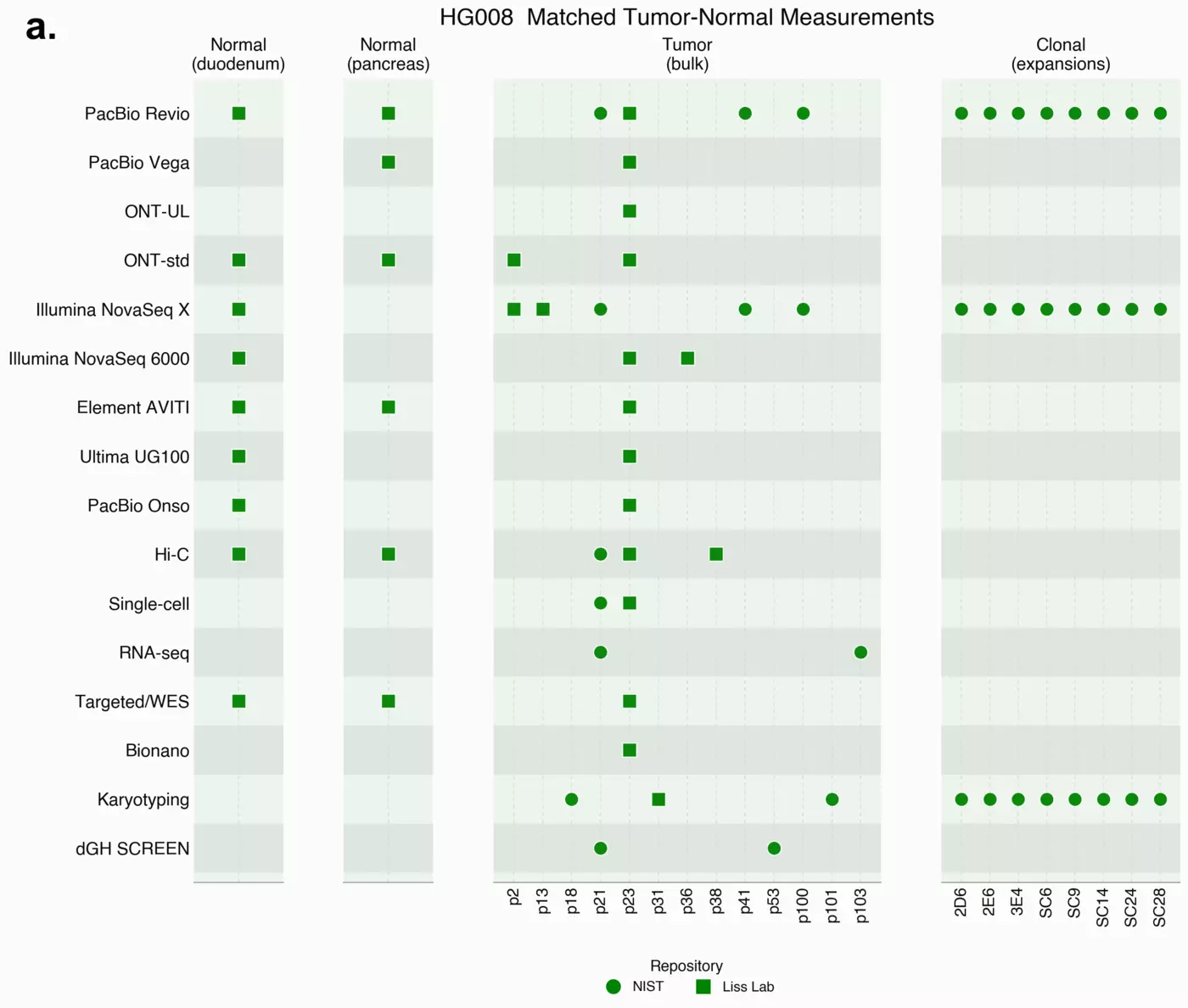
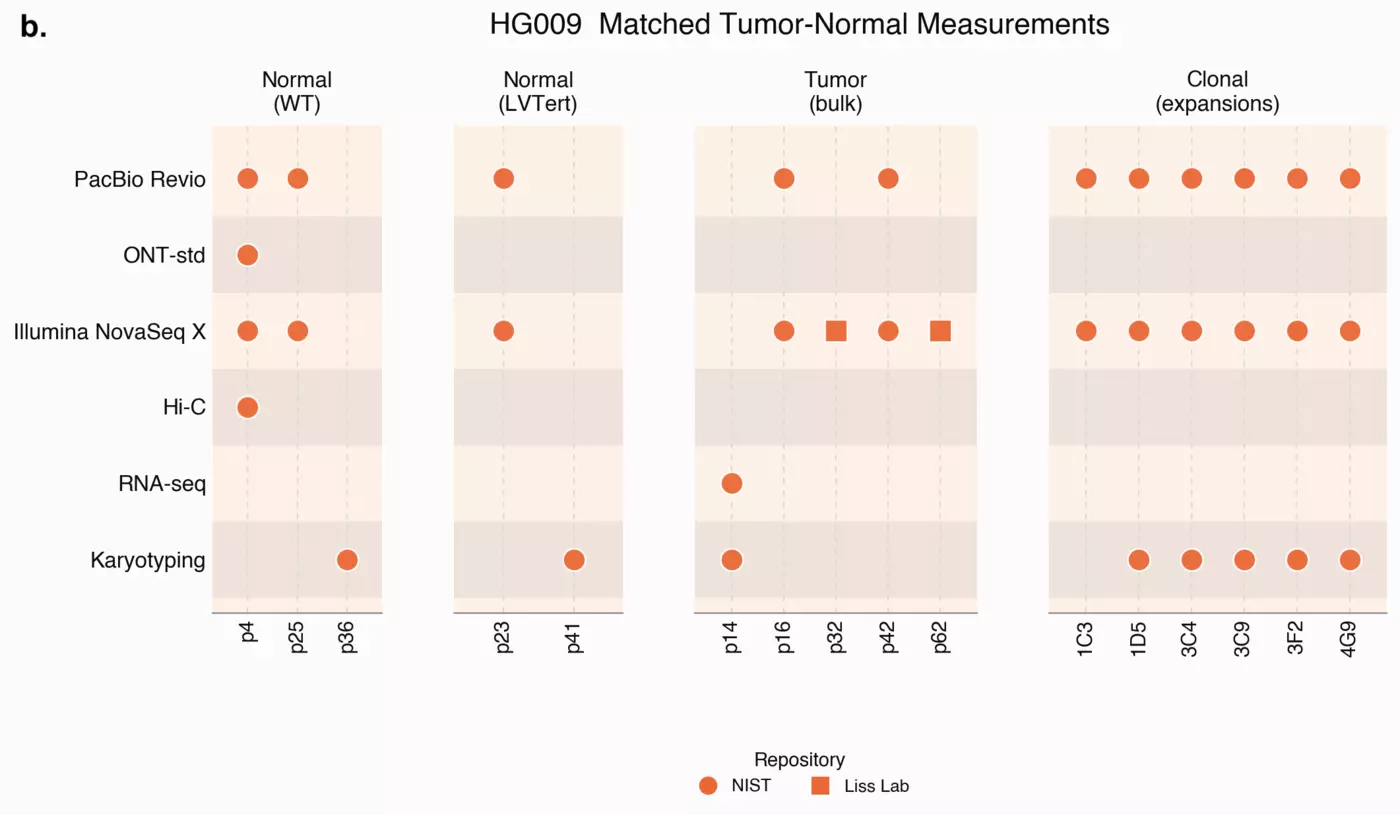
Figure 2: Matched Tumor-Normal Measurements for HG008 and HG009
(a) Illustrates the data collected across the HG008 Normal tissues (duodenum and pancreas), Tumor cell line (bulk), and Clonal cell line (expansions) samples. (b) Illustrates the data collected across the HG009 Normal CD4+ T cells (WT and LVTert), Tumor cell line (bulk), and Clonal cell line (expansions) samples. In both plots, the x-axis indicates the cell passage measured for the tumor bulk samples and the clone cell line IDs for the clonal expansions. Because these cell lines have been grown at both NIST and the Liss Lab, the marker shapes (circles for NIST, squares for Liss Lab) denote the laboratory from which the samples were received for the respective measurements.
Cancer GIAB Publications
- The manuscript describing extensive genomic data for the HG008 tumor/normal pair is now published in Scientific Data https://www.doi.org/10.1038/s41597-025-05438-2
- Our manuscript about the complete assembly of the HG008 pancreatic cancer genome, as well as somatic variant benchmarks from this genome is complete. The pre-print is available on bioRxiv ; "A complete human pancreatic cancer genome" https://doi.org/10.64898/2026.05.01.722316
Research Opportunities
NIST-NRC Postdoctoral Fellowship: 2-year fellowship at NIST, U.S. citizens only, ~$82,000 salary plus benefits, application deadlines are Feb. 1 and Aug. 1, including up to 10 page research proposal. Contact Justin Zook if you are interested in writing a proposal on a genomics research project. We have opportunities posted for metrology in Cancer Genomics, Diploid Assembly, Epigenomics and Transcriptomics, Biological Data Science/Machine Learning, and Precision Medicine.