U.S. flag

An official website of the United States government

Official websites use .gov
A .gov website belongs to an official government organization in the United States.

Secure .gov websites use HTTPS
A lock ( ) or https:// means you’ve safely connected to the .gov website. Share sensitive information only on official, secure websites.

Projects/Programs

Displaying 26 - 50 of 53

Metrology for Multi-Physics AM Model Validation

Completed
Objective To provide reference data for the validation of multi-physics models of metal additive manufacturing processes to enable improvement of AM process models and more rapid and predictable process development for AM production by manufacturers. What is the Technical Idea? The Metrology for

NCAL: Data Management

Ongoing
In the mechanical testing and materials science communities there is not a widely accepted solution for data management of test data. As part of NIST efforts on data archiving, provenance, and availability, we have worked to improve our data practices. We have extended our system beyond many out-of

NCAL: Diffraction Stress Measurement Under Applied Load

Ongoing
Using X-ray diffraction (XRD) techniques one can measure the full stress tensor just inside the surface of a sheet metal specimen under applied loading. This permits the measurement of biaxial stress states resulting from directly applied deformation (see NCAL: Multiaxial Material Performance) or

NCAL: Intermediate Strain Rate Testing

Ongoing
This project seeks to improve servohydraulic testing methods at intermediate strain rates by addressing the well-known problems associated with excessive stress oscillations (ringing) that currently limit our understanding of the mechanical behavior of engineering materials for loading conditions

NCAL: International Documentary Standards Activities

Ongoing
NIST Center for Automotive Lightweighting (NCAL) staff participate in many different international standards committees (e.g. ISO TC 164, ASTM E28 and D30); however, our main focus has been in the mechanical testing of metals and, to a lesser extent, composites. We work on the calibration and

NCAL: Multiaxial Material Performance

Ongoing
Modern metal forming methods are designed and optimized using digital models of specific manufacturing operations. These models rely on a precise understanding of the mechanical behavior of sheet materials as they undergo multiaxial loading out to large plastic strains without failure (necking or

NCAL: NIST Center for Automotive Lightweighting

Ongoing
The ongoing development of new, advanced lightweight materials presents opportunities for the USA automotive industry to produce better, more reliable and less expensive products provided the new materials can be efficiently manufactured. The use of lightweight materials in automobiles, such as

NCAL: Quantifying Crystallographic Texture and Phase Fraction

Ongoing
Predicting the deformation and force response of a polycrystalline material with the level of accuracy needed by today’s manufacturers requires knowledge of the aggregate deformation and force response of all the grains in the material. Polycrystalline materials will respond differently depending on

NCAL: Tension-Compression Testing

Ongoing
The inability to predict the mechanical behavior of new automotive alloys during forming has generated strong demand in industry for more advanced material models and test methods necessary to calibrate them. Industry is particularly interested in modeling the behavior of advanced sheet metals

The NIST Chemistry Webbook

Ongoing
Intended Impact It is part of NIST's mission to distribute Standard Reference Data to scientists, engineers, educators, and the general public. The NIST Chemistry WebBook is intended to help fulfill NIST's mission by distributing such data over the Internet. Objective Develop a web site

NIST Data Resources for Adsorption

Ongoing
NIST/ARPA-e Database of Novel and Emerging Adsorbent Materials A centralized resource for the scientific community to find and compare single- and multi-component adsorption isotherms reported in the literature. The database sorts data according to adsorbent material, adsorbate species

NIST LabCAS: Data Driven Science Architecture and Resource

Ongoing
Biological data lie at the heart of innovation and artificial intelligence (AI) advances in the emerging biotechnology sector and serve as key strategic resources for achieving major breakthroughs in biomanufacturing, as summarized by the National Security Commission on Emerging Biotechnology's

NIST Monoclonal Antibody Reference Material 8671

Ongoing
The NISTmAb material is a recombinant humanized IgG1κ expressed in murine suspension culture. It is an »150 kDa homodimer of two identical light chains and two identical heavy chains linked through both inter- and intra-chain disulfide bonds. The protein has low abundance post-translational

NIST Standard Reference Simulation Website

Ongoing
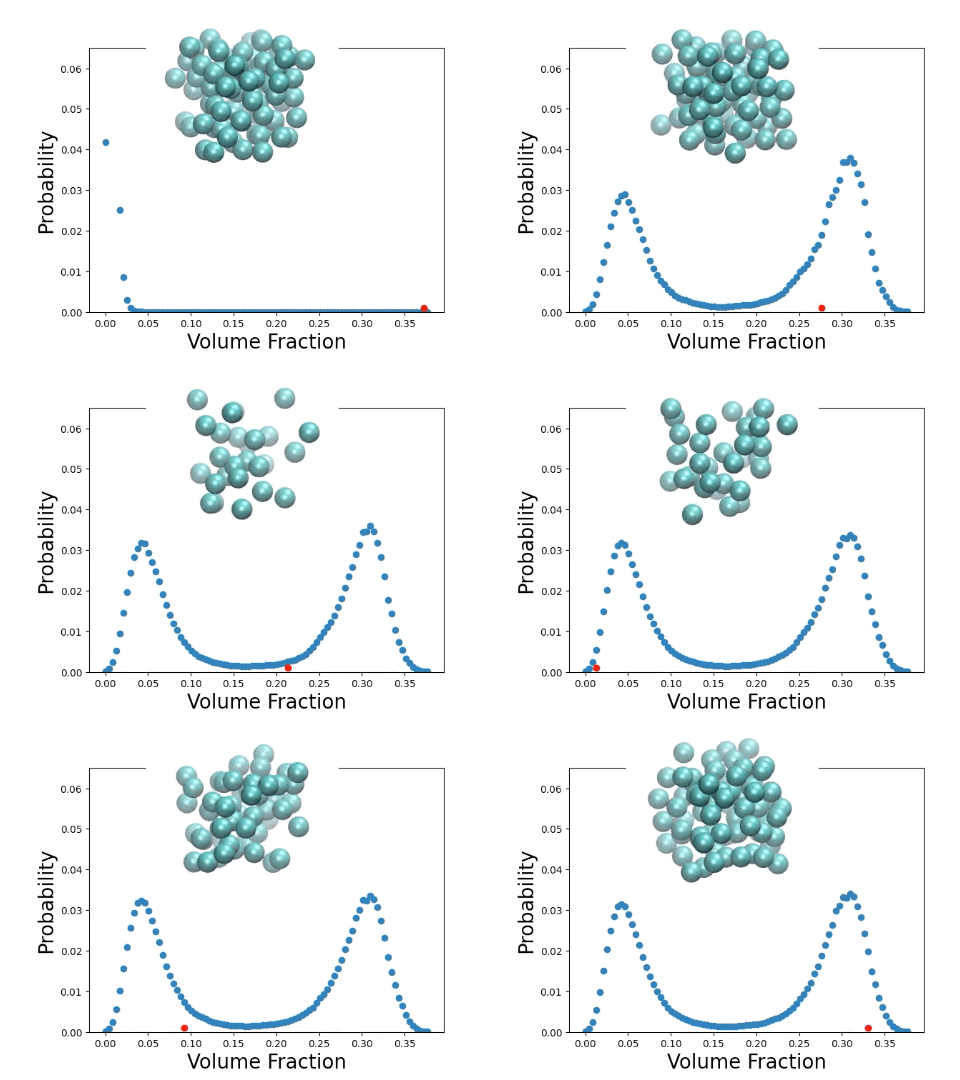
Molecular simulations, in particular Monte Carlo Molecular Simulation and Molecular Dynamics Simulation, are methods for computing the properties of some kind of system, for which the intermolecular interactions are specified via mathematical relationships derived from statistical mechanics. Since

NIST and the SWGDRUG Mass Spectral Reference Library of Seized Drugs

Ongoing
Synthetic drugs such as fentanyl and its analogues are driving an unprecedented epidemic of overdose deaths in the United States. Clandestine labs create these new substances in part to evade law enforcement. This places a major burden on federal, state, and local law enforcement agencies to

Peptide Mass Spectral Libraries

Ongoing
Intended Impact Modern mass spectrometers used in the field of proteomics are capable of profiling thousands of peptides in a single experiment. Each of these peptides is fragmented to form a mass spectrum. Therefore, interpretation of these mass spectra is a critical step in the experimental

Potential Primary Measurement Tool for the Quantification of DNA

Ongoing
The biotechnology industry relies primarily on absorbance and fluorescence methodologies to assess DNA mass. However, these measurements can be seriously compromised by impurities in the DNA preparations or state of the DNA itself. These techniques are also not traceable to the SI because the

Precursor Material Qualification

Completed
To develop, utilize, and analyze methods of characterizing the precursor materials in additive manufacturing in both virgin and recycled states with the goal of advancing measurement science to benefit the AM community. The components of principal interest will include the rheological, size

Reference Fluid Thermodynamic and Transport Properties Database (REFPROP)

Ongoing
REFPROP is a computer program, distributed through the Standard Reference Data program of NIST, that provides thermophysical properties of pure fluids and mixtures over a wide range of fluid conditions including liquid, gas, and supercritical phases. It contains critically evaluated mathematical

Solvation Thermodynamics

Ongoing
Solvation thermodynamics data are essential in the characterization and interpretation of any process carried out in the liquid phase. The data have application in the study of biochemical processes such as protein folding and protein-protein association in aqueous fluids and are useful as

Standards Development to Ensure Reliable Breath Analysis in the Field

Ongoing
Numerous volatile organic compounds (VOCs) have been identified in human breath. These compounds can be produced by the body or by organisms in the body (e.g., bacteria or viruses) and provide a non-invasive window into human health. Inexpensive point-of-care devices are being developed to diagnose

Standards for Metagenomics

Ongoing
Metagenomics is a powerful technology combining high-throughput (a.k.a. “next-generation”) sequencing with advanced bioinformatics to identify and quantify mixtures of organisms in a sample. Metagenomics workflows consist of 4 main steps: Sample collection: location, amount, storage, etc. Extraction

Tandem Mass Spectral Library

Ongoing
Intended Impact Modern mass spectrometers commonly generate ions by electrospray mass spectrometry which are separated and then fragmented by collisional dissociation. This process yields fragment ion ‘fingerprints’ (or mass spectra) that are widely used to identify the individual components in a
Was this page helpful?