U.S. flag

An official website of the United States government

Official websites use .gov
A .gov website belongs to an official government organization in the United States.

Secure .gov websites use HTTPS
A lock ( ) or https:// means you’ve safely connected to the .gov website. Share sensitive information only on official, secure websites.

Projects/Programs

Topic Area
Displaying 351 - 375 of 481

Phase and Amplitude Noise Metrology

Ongoing
The group provides high-precision measurement of electromagnetic signals in the radio-frequency, microwave and optical range. These measurements include phase noise, amplitude noise and perturbations due to vibration and temperature. Such precision measurements support high-value applications such

The Photoforce Project

Ongoing
Traditional power meters measure the power of a laser beam by absorbing its energy. Radiation pressure (photon momentum) permits the measurement of a beam’s power by “absorbing” its momentum and reflecting its energy. Light reflecting from a mirror causes a force that is proportional to its optical

Photometry

Ongoing
The development of revolutionary energy-efficient solid-state lighting (SSL) products has sparked the need for new performance metrics and measurement methods to address their unique construction and operating conditions. NIST has been working closely with the U.S. Department of Energy (DOE)

Photon Absorbed-Dose-to-Water Primary Standards

Ongoing
Modeling of accumulated-dose dependence in the heat defect of H2/O2 exhibits expected peak behavior in qualitative agreement with experiment, and is being further refined for purposes of reducing the associated relative uncertainty from its present value of 0.3 %. Studies to quantify the possible

Photon Drag in Metal Films

Ongoing
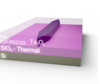
The photon-drag (PD) effect is the rectified electrical current in a medium generated by radiation pressure. That is, the optical force delivered to an illuminated metal results in a measurable voltage across the film (Figure, left). For decades, this effect in metals has been understood in terms of

Photonic Dosimetry

Ongoing
With this effort, NIST is responding to industry needs for traceable, measurement solutions that can resolve spatial variations of absorbed dose at the level of individual components on a silicon wafer or bacteria on surgical instruments. Presently, there is only limited traceability to national

Photonic Quantum State Imaging Metrology

Ongoing
Fundamental understanding of quantum behavior of single molecules, which is a favorable candidate for quantum information processing technologies, has advanced gradually, relying on empirical studies mostly. This requires a measurement platform to study fundamental quantum characteristics in single

Photonic Radiometry

Ongoing
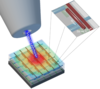
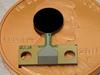
Meeting the needs of the photonics industry and anticipating emerging technologies requires investigation and development of improved measurement methods and instrumentation. This project develops state-of-art, absolute microfabricated thermal detectors with absorber coatings consisting of carbon

Photonic Thermometry

Ongoing
Why do we need reliable temperature metrology? Temperature, the second most measured physical property after time and frequency, is indispensable to innumerable industries, military services, medicine, climate, and weather forecasts – precise, accurate, and rapid temperature metrology enables much

Physics and Hardware for Intelligence

Ongoing
Our work in this area can be separated into two categories: conceptual and experimental. Please read our publications linked below for more information. Experimental: Our latest generation of synaptic circuits are described in a 2024 paper published in APL Machine Learning. These circuits are our

Pico-Watt ACR

Ongoing
Design Parameters for Improved ACR Sensitivity An absolute cryogenic radiometer (ACR) is an electrical substitution instrument for calibrating optical power. A bolometer designed so that virtually all incident optical power is absorbed by the radiometer, an ACR allows for absolute calibration

Plasma Metrology

Ongoing
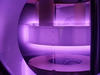
Plasma, the fourth state of matter, is common in both nature (e.g., lightning, the earth's ionosphere, stellar objects) and in modern technology (e.g., semiconductor processing, lighting, plasma televisions, medical equipment). Yet despite this ubiquity, the plasma state is still a wide open

Platform for Realizing Integrated Molecule Experiments (PRIME)

Ongoing
Blackbodies realize a clear relationship between radiated power and temperature through Planck’s law. While a reliable instrument for temperature and power calibrations, blackbodies are afflicted with a plethora of systematics (e.g., non-ideal emissivity, propagation loss, temperature gradients

Portable Field Test Standard for Evaluation of Hydrogen Gas Dispensers

Completed
This project provides a metrological tool and standards supporting the fair trade of hydrogen gas as a vehicle fuel of the future. Objective(s): The Fluid Metrology Group (FMG) and the Office of Weights and Measures (OWM) collaborated in designing, constructing, and testing a hydrogen gas dispenser

Portable Optical Lattice Clock

Ongoing
Exploiting their very high precision, atomic clocks today are used extensively in demanding timekeeping applications. These include a variety of navigation, communication, and remote sensing and imaging applications. The very best atomic clocks today, optical clocks, are among the most precise

Precision Electro-Mechanical Experiments (PREME)

Ongoing
NIST-4 Kibble Balance Previously called ‘the Electronic Kilogram’ Project, a major component of PREME is the realization of SI unit of mass, the kilogram, using the NIST-4 Kibble balance, the fourth generation of Kibble balances at NIST. This is accomplished through a high-accuracy comparison of

Precision Materials for Quantum Devices

Ongoing
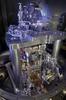
MBE System Our fabrication system is composed of ultra-high vacuum (UHV) chambers that support the in-vacuum exchange of 75 mm wafers without exposure to air as seen in Figure 1. These chambers are: (1) a deposition chamber with electron gun deposition, UHV compatible sputter guns, in situ shadow

Precision Measurement Grants Program

Ongoing
If funding is available, one new grant in the amount of $50,000 per year will be awarded for the initial period of October 1 through September 30 of the following year. The award may be continued for up to two additional years; however, future or continued funding will be at the discretion of NIST

Precision metrology with integrated photonics

Ongoing
This project develops integrated photonics– devices based on waveguides that are fabricated in a nanoscale device layer on a silicon wafer –for the purposes of exploring nonlinear science, enabling new applications with scalable integrated photonics light sources, and enhancing classical and quantum

Precision Spectroscopy and Quantum Control of Trapped Molecular Ions

Ongoing
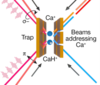
Spectroscopy and Quantum Control of Molecular Ions Molecules exhibit vibration and rotation of their nuclei, degrees of freedom not present in atoms, and less stringent selection rules for transitions. This creates experimental challenges and great opportunities for exploring new physics. In this

Pressure/Vacuum Calibrations

Ongoing
Piston Gauge (29010C - 29040S) This service provides calibrated secondary standard piston gauges, calibrated electronic pressure instruments, and special tests of customer supplied piston gauges. Measurements of pressure are available for submitted calibration items for the range from 10 kPa to 280

Primary optical watt radiometer (POWR)

Ongoing
The POWR, including the detector module, was completely designed by NIST to have the versatility to grow with NIST's needs and embrace new technologies. It provides optical power measurements with uncertainties of 0.01 % ( k=1), which have been verified by an intercomparison with two other cryogenic

Prototyping Platforms for Emerging Technologies

Ongoing
Emerging technologies aim to overcome traditional memory limitations with higher density, lower power consumption, faster read/write speeds, better endurance, and lower cost [2]. Many new candidate memory elements are analog or stochastic, requiring new testing infrastructure, and the context of

Quantifying the environmental contributions to mass change

Ongoing
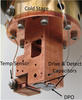
Experiments using two types of centimeter scale oscillators are described: the double paddle oscillator (DPO) and a commercial quartz crystal microbalance (QCM). Double Paddle Oscillator (DPO) Since mass changes are mostly on the surface of mass artifacts, we have implemented a micro-weighing sensor
Was this page helpful?