U.S. flag

An official website of the United States government

Official websites use .gov
A .gov website belongs to an official government organization in the United States.

Secure .gov websites use HTTPS
A lock ( ) or https:// means you’ve safely connected to the .gov website. Share sensitive information only on official, secure websites.

Projects/Programs

Displaying 51 - 75 of 101

Metrics for Reactive Wetting in Complex Systems

Completed
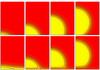
From fundamental physical considerations, we have derived a set of partial differential equations describing wetting and spreading. These equations are derived using a variational thermodynamic principle applied to a two-component alloy system with three (vapor, liquid and solid) phases. The method

Metrology of Magnetic Materials

Ongoing
Currently, the bulk of this project is focused on three main pieces: Thermal MagIC: An SI-Traceable Method for 3D Thermal Magnetic Imaging and Control Magnetic Refrigeration Magnetic Standard Reference Materials (SRMs) Thermal MagIC (MAGnetic Imaging and Control) is focused on developing new

Metrology for Nanoimprint Lithography

Completed
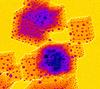
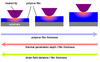
Nanoimprint Lithography (NIL) was originally perceived as a versatile, low-cost, and high-resolution patterning alternative for optical lithography in CMOS fabrication. However, it is becoming apparent that NIL has great potential for nanotechnology in general. It is capable of patterning sub-10 nm

Metrology for Nanolithography

Ongoing
Small Angle Scattering techniques are employed to measure, with sub-nm precision, pattern shape, dimensions, and orientation for structures created in periodic arrays. Critical-Dimension Small Angle X-ray Scattering (CD-SAXS) utilizes the variable-angle transmission scattering from a small beam size

Micro-rheometry

Completed
One way to develop small-volume rheology methods that we have used successfully is to start with existing concepts and geometries of rheometry and to then "think small." This approach ensures that we are measuring fundamental materials properties rather than quantities that are experiment and

Microscopy Methods

Completed
Due to projection effects, analytical transmission electron microscopy (AEM) of thinned or sectioned samples has traditionally been limited to essentially two-dimensional imaging and analysis. Current nanometer scale devices are too small and complex for current sectioning capabilities and two

Microstructure-Property Tools for Structure-Property Design

Ongoing
Materials Digital Twins for AM Current methodologies for designing digital twins in additive manufacturing (AM) exhibit two main approaches: one involves AI models. that establish a direct correlation between input and output properties, overlooking materials structure and characterization, while

Modeling Dispersion Rheology for Non-Spherical Particles

Completed
The goal of this MGI project is to establish an interactive database, generated by sophisticated modeling, such as dissipative particle dynamics and smooth particle hydrodynamics, to compute the rheological properties of polymer composites, where interaction among inclusions, inclusion particle

Multiscale MD-FEM Methodology

Completed
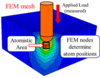
MSED, as a part of the MGI effort within NIST, is developing a multiscale modeling schema, statically coupling finite element modeling (FEM) to atomistic Molecular Dynamics (MD) 1. This methodology allows a far more realistic representation of physical phenomena than that obtained by applying each

Multiscale Modeling and Validation of Semiconductor Materials and Devices

Ongoing
The limitations of scaling traditional CMOS (complementary metal-oxide semiconductors) designs have necessitated that the semiconductor industry consider new materials and design concepts. For wide bandgap semiconductor devices, optimization of materials and fabrication processes is needed to

Nanoparticle Assembly in Complex Fluids

Completed
Engineered nanomaterials are promising for technological and medical purposes. However, molecular mechanisms of toxicology are less known. This presents a problem and barrier for future innovation and applications as new nanomaterials are developed for healthcare where particles are intentionally

Nanoscale Thermal Properties

Completed
It is known that at the nanoscale, composition and interface structure play important roles in determining the mechanical, thermal, and electrical properties of multiphase nanomaterials and nanocomposites. To probe the thermal properties of these heterogeneous nanomaterials, local thermal analysis

Nanotube Metrology

Completed
Single-wall carbon nanotubes (SWCNTs) are a tubular form of carbon consisting of a single shell of sp2 bonded carbon with a nanometer scale diameter that have many predicted properties superior to other available materials. However, every production technique for SWCNTs produces many different

NCAL: Data Management

Ongoing
In the mechanical testing and materials science communities there is not a widely accepted solution for data management of test data. As part of NIST efforts on data archiving, provenance, and availability, we have worked to improve our data practices. We have extended our system beyond many out-of

NCAL: Diffraction Stress Measurement Under Applied Load

Ongoing
Using X-ray diffraction (XRD) techniques one can measure the full stress tensor just inside the surface of a sheet metal specimen under applied loading. This permits the measurement of biaxial stress states resulting from directly applied deformation (see NCAL: Multiaxial Material Performance) or

NCAL: Intermediate Strain Rate Testing

Ongoing
This project seeks to improve servohydraulic testing methods at intermediate strain rates by addressing the well-known problems associated with excessive stress oscillations (ringing) that currently limit our understanding of the mechanical behavior of engineering materials for loading conditions

NCAL: International Documentary Standards Activities

Ongoing
NIST Center for Automotive Lightweighting (NCAL) staff participate in many different international standards committees (e.g. ISO TC 164, ASTM E28 and D30); however, our main focus has been in the mechanical testing of metals and, to a lesser extent, composites. We work on the calibration and

NCAL: Materials Testing 2.0

Ongoing
The traditional approach to calibrating material models, known as Materials Testing 1.0, is a time-consuming and costly process that requires multiple experiments to be performed on different types of testing equipment. This not only results in high capital costs for testing machines but also leads

NCAL: Multiaxial Material Performance

Ongoing
Modern metal forming methods are designed and optimized using digital models of specific manufacturing operations. These models rely on a precise understanding of the mechanical behavior of sheet materials as they undergo multiaxial loading out to large plastic strains without failure (necking or

NCAL: NIST Center for Automotive Lightweighting

Ongoing
The ongoing development of new, advanced lightweight materials presents opportunities for the USA automotive industry to produce better, more reliable and less expensive products provided the new materials can be efficiently manufactured. The use of lightweight materials in automobiles, such as

NCAL: Quantifying Crystallographic Texture and Phase Fraction

Ongoing
Predicting the deformation and force response of a polycrystalline material with the level of accuracy needed by today’s manufacturers requires knowledge of the aggregate deformation and force response of all the grains in the material. Polycrystalline materials will respond differently depending on

NCAL: Tension-Compression Testing

Ongoing
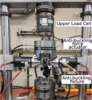
The inability to predict the mechanical behavior of new automotive alloys during forming has generated strong demand in industry for more advanced material models and test methods necessary to calibrate them. Industry is particularly interested in modeling the behavior of advanced sheet metals

NIST Combinatorial Methods Center (NCMC)

Completed
Established in 2002, the NCMC combines pioneering research and customer engagement to foster wide-spread adaptation of combinatorial and high-throughput methodologies. NCMC research addresses key challenges faced by polymer researchers who want to employ combi. In particular, the NCMC creates new

Particles, Tubes, and Colloids

Ongoing
Description A highlight of the PTC project is our success in purification of well-defined SWCNT populations using liquid phase separation methods. Although we use multiple techniques and methods, ion exchange chromatography, rate-zonal and isopycnic ultracentrifugation, size exclusion chromatography
Was this page helpful?