Official websites use .gov
A .gov website belongs to an official government organization in the United States.

Secure .gov websites use HTTPS
A lock (
) or https:// means you’ve safely connected to the .gov website. Share sensitive information only on official, secure websites.


CHRNS: LIPSS - Liquid Insertion Pressure System for SANS
Operations
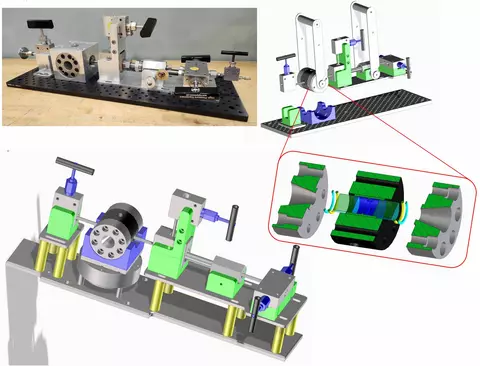
LIPSS is a system designed for in situ studies of biomolecule solutions under high-pressure. It enables SANS data collection on liquid samples - biological macromolecules or others - at pressures up to 350 MPa, with simultaneous temperature control within the range -20 < T(°C) < +65 (further details and instructions can be found on the LIPSS sample environment webpage). Ongoing developments at the NCNR include a new insertion base (see schematics) and improved cooling capabilities.
Improvements
LIPSS can now be inserted in the sample chamber of the NCNR suite of instruments, where subfreezing temperatures can be used in a controlled atmosphere to prevent condensation of water on the outer surfaces, using a single-point connection. The plug-and-play design decreases dead time and improves reliability by minimizing the number of steps required for sample changes at the SANS instrument. In addition to assisting with alignment, the new base includes a plug-and-play port for installing and removing a McHugh cell within the sample chamber, while keeping the outer pressurizing system isolated and primed for the next measurements. In addition, a new temperature control system was added to assist the Peltier system with driving and controlling the sample temperature under pressure.
This update addresses a growing need for higher cooling capacity at subzero temperatures, impacting, for example, studies for cold-chain effects on biopharmaceuticals [1-2] or food nutraceuticals. In combination with improved software support, the latest improvements make LIPSS more efficient in using neutron beamtime and easier to use, thereby broadening its scope of applications.
[1] D. Gomes, S. Teixeira, J. Leão, J. B., Razinkov, V. I., Qi, W., Rodrigues, M. A., & Roberts, C. J. (2021). In Situ Monitoring of Protein Unfolding/Structural States under Cold High-Pressure Stress. Molecular Pharm. 18(12), 4415-4427.
[2] J. Berger, S. Teixeira, K. Reed, V. Razinkov, C. Sloey, W. Qi, C. Roberts (2022). High-Pressure, Low-Temperature Induced Unfolding and Aggregation of Monoclonal Antibodies: Role of the Fc and Fab Fragments. J. Phys. Chem. B 126(24), 4431-4441. doi: 10.1021/acs.jpcb.1c10528