Official websites use .gov
A .gov website belongs to an official government organization in the United States.

Secure .gov websites use HTTPS
A lock (
) or https:// means you’ve safely connected to the .gov website. Share sensitive information only on official, secure websites.


CHRNS: Cryogenic Goniometer
Studying the structure, dynamics, and electronic/magnetic properties of single crystals and thin films often requires a combination of low or ultra-low temperatures and magnetic fields, along with simultaneous control of the crystal orientation with respect to the neutron beam and the instrument detector system. The control of crystal orientation is mostly performed outside the sample environment required to achieve the temperature and field, and the crystal is held with a fixed vertical axis, with sample rotations in the horizontal plane only possible by rotating the entire cryostat. On the occasion that the crystal orientation is not perfect and the desired scattering plane is not accurately oriented, the sample would need to be removed, realigned, and replaced in the cryostat, which results in wasting significant neutron time in re-preparing the system and limiting the range of reciprocal space available to an experimenter at a given time resulting in constraining the scientist’s response to the experiment in progress. To enable unprecedented experimental flexibility and maximize efficiency, we have developed a system that uses a sample goniometer within the sample environments, allowing on-the-fly realignment of the sample while maintaining the experimental temperature and magnetic field conditions.
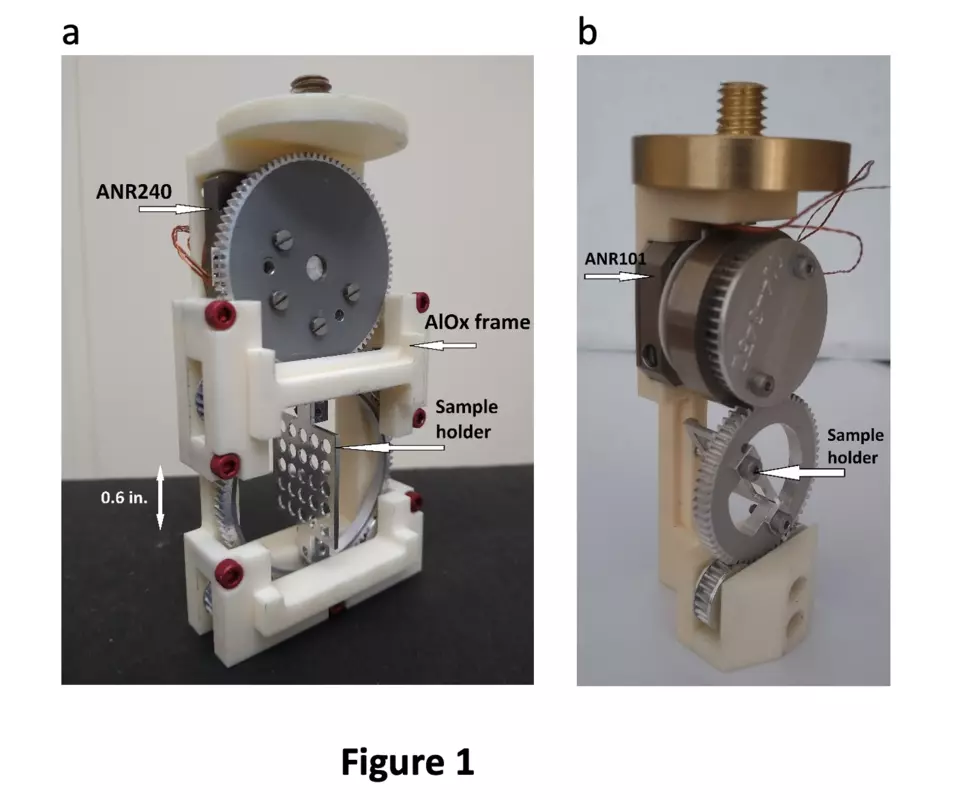
The prototype design of the low-temperature goniometer (Figure 1(a)) can operate at temperatures as low as 10 mK and in external magnetic fields up to 20 T, with a horizontal rotation axis. It has been successfully used for several low-temperature magnetic neutron experiments, but only in the largest cryostat at the NCNR. With experience using the device, we improved several aspects to enhance the application and usability. These upgrades include:
- Reducing the size of the goniometer (Figure 1(b)) to fit in most cryogenic equipment, including:
- 50 mm helium dilution refrigerator inserts,
- 10 T and 11 T cryo-magnets
- All other helium cryostats
- Top loading CCR for the 7 T cryo-magnet
- Moving the rotation axis of the new goniometer to a different orientation in the horizontal plane, which extends experimental capabilities
- Improving the sample thermalization.
Low-temperature testing indicated a large temperature difference between the sample and the cryostat cold plate. The cold plate temperature must match the sample temperature across the entire experimental temperature range. The goniometers were placed inside a vacuum can with the aluminum walls (Figure 2 (a,b)) sealed in a helium atmosphere to provide sample thermalization. Further testing demonstrates excellent agreement between sample and cryostat cold plate temperatures within a wide temperature range (Figure 2(c)).
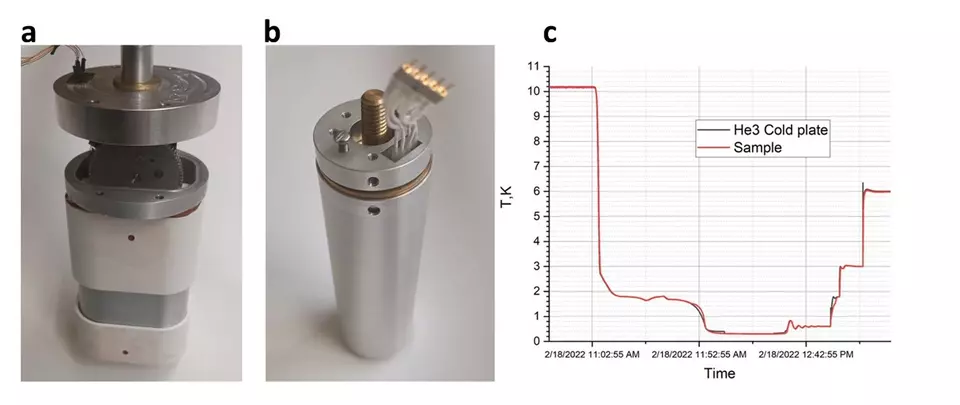
Figure 2
Also, we introduced low temperature sample rotator to provide rotation over vertical axis (Figure 3).
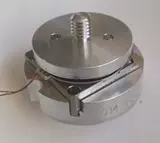
Figure 3
This device has several significant advantages over existing cryostats and sample stick vertical rotators. It has higher precision, can be easily attached and operated with any available low-temperature sample sticks and inserts, and provides more efficient sample shielding that can be designed based on neutron instrument requirements.
Another low-temperature device is a small-angle cryogenic goniometer, capable of performing horizontal-plane sample alignment inside a cryostat (Figure 4). The goniometer needs to be placed inside the neutron shielding and attached to the cryostat cold plate (sample position). A goniometer performs ± 3 Degrees tilt around perpendicular axes in the horizontal plane.
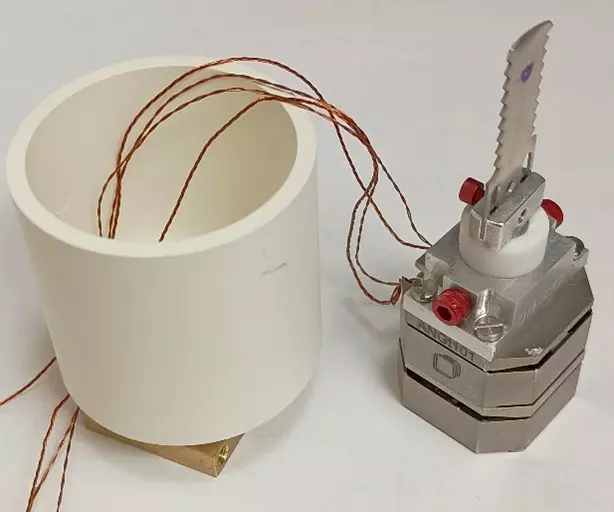
Figure 4
We implemented communications of goniometers and rotators with the instrument control software (NICE) for CHRNS-MACS to allow a seamless integration into an experimental protocol for our low temperature devices. Example of Cryogenic Goniometer Control Program represented on (Figure 5).
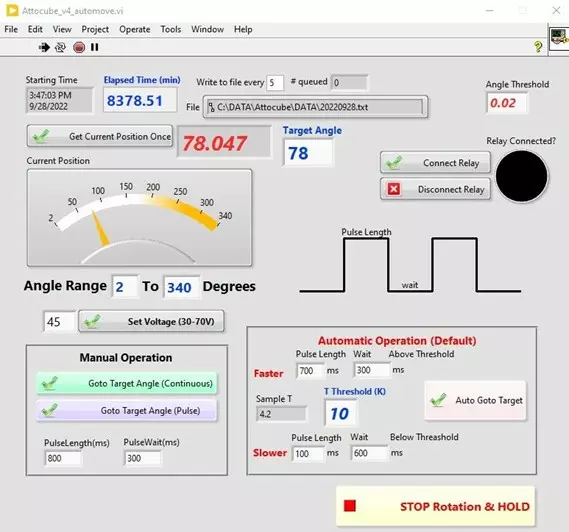
Figure 5
The new sample goniometers allow for easy adjustment of sample tilt and scattering plane switch for single crystal samples, enabling quick access to a large range of momentum-space for the study of quantum magnetism, superconductivity, and other frontiers of condensed matter physics with neutron scattering.