

Official websites use .gov
A .gov website belongs to an official government organization in the United States.

Secure .gov websites use HTTPS
A lock (
) or https:// means you’ve safely connected to the .gov website. Share sensitive information only on official, secure websites.


NG4 DCS

Instrument Purpose
To provide a highly versatile neutron spectrometer for measuring structural and magnetic dynamics across an expansive range of energy and momentum transfers.
The NCNR Advantage
- Extreme Flexibility: The DCS features seven high-speed disk choppers with multiple slot widths, allowing users to adjust the instrument's energy window and resolution to their specific scientific needs without changing the physical setup.
- Cleanest Signal: The pre-sample guide, graphite filter, and chopper system remove contaminant radiation, resulting in an exceptionally low background and high signal-to-noise ratio. The detector chamber is filled with argon gas to minimize air scattering, ensuring peak data quality for weak inelastic signals.
- Broadest Wavelength Range: Useful monochromatic incident neutron wavelengths can be adjusted from 1.8 Å to 12 Å (25 meV to 0.5 meV), making DCS effective for high-energy inelastic and low-energy quasielastic studies.
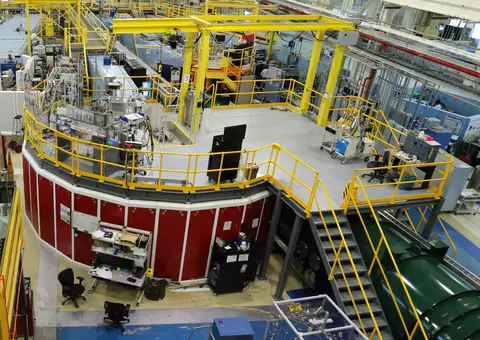
Credit:
Y. Qiu (NCNR)
Research Domains
- Energy Materials: Mapping hydrogen diffusion in fuel cell membranes and ion transport in solid-state battery electrolytes.
- Soft Matter & Biology: Probing the "water of hydration" dynamics around proteins and the segmental motion of polymers.
- Quantum Magnetism: Identifying magnetic excitations, crystal field levels, and spin-wave dispersions in frustrated magnets.
- Confined Liquids: Investigating the behavior of water and organic molecules within nanoporous materials like zeolites and MOFs.
What You Can Measure
- Quasielastic Neutron Scattering (QENS): Quantifying translational and rotational diffusion on the picosecond to nanosecond scale.
- Inelastic Scattering: Measuring vibrational densities of states and discrete molecular excitations.
- Magnetic Excitations: Mapping (Q, ω) to reveal the underlying Hamiltonian of quantum systems.
Technical Specifications
| Parameter | Specification |
|---|---|
| Source Type | Cold Neutrons (NG4 Guide) |
| Incident Wavelength (λi) | 1.8 Å to 12 Å |
| Energy Resolution (ΔE) | 10 μeV to > 500 μeV (Configurable) |
| Chopper Speed | 20,000 RPM |
| Detector Array | 913 high-pressure 3He detectors in 3 banks |
| Scattering Angle (2θ) | -30° to +140° (Continuous coverage) |
Specialized Sample Environments
- Cryogenic Access: Standard compatibility with dilution refrigerators (< 50 mK) and 3He inserts (300 mK).
- High-Magnetic Fields: Supporting superconducting vertical field split-coil magnets up to 12 T.
- Gas Adsorption: Specialized in-situ gas-loading systems for measuring materials under controlled hydrogen or CO2 pressure.
- High Pressure: Supporting piston cylinder clamp and helium pressure cells to pressures of 2 GPa.
- High Temperature: Supporting furnaces up to 700 oC (air) and 1600 oC (vacuum).
Expertise & Support
- The DCS Science Team: Our staff includes world experts in time-of-flight spectroscopy who provide hands-on assistance with experimental planning and data interpretation.
- Software & Analysis:
- DAVE: Direct support for the NIST-developed DAVE software for data reduction, S(Q, ω) mapping, and fitting.
- Experiment Planning: Access to a custom calculator to help you choose the optimal wavelength and resolution setting for your experiment.
Access & Resources
Live Data
Submit a Proposal
Instrument Contacts
guangyong.xu [at] nist.gov (guangyong[dot]xu[at]nist[dot]gov)
(301) 975-4144
wei.zhou [at] nist.gov (wei[dot]zhou[at]nist[dot]gov)
(301) 975-8169
Created July 2, 2026, Updated August 27, 2026