Official websites use .gov
A .gov website belongs to an official government organization in the United States.

Secure .gov websites use HTTPS
A lock (
) or https:// means you’ve safely connected to the .gov website. Share sensitive information only on official, secure websites.


History
History & Milestones
The NIST Center for Neutron Research (NCNR) traces its origins to the late 1950s, when the decision was made to build a specialized research reactor to advance the measurement science and industrial standards mission of the National Bureau of Standards (now NIST). Since the National Bureau of Standards Reactor (NBSR) first achieved continuous operation in 1969, the NCNR has evolved into one of the world’s premier neutron science facilities, serving more than 3,000 researchers from academia, government, and industry annually. As a national user facility, the NCNR provides state-of-the-art, non-destructive, neutron measurement techniques to researchers studying the structure and dynamics of materials, which include life-saving pharmaceuticals, next-generation fuel cells, high-tech alloys, and quantum materials. These techniques yield unique and essential insights that are often impossible to obtain through other methods. By bridging the gap between fundamental research and practical application, the NCNR plays a critical role in fostering U.S. innovation, supporting the development of over 1,200 patents, and sustaining U.S. global industrial competitiveness.
The timeline and historical documents below detail the milestones of this journey, from the early design and construction of the NBSR to the expansion of the NCNR's world-class cold neutron capabilities and its ongoing impact on the American scientific landscape.
Timeline
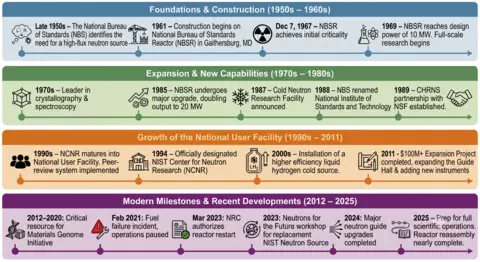
Foundations & Construction (1950s – 1960s)
- Late 1950s: The National Bureau of Standards (NBS) identifies the need for a high-flux neutron source to support its mission in measurement science and the burgeoning nuclear industry.
- 1961: Construction begins on the National Bureau of Standards Test Reactor (NBSR) at the new NBS campus in Gaithersburg, Maryland.
- 1967: The NBSR achieves initial criticality on December 7, 1967, marking the start of its nuclear operations.
- 1969: The reactor reaches its design power of 10 Megawatts (MW), beginning full-scale research operations for thermal neutron scattering.
Expansion & New Capabilities (1970s – 1980s)
- 1970s: The facility becomes a leader in crystallography and chemical spectroscopy, supporting early industrial collaborations in metallurgy and polymers.
- 1985: The NBSR undergoes a major power upgrade, doubling its thermal output from 10 MW to 20 MW. This significantly increases the neutron flux available for experiments.
- 1987: The formal establishment of the Cold Neutron Research Facility (CNRF) is announced. This begins the NCNR's expansion into research with "cold" neutrons (slower neutrons cooled to liquid-hydrogen temperatures), which are needed to study larger-scale structures such as polymers and molecules.
- 1988: The NBS is renamed the National Institute of Standards and Technology (NIST). This further clarifies the facility's role in supporting U.S. industrial competitiveness.
- 1989: The Center for High Resolution Neutron Scattering (CHRNS), a partnership with the National Science Foundation (NSF) is created.
Growth of the National User Facility (1990s – 2011)
- 1990s: The NCNR matures into a true National User Facility by implementing a formal merit-based, peer-reviewed proposal system that opens access to thousands of researchers from across the globe.
- 1994: The NBSR facility is officially designated the NIST Center for Neutron Research (NCNR) to reflect its expanding role beyond the reactor itself.
- 2000s: A higher-efficiency liquid-neutron cold source is installed to boost the flux of cold neutrons.
- 2011: A major $100M+ Expansion Project is completed. This adds a second guide hall, five new world-class instruments, and expanded laboratory space to meet growing scientific demand.
Modern Milestones & Recent Developments (2012 – Present)
- 2012–2020: The NCNR becomes a critical resource for the Materials Genome Initiative, providing data to accelerate the discovery of new batteries, carbon-capture materials, and biological drugs.
- 2021: The facility experiences a fuel failure incident during a routine startup on February 3, 2021. Operations are paused to implement comprehensive safety and engineering upgrades.
- 2022: The NRC issues a Confirmatory Order as a formal result of an Alternate Dispute Resolution (ADR) process.
- 2023: The NRC authorizes the reactor restart on March 9, 2023.
- 2023: The "Neutrons for the Future" workshop gathers over 200 participants to plan for a replacement NIST Neutron Source (NNS).
- 2024: Major upgrades to the NCNR neutron guides NG5, NG6, and NG7 are completed within the confinement building during the ongoing outage.
- 2025: Preparation for full scientific operations continues with reactor reassembly nearly complete.
- 2026: Full-power operations resume, and transition to scientific operations begins.
Historical Documents & Resources
- NIST Special Publication 1120: The NIST Center for Neutron Research: Over 40 Years Serving NIST/NBS and the Nation – A comprehensive historical account authored by J.J. Rush and R.L. Cappelletti detailing the facility’s design, growth, and scientific impact.
- NCNR Economic Impact Study (NIST GCR 25-060): Assessment of the Retrospective and Prospective Economic Impacts of Investments in U.S. Neutron Research Sources and Facilities from 1960 to 2030 – A 2024 report by RTI International quantifying the significant economic returns and industrial benefits generated by NCNR research.
- National Academies Assessment Reports: Access to independent, expert reviews dating back to 1959 (with the latest FY 2023 report) that evaluate the scientific quality and effectiveness of NCNR programs.
- The Cold Neutron Research Facility (CNRF) Founding Document (NIST IR 4527): The 1991 publication outlining the establishment of the United States’ first internationally competitive cold neutron source and its early instrumentation.
- NCNR Seminar Archives: A digital record of scientific seminars and presentations dating back to 2001, reflecting the evolving research culture and technical discourse at the center.
- NCNR Annual Reports (Accomplishments and Opportunities): A collection of annual highlights showcasing breakthroughs in materials science, biology, and chemistry performed at the facility