

Official websites use .gov
A .gov website belongs to an official government organization in the United States.

Secure .gov websites use HTTPS
A lock (
) or https:// means you’ve safely connected to the .gov website. Share sensitive information only on official, secure websites.


SUPERCONDUCTING MAGNET SYSTEMS
| System Name | 7T dry VF | 7T wet VF | 9T wet HF | 10T dry VF | 11T wet VF | 12T dry VF | 15T wet VF |
|---|---|---|---|---|---|---|---|
| Inductance (H) | 6.0 | 35.2 | 32.0 | 34.4 | 24.0 | 200.5 | |
| Persistence switch I(mA) | N/A | N/A | 18 | N/A | 64 | N/A | 65.2 |
| Non-Lambda Field (T) | 7 (27.429 A/T, 192 A) | 7 (12.850 A/T, 90 A) | 9 (13.211 A/T, 118.9 A) | 10 (11.078 A/T, 110.8 A) | 9 (9.827 A/T, 88.4 A) | 12 (12.92A/T,155A) | 10 (7.682 A/T, 76.8 A) |
| Lamba Field (T) | N/A | N/A | N/A | N/A | 11 (108.1 A) | N/A | 14 (107.55 A) |
| Temperature Range (K) | 0.3-750 | 0.3 - 300 | 2.0 - 300 | 0.05-300 | 0.05 - 10 | 0.04-300 | 0.05 - 300 |
| Max Sample Diameter (mm) | 71 | 28.5 | 48 with 1K stick, 33 with dil fridge insert | 25, 50(bottom load) | 15, 10 (dilution insert) | ||
| Horiz. Angular Access (degrees) | 340 | N/A | 315 | 350 | 335 | ||
| Split (mm) | 35 | 26 | 43, (94 bore diameter) | 37 | 35 | 35 | 20 |
| Taper (degrees) | 0 | Opening Angle Bore: +/- 5° Split: +/- 3° | 0 | 0 | +/- 2° | ||
| Available Instruments (max fields) | BT1(), BT7(), MACS(),DCS(7), SPINS() | BT1(7), BT7(7), SPINS(7), Reflectometers(7) | NG3(9), NG7(9), BT5(TBD) | BT1(2.75), BT7(10), MACS([email protected],[email protected]),DCS(10), SPINS(10) | BT7(11.5), DCS(11.5), SPINS(11.5), MACS | BT1(), BT7(), MACS(),DCS(12), SPINS() | BT7(15) |
General Info:
Magnet Design:
Our superconducting magnets (SCMag) are designed specifically for neutron scattering. The magnet geometry and cryostat design allow maximum neutron beam access. Samples are housed in a variable temperature insert that is thermally isolated from the magnet, allowing the researcher to examine temperature and magnetic field dependent effects. Presently, all of our systems are cooled with liquid helium. The magnet normally operates at 4.2 Kelvin, but if alambda
option is available, additional cooling to ~2.2 K is possible.Superconducting Magnet Materials:
Conventional low temperature alloy ( e.g. NbTi) in the form of filaments embedded in an ohmic conductor and wound into a solenoidMaximum Fields:
The 15 Tesla magnet is currently our highest field system, but is restricted to use on BT7 only at this time. Our 11.5 Tesla dilution fridge allows high field coupled with ultralow temperatures at many instruments, while the 10 Tesla magnet allows very good temperature control over a larger range, and is also compatible with a wide range of instruments. The 9T is our highest field and only horizontal field system.Quenching:
The SCMag may undergo an abrupt transition from the superconducting to the resistive state. Sometimes the cause is clear ( e.g. exceeding the maximum rated field, ramping the current too rapidly) and sometimes not. The most obvious sign of a quench is a surge of exhaust from the helium bath. This may be loud and alarming, but all of our SCMag systems are designed to handle a quench safely.Persistent Switching:
Once the SCMag is energized and operating at steady state, the external current source is no longer needed and may be effectively removed from the circuit by means of a persistent switch, however not all magnets are equipped with a persistence switch. 9T, 11.5T and 15T are the ones with persistence switches.Persistent Switch (PS) Schematic
The PS is comprised of a resistive heater in thermal contact with a segment of superconducting wire that is connected in parallel with the magnet solenoid (M). When the heater is energized with a small current (~ 50mA), the wire segment becomes resistive and a voltage may be applied across M, allowing it to be energized/de-energized. When the persistent switch heater is turned off, the wire segment goes into the superconducting state and shorts the magnet. The external current source may then berun down
while the superconducting current in the magnet persists.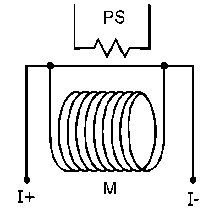
Symmetric and Asymmetric Modes:
Most experiments will use a symmetric field configuration, but a polarized neutron beam experiment will require an asymmetric field to prevent beam depolarization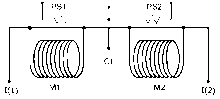
Sample Mounting:
When using the single crystal samples in high magnetic fields, please be aware that sample's holder needs to be mechanically strong enough that the sample won't bend the holder at high magnetic fields. At high B fields, the magnetic force exerted on the sample is so strong that the sample holder can be bent to a certain degree that you cannot see bragg peaks anymore due to misalignment.
Sample mounting information for superconducting magnets and all other sample environment equipment can be found here .
Contacts
-
(301) 975-5295