U.S. flag

An official website of the United States government

Official websites use .gov
A .gov website belongs to an official government organization in the United States.

Secure .gov websites use HTTPS
A lock ( ) or https:// means you’ve safely connected to the .gov website. Share sensitive information only on official, secure websites.

Projects/Programs

Displaying 76 - 100 of 113

NIST Food Protein Allergen Program

Ongoing
Food allergen management is an increasingly important economic and public health concern; therefore, accurate and reliable allergen measurements are a crucial component of the management pathway. Traditional methods for food allergen detection are based on immunoassay techniques and are linked to a...

NIST Food Safety Program

Ongoing
The Food Safety Program at the National Institute of Standards and Technology (NIST) provides advanced analytical chemistry and quantitative biology to ensure that food is free of contaminants and allergens and is authentic, promoting U.S. manufacturers’ participation in domestic and foreign markets...

NIST Ocean Carbon Measurements

Ongoing
NIST is committed to sustaining the quality of ocean carbon measurements by developing capabilities to provide certified reference materials for the ocean carbonate system measurements and by conducting research to understand fundamental elements of the ocean carbon thermodynamic system. NIST Ocean...

NIST U.S. Pacific Islands Program

Completed
To help address environmental research and resource management in the Pacific Islands region, the 111th U.S. Congress directed NIST to "expand its capabilities and resources into the Pacific region through a Pacific Islands component of NIST" and included funding to "expand its biodiversity storage...

NIST PS1 Primary Standard for quantitative NMR (Benzoic Acid)

Completed
With explicit SI linkage, the overall impact of this apical reference material is profound—this primary standard, as well as forthcoming members of its class, provides technology transfer of chemical purity realization to the commercial sector for characterization of many thousands of organic...

The NIST Standard Reference Photometer for Ozone Measurement Traceability

Ongoing
The concentration of ozone in the atmosphere continues to be an important global issue both scientifically and politically. Stratospheric ozone protects the Earth from harmful UV radiation, while tropospheric ozoneis a major health concern and contributes to global climate change as a greenhouse gas...

NIST Tools for Cannabis Laboratory Quality Assurance

Ongoing
Since the 1970s, cannabis (marijuana and hemp) and its constituent, Δ 9-tetrahydrocannabinol or THC, have been classified as Schedule I controlled substances. Seized evidence is tested by forensic laboratories, which verify the identity of the plant through macro- and microscopic evaluation and the...

NIST Traceable Reference Material Program for Gas Standards

Ongoing
The Gas Mixture SRM, NTRM, and EPA Protocol Programs provide a mechanism to produce needed calibration gas standards with a well-defined traceability. These mixtures are specified in the Code of Federal Regulations (CFR) to calibrate instruments to be used to monitor regulated emissions. The NTRM...

Novel Psychoactive Substance (NPS) Data Hub

Ongoing
A growing portion of forensic drug laboratory’s workload is the identification of novel psychoactive substances (NPSs), or emerging synthetic drugs (ESDs), presented as exhibit materials after seizure events. A pressing need exists for the rapid characterization of both the active ingredient(s) and...

Organic Compounds in Human Serum, Milk, and Urine

Ongoing
Standard Reference Materials (SRMs) have been specifically designed to assist in the quality assurance measurements for compounds found in human fluids. Clinical and biomonitoring laboratories rely on these SRMs for method validation and as control materials during specific analyses. Various human...

Pacific Marine Mammal Health Assessments (PMMHA)

Completed
Pacific Marine Mammal Health Assessments (PMMHA), which began in Fall 2010, are an expansion of NIST marine mammal health assessment collaborations that began in 2002 with bottlenose dolphin wild populations. NIST has a history of involvement in marine mammal health assessment related work...

Per- and Polyfluoroalkyl Substances (PFAS)

Ongoing
Perfluorinated and polyfluorinated alkyl substances (PFAS) constitute a family of compounds that are distinguished by partial or complete fluorination of alkyl hydrocarbons. Dubbed “forever chemicals”, the unique chemistry of PFAS imparts a high level of stability, making the compounds resistant to...

Plasma Process Metrology

Ongoing
Intended Impact The model for rf bias effects that we have developed should make it easier for industry to select optimal operating frequencies and may stimulate the adoption of new methods for RF biasing, such as multiple-frequency bias and non-sinusoidal bias. NIST studies of electrical endpoint...

Potential Primary Measurement Tool for the Quantification of DNA

Ongoing
The biotechnology industry relies primarily on absorbance and fluorescence methodologies to assess DNA mass. However, these measurements can be seriously compromised by impurities in the DNA preparations or state of the DNA itself. These techniques are also not traceable to the SI because the...

Real Fuels

Ongoing
The variability of the price of oil, the need for energy efficiency and pollution minimization has led to increasing interest in alternative fuels. These fuels are structurally and compositionally different than the conventional fuels presently used.  Past work on conventional fuels have established...

Reference Material Production and Support

Ongoing
Bulk Cryogenic Production Large-batch cryogenic reference materials are produced using a specialized Palla VM-KT Vibrating Cryomill. The mill is pre-cooled to cryogenic temperatures using liquid nitrogen. Frozen material is fed through the inlet funnel to a vibrating chamber containing 26 titanium...

Sample Tracking and Analytical Reporting (STAR)

Ongoing
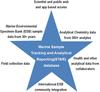
STAR (formerly known as Marine STAR) will develop a web-based interface to provide easy access to sample information from the NIST Biorepository. Information will include, but is not limited to, sample availability, chemical analysis status and results, and links to publications. Metadata associated...

Seabird Tissue Archival and Monitoring Project (STAMP)

Ongoing
Seabirds are an important group of upper trophic-level marine organisms with potential for accumulating lipophilic chemical contaminants which have been linked to adverse health effects. Analyses of seabird tissues, particularly eggs, have played important roles in temporal and spatial ecosystem...

Standard Reference Materials for Hexavalent Chromium in Contaminated Soil

Completed
During the last century, chromate and dichromate chemical production facilities processed considerable amounts of chromite ore for industrial manufacturing purposes. The waste material from these operations called chromite ore processing residue (COPR) was disposed of in waste sites across the...
Was this page helpful?