

Official websites use .gov
A .gov website belongs to an official government organization in the United States.

Secure .gov websites use HTTPS
A lock (
) or https:// means you’ve safely connected to the .gov website. Share sensitive information only on official, secure websites.


Metrology for Accelerated Laboratory Weathering
Summary
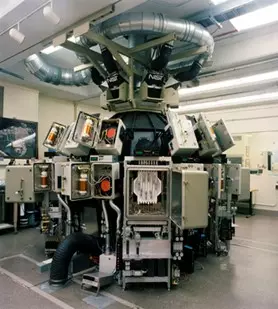
The NIST Accelerated Weathering Laboratory provides researchers with well-quantified accelerated-aging environments, using a unique SPHERE (Simulated Photodegradation via High Energy Radiant Exposure) technology. The 2m SPHERE and the recently developed 6-port SPHEREs enable NIST to develop advanced metrology and methodology for accelerated laboratory weathering and service life prediction for engineered infrastructural materials, including composites for structural support, coatings for corrosion protection of structural elements, roofing, siding and sealants for the building envelopes. This project will investigate the effects of spectral power distribution, high UV irradiance, cycles of temperature, moisture and light exposure on long-term performance of engineered polymeric materials for the development of new standards for metal halide-based accelerated laboratory weathering devices and service life prediction procedures. The material degradation databases generated from this work will provide a better understanding on degradation mechanisms and failure modes of infrastructure materials, which is essential for industry to improve choices of materials and develop new materials for resilient infrastructure under chronic environmental hazards and natural disasters.
Description
Objective
To develop and implement measurement science using the NIST Accelerated Weathering Laboratory technology for conducting accurate and traceable aging experiments and service life prediction of resilient infrastructure materials.
Technical Idea
The integrating sphere-based technology used in NIST weathering devices, SPHERE (Simulated Photodegradation via High Energy Radiant Exposure), provides the highest uniformity and intensity of UV irradiation, and the electrode-less microwave-energized mercury arc (Metal Halide) lamp offers more stability. In the NIST Accelerated Weathering Laboratory (AWL), SPHERE provides researchers with well-quantified accelerated-aging environments with precise temperature and relative humidity control [4]. Some NIST environmental chambers also offer mechanical stress in tension or compression. Since the early 2000s, NIST researchers and industrial collaborators have demonstrated the capabilities of 2m SPHERE. These capabilities enable accurate reciprocity law studies and provide key degradation, accelerated weathering parameters such as activation energy, wavelength effects, and humidity effects for reliability-based service life prediction (SLP) modeling. Many case studies have shown we can predict outdoor performance using 2m SPHERE exposure data [5,6]. However, 2m SPHERE is a unique and great research facility, which is not accessible to many non-NIST researchers. Due to economic reasons, it is not practical to do tech transfer for 2m SPHERE. To meet the needs of researchers using the NIST AWL (both NIST staff and external collaborators), a focus is placed on (1) development of a commercially viable version of NIST SPHERE - the 0.5 m (6-port) SPHERE, (2) development of metrology to validate the 0.5 m (6-port) SPHERE performance for reliable accelerated weathering, including the accurate measurements of spectral UV irradiance, specimen temperature and moisture, and (3) development of protocols for service life prediction of infrastructure materials based on SPHERE technology, including a systematic study on effects of spectral power distribution, high UV irradiance, cycles of temperature, moisture and light exposure on long-term performance of engineered polymeric materials. Currently, the design and construction of the prototype 6-port SPHERE (~4x higher UV intensity than that of 2m) with 6-environmental chambers (designed and built in NIST) are completed, are under validation using model infrastructure materials. To help commercialize NIST-SPHERE-based technology, NIST transferred the design of the 6-port sphere–lamp system to Labsphere Company, and the design of six environmental chambers design to contracted vendor to build the 2nd 6-port SPHERE, which is currently in preliminary operation conditions. With success in installing, operating and validating the commercially viable 6-port SPHERE, NIST can demonstrate the possibility of a turn-key 6-port SPHERE by working with Labsphere and the chamber contract vendor. Additionally, an extensive SPHERE irradiance calibration using a commercial spectral radiometer system will be completed to maintain accurate irradiance values for any weathering device and provide a commercial irradiance measurement system. This project aims to advance the metrology for reliable accelerated laboratory weathering, facilitate the transfer of NIST SPHERE technology, enable service life prediction model validation, and promote advances in standards and codes for service life prediction of infrastructure materials under chronic environmental hazards and natural disasters.
Research Plan
In FY26, this project will aim to achieve the full operation of two NIST-traceable weathering devices (the 6-Port SPHERE system), to continuously develop metrologies to improve the accuracy of accelerated aging, and to develop metal halide lamp-based standard test methods for our stakeholders. The possibilities of retirement of 2m SPHERE will be evaluated by engaging industrial partners and fully validating the 6-Port SPHEREs as a reliable accelerated weathering device that can replicate material outdoor performance. The research plan consists of the following tasks:
- Achieve full operation of two 6-port SPHEREs, tasks include (1) completing testing and evaluating the capabilities of the environmental chambers (operation limit of temperature/relative humidity); (2) continuing to characterize the performance of 6-port SPHERE, including the effect of lower UV wavelength (< 290 nm) on the reciprocity law, and repeatability of exposure experiments. The materials selection will also include (not limited to) PET (polyethylene Terephthalate) films for window-protection, high-density PE (polyethylene) with UV stabilizing components, asphalt shingles, commercial products (post-consumer PET and HDPE plastic films), and multi-layer photovoltaic back sheet systems. Compare data with known uncertainties at various UV dosesand UV exposure conditions from 6-Port, 2m SPHERE, outdoor, and other weathering tests to demonstrate that the UV exposure results from 6-Port are reliable, repeatable, and can be used for service life prediction (SLP) with a shorter accelerating period.
- Establish a UV-vis Spectra Irradiance Measurement System for measuring the irradiance and health monitoring of the SPHERE devices. The new spectroradiometer (CAS140D-157U2B) has been configured and incorporates the existing SPHERE irradiance monitoring API (application programming interface) for the irradiance measurement. In FY2026, the primary tasks include (1) continuing to improve the SPHERE irradiance calibration process for route and manual acquisition, and (2) providing an easy-access web-based database for SPHERE researchers to obtain spatial irradiance of 6-port SPHERE. A health-monitoring program will also be installed on the two 6-port SPHEREs to check the operation safely.
- Engage industry partners to advance and transfer measurement science to stakeholders in an effective and timely manner. FY2026 encouragement will include working with scientific peers (academia, consultants, workshop/conference attendees), industrial peers (ex. former consortium members, testing labs), standards organizations (ASTM G03, D20, D01 members), end users (specifiers-architects, building engineers, inspectors) to generate awareness and demand for the NIST SPHERE scientific products. Working with stakeholders to follow up on the 2025 Service Life Prediction (SLP) symposium to possibly host a 2026 or 2027 SLP conference to showcase and recruit early adopters of the new 6-port SPHERE.
- Continue to improve the understanding of sample temperature under high-intensity UV radiation. Real sample surface temperature measurements of various sample geometries/sample holders will be conducted using thermal couples (at different locations on the sample holder) at different UV intensities and chamber-controlled conditions (T &RH). Results will be compared to chamber-controlled temperatures, and proper adjustments will be made to reach desired sample temperatures in the Watlow control program.
- Continue to document all 6-Port hardware (SolidWorks) with updated diagrams/drawings, programs, and operations on the NIST-internal backup drive for tech transfer preparation.
References
J.E. Pickett, K.M. White, and C.C. White, “Service Life Prediction: Why is this so hard?”, in C.C. White, K.M. White, and J.E. Pickett (Eds.), Service Life Prediction of Polymers and Plastics Exposed to Outdoor Weathering, Elsevier, 2017.
ASTM D7869-17 Standard Practice for Xenon Arc Exposure Test with Enhanced Light and Water Exposure for Transportation Coatings, ASTM, West Conshohocken, PA.
H. Wu, “Highly Accelerated UV Weathering: When and How to Use it”, in C.C. White, K.M. White, and J.E. Pickett (Eds.), “Service Life Prediction of Polymers and Plastics Exposed to Outdoor Weathering,” Dec 4, 2017. Elsevier, (2017)
J.W. Chin, E. Byrd, N. Embree, J. Martin, J.D. Tate, J. “Ultraviolet Chambers Based on Integrating SPHERES for Use in Artificial Weathering,” Coatings Tech., 2002, 74(929), 39.
X. Gu, X. et al. (2009), “Linking Accelerated Laboratory Test with Outdoor Performance Results for a Model Epoxy Coating System,” In: Martin, J.W., Ryntz, R.A., Chin, J., Dickie, R.A. (eds) Service Life Prediction of Polymeric Materials. Springer, Boston, MA (2009).
J.E. Pickett, O. Kuvshinnikova, L.-P. Sung, B. Ermi, “Accelerated weathering parameters for some aromatic engineering thermoplastics,” Polym. Degrad. Stab. 166 (2019) 135-144.
Major Accomplishments
- The evaluation of operation limit of temperature/relative humidity in the environmental chambers has been completed for the 1st 6-port SPHERE in FY2024 and the 2nd 6-port SPHERE in FY2025. Developed two commercially viable weathering devices using NIST SPHERE technology and prepared for tech transfer to industrial stakeholders.
- The new spectroradiometer (CAS 140D-157U2B, a replacement for the existing CAS140C with higher spectral resolution and reliable irradiance measurement for wavelengths < 290 nm) was delivered in Sept 2024 and has been incorporated into existing versions of the Chamber Calibration and SPHERE Wall Monitoring software applications. Developed an absolute UV-vis Spectra Irradiance Measurement System using a commercial product to measure the SPHERE devices' irradiance and health safety monitoring.
- For the NIST Accelerated Weathering Lab, accomplishments centered around the 2m SPHERE operation improvements and the installations of the small SPHERE devices. For SPHERE maintenance: formalized maintenance schedule for 2m SPHERE consumable components; upgraded to 2m SPHERE strain chambers to independent operation (previously daisy-chained operation); and documented, using CAD drawings, the components of the SPHERE devices and ducting/hardware for the facilities control systems in the laboratories for the 2m SPHERE and smaller SPHERE devices. For small SPHERE installation: completed the ducting for the smaller SPHERE devices; upgraded positioner for irradiance measurements for SPHERE devices using linear encoders for faster and more accurate position location; procured a commercial radiometer instrument, modified specifically for SPHERE high intensity lights; developed a plan for a SLP database to contain SPHERE operation and materials characterization data; and developed a SPHERE operation web-based program. Dow Chemical purchased a strain SPHERE from LabSphere, our partner in creating the SPHERE Devices. For the Accelerated Weathering of Engineering Polymeric Systems project: Measurement science tools, including traceable measurements, database, validated statistical model were completed on a variety of industrially relevant polymeric materials. A database of property changes (damage) vs. UV irradiance and exposure conditions was compiled for the legacy, model epoxy amine system (glassy, cross-linked polymer), polyethylene (thermoplastic polymers, and poly(ethylene terephthalate). Another polyester system was also studied in 2018. Mechanical properties for all polymer systems were used for the initial modeling and validation exercise. The chemical properties were also examined to better explain the progress in degradation.
- For the 6-Port SPHERE Operation task, an experimental plan was executed to define capabilities and standard operating procedure for the commercial (LabSphere) radiometer and compare to NIST radiometer system. Two steps of the plan were completed: a positioner was fabricated for radiometer fiber assembly and software for operation and a standard operating procedure (SOP) was drafted for commercial radiometer. The irradiance SOP will be refined for the EL Budget Milestone. COVID19 has delayed the completion of the report on the irradiance results of commercial versus NIST radiometers as a set of irradiance measurements were scheduled for the end of March. The greater ambient operating temperature (50C versus 30C) of the 6-Port SPHERE was verified with a series of temperature measurements at sample surface and methods to mitigate sample surface temperature in 6-Port SPHERE, potentially via a cooling system or a modified sample holder arrangement has been investigated and will be summarized in a report. Standardized protocols for most laboratory accelerated experiments require 30C temperatures. The installation of one prototype environmental chamber on 6-Port SPHERE was completed. This included the hardware/electrical/electronics and software, the water system for humidity generation, and the safety control system. COVID19 delayed the completion of the operation parameters testing. A report will be completed to document the environmental chamber components and operation. A report describing the experimental plan, including irradiance measurements and well-characterized polymer system (epoxy amine) degradation experimental results, for the benchmarking the operation of 6-Port SPHERE compared to 2m SPHERE was completed. The preparation procedure was modified to successfully prepare the epoxy amine specimens for the exposure experiment. The reciprocity experiment with epoxy amine on 6-Port SPHERE, using 30C, dry conditions and 4 different UV levels and similar conditions on the 2m SPHERE was started. COVID19 has delayed the completion of the experiment.
- For the SPHERE Engagement task, a white paper is in process on the SPHERE device impact to drive NIST research in accelerated aging. The paper will include a review of all weathering standards from a variety of SDOs and committees (ASTM, IEC, IEEE, UL) working with IMG staff and their current standard engagements, identify stakeholders whose applications provide impact on SPHERE device, examine overlap with Resilience Goal including Disaster and Failure programs, and solicit input from 4 defined communities (Scientific, Industrial, Standards Organizations (above already), and End Users). COVID19 has delayed a symposium on Service Life Prediction and other means to solicit input from the four communities. Plans for a survey will be developed for approval to be executed next year.
- For the SPHERE Data Validation task, the results for the performance properties from PE, PET, and the polyester system from the former accelerated weathering of polymers project were compiled into a dataset for model validation. The work will be published in a peer reviewed journal. A real industrial relevant polymer system, a similar PE system with UV absorbers was selected. A design of experiment was drafted to include 2m SPHERE, 6-Port SPHERE (with key UV exposure parameters, time and chamber constraints) and outdoor exposure components to implement experimental design for fast service life prediction. COVID19 has delayed the completion of the data compilation and model validation.