

Official websites use .gov
A .gov website belongs to an official government organization in the United States.

Secure .gov websites use HTTPS
A lock (
) or https:// means you’ve safely connected to the .gov website. Share sensitive information only on official, secure websites.


Acceptance Criteria and Modeling Parameters for Structural Components under Multiple Hazards
Summary
This project addresses the need for modeling and design criteria to evaluate whether buildings can meet their intended performance objectives under various hazard exposure scenarios. As the structural engineering community continues to develop and adopt performance-based design approaches, it becomes increasingly imperative to define criteria that are capable of accurately assessing building performance under multiple hazards, including consideration of both strength and serviceability limits. In the case of wind loading, experimental evaluation of such acceptance criteria for structural components requires new testing protocols to represent the anticipated loading history in extreme windstorm events. While simplified rotation-based acceptance criteria used in current standards are unable to accurately capture the influence of axial forces and varying span length, this project pursues the development of acceptance criteria based on component deformations. This approach shows promise for broader applicability across multiple hazards, including wind, earthquake, and disproportionate collapse. A combination of experimental and analytical methods within this project will support the development of improved acceptance criteria for adoption in performance-based design standards.
Description
Objective
To develop acceptance criteria and modeling parameters of structural components for incorporation in performance-based methodologies and standards/codes for the design of structures subjected to multiple hazards.
Technical Idea
Wind: Engineering design practice is evolving to permit inelasticity under extreme wind loads. In support of this new paradigm, a Prestandard for Performance-Based Wind Design was published in 2019 (ASCE, 2019) with an updated version released in 2023 (ASCE, 2023a). The 2023 Prestandard includes the following requirement related to acceptance criteria for deformation-controlled elements and actions:
For wind loading, the deformation level shall account for multiple cycles of inelastic deformation and the potential for low-cycle fatigue.
However, it does not provide specific guidance for how to achieve this requirement. The Prestandard further acknowledges the need for research and testing on the performance of building elements under long-duration wind loads because “the post-peak strength and stiffness degradation characteristics of structural members during several cycles over a long duration is unknown.”
The Prestandard highlights the need for development of new acceptance criteria for main wind force resisting systems under long-duration cycles of inelastic deformation to support performance-based design for wind. Both along-wind and across-wind loading protocols would require consideration, because along-wind loading results in a sustained mean component along with long-duration cycles, while across-wind loading only results in long-duration cycles. Structural testing of connections and other components in the NIST Performance-based Engineering Research for Multi-hazards (PERforM) Laboratory under wind loading protocols would enable characterization of their hysteretic behavior and rotation/deformation limits. In addition to strength-based considerations, serviceability criteria (e.g., lateral drift) often control structural design for wind, and serviceability criteria required to achieve higher-level performance objectives related to comfort of occupants and integrity of building enclosures may also be explored.
Disproportionate Collapse: The acceptance criteria included in the ASCE/SEI 76-23 Standard for Mitigation of Disproportionate Collapse (ASCE, 2023) are largely based on seismic acceptance criteria from ASCE 41-17, except for a few types of structural components where NIST contributed rotational acceptance criteria based on testing under column removal scenarios by NIST and others. Seismically based acceptance criteria do not account for the important influence of axial deformation demands or system span length on the connections because these criteria were derived from cyclic testing without axial restraint.
Weigand and Main (2016) proposed a new approach in which the axial deformation capacities of component-width segments of connections (termed “sub-components” in the research plan) were used to calculate rotational capacities of the connections. This approach showed promise in providing results that are risk-consistent because it captures the influence of axial deformation demands on the connection, including those resulting from span length. However, experimental validation has only been conducted for single-plate shear connections under column loss (a monotonic loading condition) with a fracture criterion that depends only on cumulative plastic deformation (Weigand, 2016). There is a need to assess whether the approach can be extended to other connection types and to determine an appropriate basis for fracture of connection components subjected to cyclic loads.
Earthquakes: The modeling parameters and acceptance criteria in ASCE/SEI 41-23 Seismic Evaluation and Retrofit of Existing Buildings (ASCE, 2023b) are based on a limited number of fully reversed cyclic tests. Repeated cycles of inelastic deformations lead to failure of connection components via low-cycle fatigue. Current rotation limits do not explicitly account for this effect, leading to component acceptance criteria that depend on the loading protocol. A new paradigm is needed to reestablish the performance-based assessment procedures in ASCE/SEI 41 and other performance-based design standards in a way that explicitly accounts for dependence of a component’s capacity on its deformation history.
By mining the datasets used to formulate the ASCE/SEI 41 acceptance criteria and comparing them to the results of connection tests performed under long-duration cyclic loading protocols suitable for wind design, this project would also allow assessment of the suitability of the approach proposed by Weigand and Main (2016) in determining acceptance criteria for connections in earthquakes.
Research Plan
To achieve the stated objective, the research plan has the following primary tasks:
- Developing new loading protocols: The primary focus of this task will be on development of loading protocols for determination of acceptance criteria and modeling parameters for steel and reinforced concrete connections subjected to extreme winds and column loss scenarios.
- Generating an experimental database of acceptance criteria and modeling parameters: The loading protocols developed in Task 1 will be used to conduct laboratory testing on various steel and reinforced concrete connections to characterize their performance under extreme wind loads and column loss scenarios. The outcome of this task will be a comprehensive database of acceptance criteria and modeling parameters corresponding to different performance objective levels ranging from immediate occupancy to collapse prevention.
- Validating computational models and enhancing the database of acceptance criteria and modeling parameters: The focus of this task is to develop and validate computational models of the tested connections, to provide tools for engineers to assess the system-level performance of structures under extreme winds and disproportionate collapse. Parametric studies using the validated modeling approaches will be conducted to (1) examine the performance of connections with geometries or other design parameters not included in the experimental program and (2) identify critical parameters that influence the acceptance criteria and modeling parameters of the connections.
- Enabling improvements to performance-based design standards for extreme winds and disproportionate collapse: In this task, the NIST team will work closely with standards developing organizations (SDOs) to implement in their respective performance-based design standards the acceptance criteria and modeling parameters corresponding to different performance objectives developed in this project.
The products of this research are needed by designers, builders, and operators of buildings, in addition to SDOs such as ASCE/SEI, ACI, and AISC. Clearly defined performance metrics are essential in determining whether a building can meet its desired performance objectives. The implementation of the products from this research into performance-based design standards will lead to more robust and efficient buildings while upholding public safety requirements through greater risk consistency across multiple hazards. Building designers, officials, and stakeholders also will directly benefit from the clear and comprehensive acceptance criteria that are produced by this research.
The mission of NIST is “to promote U.S. innovation and industrial competitiveness by advancing measurement science, standards, and technology in ways that enhance economic security and improve quality of life”. This research directly supports the mission as it will facilitate improved estimates of building performance in the U.S., enabling beyond-code building design and performance across multiple hazards, thus leading to reduced economic losses associated with building repair and downtime.
References
American Society of Civil Engineers (2019). Prestandard for Performance-Based Wind Design, ASCE, Reston, VA. <https://ascelibrary.org/doi/book/10.1061/9780784482186>
American Society of Civil Engineers (2023a). Prestandard for Performance-Based Wind Design V1.1, ASCE, Reston, VA. <https://ascelibrary.org/doi/book/10.1061/9780784484739>
American Society of Civil Engineers (ASCE) (2017). “Seismic Evaluation and Retrofit of Existing Buildings (ASCE/SEI 41-17),” ASCE, Reston, VA.
American Society of Civil Engineers (ASCE) (2023b). “Seismic Evaluation and Retrofit of Existing Buildings (ASCE/SEI 41-23),” ASCE, Reston, VA.
American Society of Civil Engineers (ASCE) (2023). Standard for Mitigation of Disproportionate Collapse Potential in Buildings and other Structures (ASCE/SEI 41-23),” ASCE, Reston, VA.
NIST. (2017). “Recommended Modeling Parameters and Acceptance Criteria for Nonlinear Analysis in Support of Seismic Evaluation, Retrofit, and Design.” NIST GCR 17-917-45, Gaithersburg, MD, Applied Technology Council.
Weigand, J.M. and Main, J.A. (2016). “Deformation Limits and Rotational Capacities for Connections under Column Loss.” Proceedings of the Eighth International Workshop on Connections in Steel Structures, Boston, MA, May, 2016.
Major Accomplishments
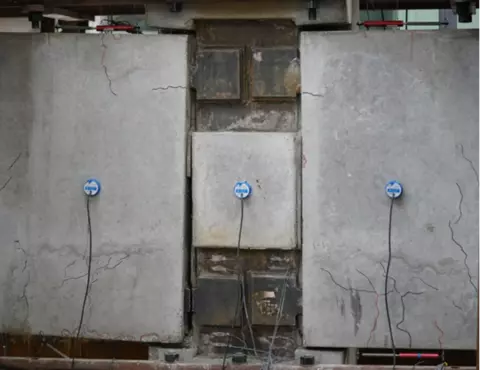
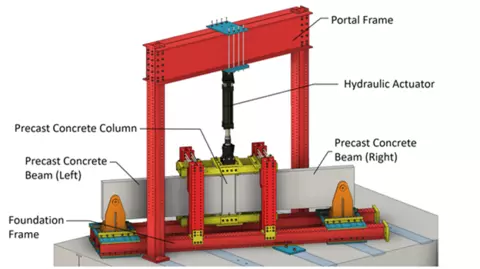
Completed experimental evaluation of five novel precast concrete beam-to-column moment connections designed for enhanced collapse resistance.
- Related publication: Malcolm L. Ammons, Jonathan M. Weigand, Majd Hijazi, and Travis E. Thonstad. (2025). “Experimental evaluation of novel precast concrete beam–to–column moment connections for enhanced collapse resistance.” PCI Journal, 70(4), 52-68. <https://doi.org/10.15554/pcij70.4-01>
First US national standard for disproportionate collapse, ASCE 76-23, published in June 2023 with significant contributions from NIST project staff, including leadership of a chapter on acceptance criteria.
- NIST press release: https://www.nist.gov/news-events/news/2023/06/new-building-standard-paves-way-collapse-resistant-structures
- ASCE/SEI 76-23 standard: https://ascelibrary.org/doi/book/10.1061/9780784415931