

Official websites use .gov
A .gov website belongs to an official government organization in the United States.

Secure .gov websites use HTTPS
A lock (
) or https:// means you’ve safely connected to the .gov website. Share sensitive information only on official, secure websites.


NGA NSE
Instrument Purpose
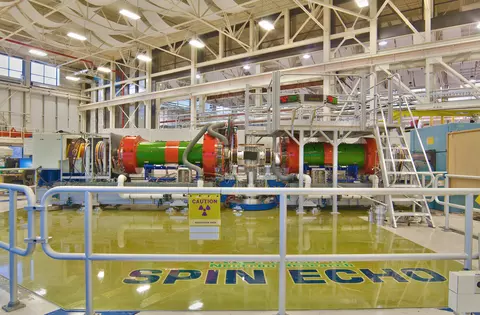
Measures atomic and molecular motions in liquid, glassy, soft matter, and biological systems, as well as slow spin relaxations in quantum magnets, providing dynamic observation across time scales from picoseconds to nearly a microsecond.
Key Capabilities
- Extended Time Resolution: Probes slow dynamics—such as fluctuations of molecular aggregates, protein domain movements, and polymer chain relaxations—that exceed the temporal range of conventional inelastic and quasielastic spectrometers.
- High Dynamic Range: Utilizes the cold neutron flux from the NGA guide to cover a Fourier time range spanning four orders of magnitude (0.003 ns to 400 ns).
- Optimal Phase Homogeneity: Advanced solenoid design and correction coils ensure the phase homogeneity required to resolve small energy changes (down to 10 neV).
Research Domains
- Soft Matter Physics: Investigating diffusion, shape fluctuations in complex fluids, and polymer chain dynamics.
- Biological Systems: Probing large-scale functional fluctuations in proteins and lipid membranes.
- Energy Materials: Measuring ion diffusion in electrolytes and thermal fluctuations in organic photovoltaics.
- Glassy Dynamics: Exploring slow structural relaxations in glass-forming liquids.
- Spin Fluctuations: Observing slow spin fluctuations in quantum magnetic systems.
What You Can Measure
- Monomeric Friction Coefficient: Quantifying the fundamental average drag force at the monomer level in polymer systems.
- Tube Diameter: Measuring the degree of spatial entanglement in polymer melts.
- Effective Viscosity: Extracting nanoscopic mechanical properties in complex fluids and polymer solutions.
- Membrane Mechanics: Probing the bending elasticity and undulation modes of amphiphilic membranes.
- Functional Domain Motions: Observing internal domain movements in proteins in solution.
- Diffusion Coefficients: Tracking relative molecular motion in dense environments.
- Spin Dynamics: Investigating spin glass behaviors, critical spin dynamics, and geometric frustration in quantum materials.
Technical Specifications
| Parameter | Specification |
|---|---|
| Source Type | H2 Cold Neutron Source (NGA Guide) |
| Wavelength Range (λ) | 4.5 Å to 15 Å |
| Scattering Angle Range (θ) | 2.5° to 95° |
| Maximum Field Integral | ≈ 1.2 Tesla-meters |
| Beam Polarization | > 95% |
| Flux at Sample Position | 3.1 × 10⁷ n/cm2/s at λ = 5 Å 2.7 × 10⁷ n/cm2/s at λ = 6 Å 1.3 × 10⁷ n/cm2/s at λ = 8 Å 5.0 × 10⁶ n/cm2/s at λ = 11 Å 1.4 × 10⁶ n/cm2/s at λ = 15 Å |
| Accessible Q-Range | 0.060 Å-1 to ≈ 1.70 Å-1 (λ = 5 Å) 0.050 Å-1 to ≈ 1.40 Å-1 (λ = 6 Å) 0.035 Å-1 to ≈ 1.10 Å-1 (λ = 8 Å) 0.025 Å-1 to ≈ 0.80 Å-1 (λ = 11 Å) 0.020 Å-1 to ≈ 0.60 Å-1 (λ = 15 Å) |
| Fourier Time Range | 3 ps to 25 ns (λ = 5 Å) 5 ps to 50 ns (λ = 6 Å) 10 ps to 100 ns (λ = 8 Å) 50 ps to 250 ns (λ = 11 Å) 150 ps to 400 ns (λ = 15 Å) |
| Detector Options | Array of 8 mm 3He tubes or 3He Multi-Wire Proportional Counter (32 cm × 32 cm) |
Specialized Sample Environments
- Liquid Sample Mounts: Single-position mount (15 °C to 125 °C) and three-position changer (-20 °C to 75 °C).
- Top-Loading Closed-Cycle Refrigerator: Wide-angle geometry accommodating low-temperature (4 K to 325 K) and high-temperature (50 K to 700 K) sample sticks.
- Bottom-Loading Closed-Cycle Refrigerator: Wide-angle configuration operating from 5 K to 600 K.
- Liquid Helium Cryostats: Specialized units for quantum system experiments down to 1.5 K.
Expertise & Support
- CHRNS Partnership: Jointly supported by NIST and the National Science Foundation (NSF) to provide technical resources and user assistance.
- Data Reduction & Modeling:
- DAVE / NSE-Reduction: Integrated software tools for echo-phase fitting, background subtraction, and resolution corrections.
- Analytical Support: Expert modeling support spanning Zimm/Rouse polymer models, membrane undulation dynamics, and protein diffusion analysis.
Access & Resources
Live Data & Analysis
Submit a Proposal
Instrument Contacts
Contacts
-
(301) 975-5134
Created July 2, 2026, Updated September 23, 2026