An official website of the United States government
Here’s how you know
Official websites use .gov
A .gov website belongs to an official government organization in the United States.
Secure .gov websites use HTTPS
A lock (
) or https:// means you’ve safely connected to the .gov website. Share sensitive information only on official, secure websites.

Plug-in electric vehicles make up a growing share of the nation's rolling stock and are prompting increased demand for the electrical equivalent of the corner
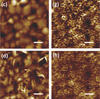
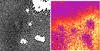
While the mysterious, unseen forces magnets project are now (mostly) well-understood, they can still occasionally surprise us. For instance, thin films of
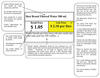
In an effort to help shoppers everywhere get the best value for their money, researchers at the National Institute of Standards and Technology (NIST) have
A little detective work by nuclear physicists has uncovered hidden uncertainties in a popular method for precisely measuring radioactive nuclides, often used to
For the first time in half a century, NIST's 4.45-million newton (equivalent to one million pounds-force) deadweight machine – the largest in the world – is
As cancer diagnostic tools, a new class of imagers – which combines positron-emission tomography (PET) with magnetic resonance imaging (MR or MRI) – has shown
NIST has partnered with the private sector to develop the next-generation open-source control software for quantum information systems. NIST is a world leader
A team of NIST scientists has devised and demonstrated a novel nanoscale memory technology for superconducting computing that could hasten the advent of an
A novel Portable Vacuum Standard (PVS) has been added to the roster of NIST's Standard Reference Instruments (SRI). It is now available for purchase as part of
Scientists at the National Institute of Standards and Technology (NIST) have developed a novel method to rapidly and accurately calibrate gas flow meters, such
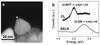
Two-dimensional (2D) materials* such as molybdenum-disulfide (MoS 2) are attracting much attention for future electronic and photonic applications ranging from
Cool instruments—literally—made by the National Institute of Standards and Technology (NIST) contributed to the media's top science stories of 2014. More than a
X-ray photoelectron spectroscopy (XPS) is one of the most sensitive and informative surface analysis techniques available. However, XPS requires a high vacuum
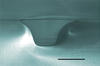
Spotting molecule-sized features—common in computer circuits and nanoscale devices—may become both easier and more accurate with a sensor developed at the
PML researchers are exploring whether ultrasound can be used as a faster, more efficient way to take three-dimensional images of radiation dose profiles in
Two new prototypes for tiny chip-based thermometers are illuminating light's potential to revolutionize the way temperature is gauged. With further development
In January, 2013, an auxiliary power unit battery aboard a Japan Airlines Boeing 787 "Dreamliner" experienced a "thermal runaway event" resulting in fire and
NIST hosted the Board of Directors of the International Electronics Manufacturing Initiative (iNEMI) on Wednesday, Dec. 10, 2014, for a half-day overview on
NASDAQ, a leading stock exchange for technology markets, has announced the launch of a precision time-stamping service for tens of billions of dollars of
Michael Postek of PML's Semiconductor & Dimensional Metrology Division has been an instrumental part of an outreach to bring access to tabletop scanning
In November, 2014, NIST hosted the seventh in a series of workshops in a NIST-Intel partnership effort on Emerging Nanoscale Interface and Architecture
NIST PML's Sources and Detectors Group has launched a new multikilowatt laser power measurement service capability for high-power lasers of the sort used by
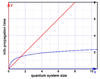
NIST scientists have devised an experimental photon-detection system for communications with error rates far below even the most ideal conventional designs
Defect-free nanowires with diameters in the range of 100 nanometers (nm) hold significant promise for numerous in-demand applications including printable
An ultra-stable, ultra-thin bonding technology has been adapted by researchers in PML's Semiconductor and Dimensional Metrology Division for use as a super