

Official websites use .gov
A .gov website belongs to an official government organization in the United States.

Secure .gov websites use HTTPS
A lock (
) or https:// means you’ve safely connected to the .gov website. Share sensitive information only on official, secure websites.


NG7 30m SANS

Instrument Purpose
To provide structural insights into the nanometer-scale architecture of complex materials, serving as a bridge between fundamental measurement science and industrial R&D.
The NCNR Advantage
- Industry-Standard Partnership: Originally a joint development between NIST, ExxonMobil, and the University of Minnesota, this instrument remains a global benchmark for studying the morphology of polymers, surfactants, complex fluids, and magnetic materials.
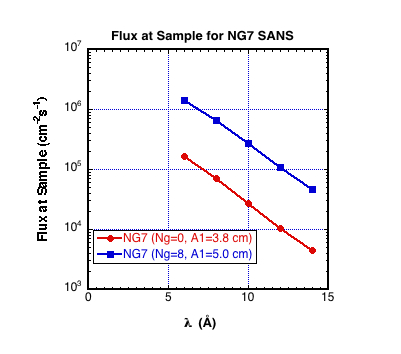
- 2026 Flux Revolution: Following the NG-7 guide upgrade to m=2 supermirrors, the instrument now delivers a factor of 2+ improvement in data rate, allowing for faster kinetic studies and the measurement of even more dilute or weakly scattering samples.
- Specialized Polarized SANS: A rare capability, 3He spin-filter analysis for fully polarized beam measurements is available, enabling researchers to decouple magnetic and structural scattering.
Research Domains
- Energy & Petrochemicals: Investigating the aggregation of asphaltenes, fractured shales, and the nanostructure of oil-water emulsions.
- Polymer Physics: Mapping chain conformations in block copolymers, polymer blends, and nanocomposites.
- Structural Biology and Applied Biophysics: Investigating the solution structure of biomolecules in a broad range of concentrations, enabled by the accessible low Q limit and increased flux, to probe structural and colloidal stability. An enhanced sample area facilitates measurements under extreme conditions, including low temperature and high hydrostatic pressure, relevant for process engineering and cold chain management of Food and Pharmaceutical materials.
- Nano-scale, and bulk magnetism: Probing magnetic nanoparticles and complex magnetic textures using polarized neutrons.
What You Can Measure
- Nanostructural Fingerprints: Determining the size, shape, and spatial distribution of features from 1 nm up to 500 nm.
- Interfacial Profiles: Measuring the "sharpness" and composition of interfaces in multi-phase systems.
- Magnetic Cross-Sections: Directly isolating magnetic correlations in superconducting, spintronic, and other advanced magnetic materials.
Technical Specifications
| Parameter | Specification |
|---|---|
| Source Type | Cold Neutron Guide (NG-7, 50 mm x 50 mm) |
| Post-2026 Flux Gain | ~ 2.2 x intensity increase vs. original guide |
| Q-Range Reach | 0.001 Å-1 to 0.7 Å-1 |
| Size Regime | ~ 10 Å to 5000 Å |
| Wavelength (λ) | 4.5 Å to 20.0 Å (Velocity Selector) |
| Wavelength Resolution | 11% to 30% Δλ/λ (FWHM) |
| Detector | 640 mm x 640 mm 3He PSD |
| Max SDD | 15.3 meters (continuously variable) |
Specialized Sample Environments
- Focusing Optics: Biconcave refractive lenses for accessing the lowest Q-values (< 0.001 Å-1) with high resolution.
- Polarization Suite: Integrated polarizing guide and RF flippers, with 3He cell analyzer for four-cross-section polarization correction.
- Automated Sample Changers: Sample blocks of up to 10-positions with high-precision thermal control (0 °C to 150 °C).
- Shear & Pressure: Compatible with a number of ultra high-pressure cells (up to 2.5 GPa) and high-shear rheometers for in-situ material processing studies.
- Low temperature and High-pressure (hydrostatic pressure up to 350 MPa): compatible with in-situ sub-0°C temperatures for measurements of freezing and cold denaturation effects on food and biopharma materials
- High Magnetic Field and Low Temperature: Devices designed to combine precision magnetic field with low temperature are available to study the magnetic properties of materials.
Expertise & Support
- Collaborative Heritage: Staffed by experts who specialize in translating industrial problems (e.g., fuel stability, drug delivery) into neutron scattering experiments.
- Software & Data Analysis:
- Igor Pro (NCNR Macros): Used by multiple facilities around the world, a reliable, high-throughput SANS data reduction.
- SasView: The world standard for reliable SANS analysis, with direct support for fitting over one hundred structural models, from simple spheres to complex hierarchical fractals.
- SASSIEweb: online tool to support experiment planning, as well as simulation and analyses for the modelling of biomolecular structures using small angle scattering data.
- Metrology Focus: Leveraging NIST’s standards mission to provide absolute intensity calibration, ensuring that "units of scattering" are consistent across decades of research.
Access & Resources
Instrument Contacts
susana.marujoteixeira [at] nist.gov (susana[dot]marujoteixeira[at]nist[dot]gov)
(301) 975-4404
john.barker [at] nist.gov (john[dot]barker[at]nist[dot]gov)
(301) 975-6732
jonathan.gaudet [at] nist.gov (jonathan[dot]gaudet[at]nist[dot]gov)
(301) 975-5010
jeffery.krzywon [at] nist.gov (jeffery[dot]krzywon[at]nist[dot]gov)
(301) 975-6650
Created July 2, 2026, Updated August 27, 2026