

Official websites use .gov
A .gov website belongs to an official government organization in the United States.

Secure .gov websites use HTTPS
A lock (
) or https:// means you’ve safely connected to the .gov website. Share sensitive information only on official, secure websites.


BT1 High Resolution Powder Diffractometer
Instrument Purpose
Provides precise determination of atomic and magnetic structures in polycrystalline materials using high-resolution neutron powder diffraction.
Key Capabilities
- Tailored Resolution: Features three interchangeable monochromators, allowing users to tailor the instrument response (intensity vs. resolution) specifically to their sample's needs.
- Excellent Data Quality: Produces nearly perfect Gaussian peak shapes, simplifying the modeling of complex multi-phase materials and subtle symmetry lowering.
- Exceptional Environment Flexibility: BT1 is highly regarded for its ability to run samples under a versatile range of specialized sample environments.
- Mail-in Program: The NCNR offers a robust mail-in service where NIST scientists collect data for you. This service is ideal for basic crystallographic needs (5 K – 300 K) and saves the time and cost of traveling to the facility.
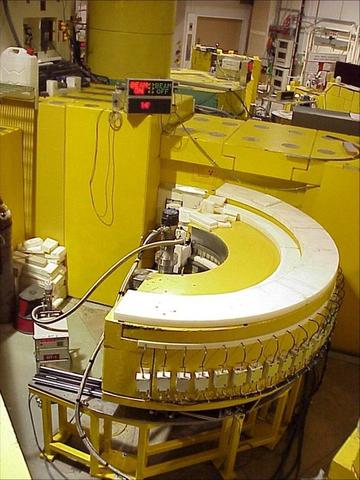
Credit:
Craig Brown
Research Domains
- Energy Storage: Investigating and determining small gas molecules in the pores of zeolites and metal-organic frameworks (MOFs), lithium and sodium ion environments within battery electrode materials, and hydrogen or deuterium sites within a host material lattice.
- Quantum Materials & Magnetism: Tracking magnetic phase transitions and magnetic order; identifying and solving magnetic structures.
- Advanced Functional Materials: Precise determination of oxygen vacancies and structural distortions in superconductors, subtle lattice distortions in ferroelectric and piezoelectric materials, and lattice changes in negative thermal expansion (NTE) materials.
- Ceramics & Intermetallics: Precise determination of stoichiometry in oxides, and site-ordering of different metals in an alloy. Analysis of phase fractions and thermal expansion over wide temperature ranges.
What You Can Measure
- Precise crystal structures (unit cell dimensions, atomic positions, light atom detection, occupancies/vacancies, and thermal parameters).
- Magnetic structure and moment determination.
- Phase identification and quantification in complex mineralogical or industrial samples.
- Structural changes under external stimuli (temperature, magnetic field, pressure, gas-loading, and electric field).
Technical Specifications
| Feature | Ge (311) | Cu (311) | Ge (733) |
|---|---|---|---|
| Primary Use | High Flux / Low Q | General Purpose / Balance | Ultra-High Resolution |
| Wavelength (λ) | 2.079 Å | 1.540 Å | 1.197 Å |
| Take-off Angle (2θ) | 75° | 90° | 120° |
| Flux at Sample (n/cm2/s) | ~1.16 × 10⁶ | ~4.40 × 10⁵ | ~1.20 × 10⁵ |
| Resolution (Δd/d) | ~0.33% | ~0.17% | ~0.08% |
| Detector Array | 32 3He detectors at 5° intervals covering up to 167° in 2θ | ||
Specialized Sample Environments
- Extreme Temperatures: Seamless integration with NCNR’s sample environment suite, covering 0.05 K to 2000 K via dilution refrigerators, cryostats, and specialized furnaces.
- Magnetic Fields: Vertical fields (up to 7 T) for probing magnetic phase diagrams.
- Gas Loading & In-Situ: Specialized cells for gas adsorption (H2/D2, CO2, etc.) and high-pressure environments (up to 2.5 GPa).
- Standard Containers: Vanadium cans in various sizes (1.5 mL, 4.0 mL, 5.5 mL, 8.0 mL, 11.5 mL), optimized for low background.
Expertise & Support
- On-Site Scientists: Our instrument scientists are international experts in structure determination from powder samples, Rietveld refinement, and magnetic crystallography. They provide hands-on assistance from experimental design to final publication.
- Data Reduction: Automated software pipelines convert raw detector counts into standard formats (GSAS, FullProf) with built-in absorption and background corrections.
- NIST Data Tools: Specialized Python scripts for real-time monitoring of thermal equilibrium and field dependence.
Access & Resources
Planning Tools
- Instrument Resolution (2-theta, Q)
- BT1 Sample Specifications & Safety
- Neutron Activation Calculator
- SLD Calculator
Live Data
Submit a Proposal
Instrument Contacts
Created August 27, 2026, Updated September 21, 2026