

Official websites use .gov
A .gov website belongs to an official government organization in the United States.

Secure .gov websites use HTTPS
A lock (
) or https:// means you’ve safely connected to the .gov website. Share sensitive information only on official, secure websites.


CHRNS NG1 CANDOR - Chromatic Analysis Neutron Diffractometer or Reflectometer
Instrument Purpose
Characterizes the nuclear and magnetic composition of buried interfaces and thin-film structures by utilizing a continuous white neutron spectrum to achieve rapid measurement speeds and real-time kinetic insights. CANDOR is part of the CHRNS partnership, jointly funded by the National Science Foundation and NIST to provide the scientific community with access to transformative neutron scattering instrumentation.
Instrument Contacts
User Resources
Research Output
Key Capabilities
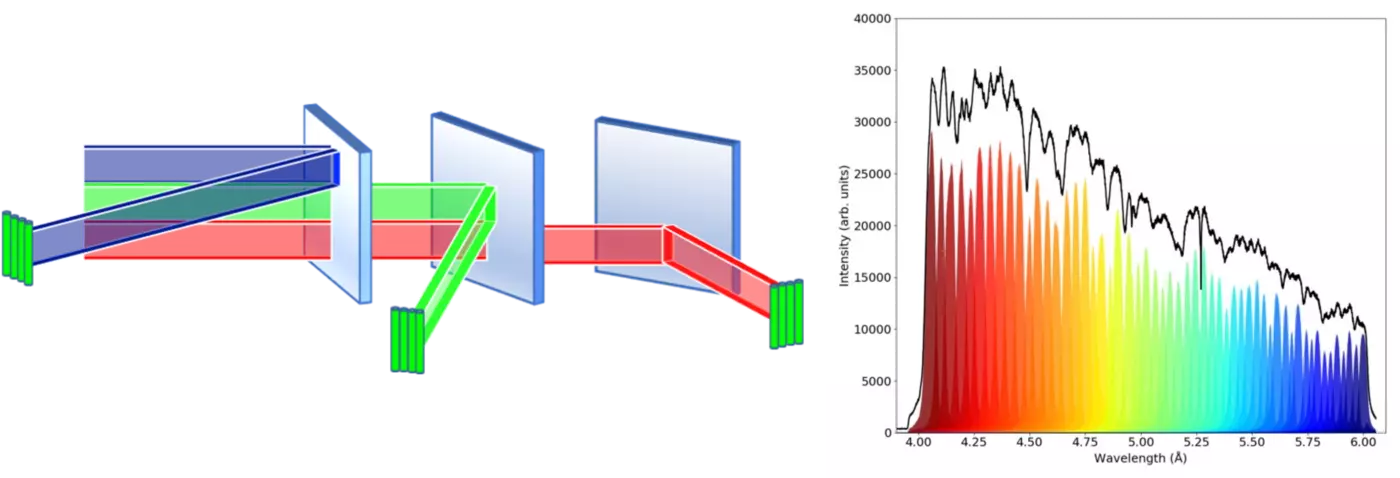
- 30×+ Gain in Data Rate: CANDOR revolutionizes reactor-based reflectometry. By collecting a broad range of wavelengths simultaneously (4 Å – 6 Å) rather than a single monochromatic slice, it achieves data collection speeds much faster than traditional reflectometers.
- Innovative Chromatic Detection: Employs a unique detector array consisting of 54 individual pyrolytic graphite analyzer crystals in series. This static, reliable configuration allows the instrument to sort the reflected "white" beam into distinct energy bins, maintaining high resolution while utilizing the full flux of the cold source.
- Real-Time Structural Evolution: The massive jump in intensity enables "neutron movies"—the ability to observe structural changes in batteries, membranes, or chemical coatings as they happen, with time resolutions previously impossible at a steady-state source.
Research Domains
- Energy Storage: Operando studies of lithium transport and interfacial degradation in solid-state batteries, high-entropy phase transitions, and gas adsorption studies in MOFs.
- Quantum Materials: Materials and interfaces for ultra-low power distributed and neuromorphic computing; mapping magnetic depth profiles in spintronic systems; understanding and designing new superconductors.
- Qubit Optimization: Isolating defects to improve coherence lifetimes and optimize fabrication processes for quantum devices.
- Process Development: Revealing processing artifacts on film quality for next-generation logic devices, such as amorphous oxide semiconductors for back-end-of-line transistors.
- Soft Matter & Biology: Investigating the dynamic self-assembly of lipid bilayers and the swelling of stimuli-responsive polymers.
- Thin Film Kinetics: Tracking rapid diffusion, oxidation, or phase transitions in multi-layered coatings.
What You Can Measure
- Specular Reflectivity: Used to determine the depth profiles of nuclear composition and magnetic field in thin films and multilayers with down to sub-nanometer resolution. Provides absolute determination of layer thickness (1 nm to 200 nm), roughness, and scattering length density.
- Non-Specular Reflectivity: For characterizing microscopic in-plane structural features in thin films, such as magnetic domains and lateral polymer phase separation.
- Diffraction: For rapid measurements of atomic structure, especially for large unit cells.
- Kinetic Data: Snapshots taken in minutes rather than hours, allowing for the study of non-equilibrium states.
- Autonomous Data Collection: Integration with active learning software that analyzes data in real-time to automatically identify the most valuable next points to measure, further increasing efficiency.
Technical Specifications
| Parameter | Specification |
|---|---|
| Source Type | Liquid hydrogen cold moderator |
| Wavelength Range (λ) | 4.0 Å to 6.0 Å (Polychromatic) |
| Energy Analysis | 54-element HOPG crystal analyzer banks |
| Wavelength Resolution (Δλ/λ) | ~1.5% (per detector element) |
| Q-Resolution (ΔQ/Q) | 1.5% |
| Dynamic Range | 8 orders of magnitude (unpolarized); 6–7 (polarized) |
| Angular Precision | ±0.01° absolute |
| Sample Geometry | Vertical |
| Polarized Beam Capabilities | V-cavity polarizer and RF flipper for incident beam, 3He spin filter for scattered beam analysis. |
Specialized Sample Environments
- Magnetic Fields: Standard polarized beam measurements in up to 3 T.
- Temperature Control: Standard range of 2.5 K to 315 K.
- Electric Fields: Capability to apply up to 2 kV across thin-film samples.
- Liquid Cells: For studying solid-liquid interfaces.
Tools & Links
- Reductus: Online browser-based data reduction service for reflectometry data transformation and processing.
- Refl1D: State-of-the-art Python package for fitting and uncertainty analysis of specular neutron and X-ray reflectivity data.
- NICE: Fully scriptable instrument control.
- Unpolarized Neutron Reflectivity Calculator: Web tool for quick reflectivity modeling for experiment planning.
- Polarized Neutron Reflectivity Calculator: Web tool with magnetic capability.
- CANDOR Q-Coverage Calculator: Planning calculator for modeling momentum transfer and angular settings on CANDOR.
- NCNR Surfaces & Interfaces Team: Experts supporting neutron reflectometry instrumentation at NIST.