U.S. flag

An official website of the United States government

Official websites use .gov
A .gov website belongs to an official government organization in the United States.

Secure .gov websites use HTTPS
A lock ( ) or https:// means you’ve safely connected to the .gov website. Share sensitive information only on official, secure websites.

Projects/Programs

Displaying 326 - 350 of 1614

DARPA Computational Cultural Understanding (CCU)

Completed
The Department of Defense (DoD) operates globally and is in constant contact with diverse cultures, and cross-cultural miscommunication can derail negotiations, incite hostile discourse, or even lead to war. Despite advances in machine learning and multimedia analysis, existing human language...

DARPA Friend or Foe (FoF) – Independent Verification and Validation (IV&V)

Completed
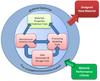
Vision Validate new measurement platforms for identifying commensal (friend) and pathogenic (foe) microorganisms Goal Provide well-characterized, microbial community reference materials of increasing complexity Approach Start with well-characterized pure cultures and scale up to complex consortia in...

Data Analytics for Smart Manufacturing Systems

Ongoing
Objective: Develop standards, software tools, methodologies, and guidelines to enable small and medium enterprises to apply data analytics services to improve decision-making and performance in smart manufacturing systems. Technical Idea: Manufacturers need enhanced decision-support tools that would...

Data Driven Decision Support for Additive Manufacturing

Completed
Objective To develop and deploy the metrics, models, and best practices for using product definition, advanced analytics, and machine learning methods in additive manufacturing design and process planning to reduce lead times and support first-part-correct goals. Technical Idea Future advancements...

AI/ML for Data Extraction and Uncertainty Predictions

Ongoing
The Material Measurement Lab at NIST employs artificial intelligence for the prediction and discovery of materials characteristics. Our applications of artificial intelligence (AI) accelerate materials research as well as help the community learn about AI's capabilities and gain confidence in...

Data Infrastructure for Biomanufacturing

Ongoing
Objective Develop measurement science for new, computationally more precise, and AI-understandable data standards that would allow for quick and easy 1) configuration of integrated equipment and software components within the production system and 2) knowledge discovery, visualization, and...

Data Infrastructure for Critical Material Recovery

Ongoing
Objective The objective of this project is to strengthen critical materials recovery data infrastructure via the development of suitable data sets, metrics, indicators, models and technical standards to help define critical materials and information pathways across entire product life cycles and...

Data Integration and Management for Additive Manufacturing

Completed
Objective Data plays the most critical role in linking AM lifecycle and value chain activities and streamlining the AM development process. While the AM data from a single build is essential for establishing part traceability, when methodically collected, the full processing history of thousands of...

Data Integration, Management and Fusion for AM Industrialization

Ongoing
Objective Developing methods, models, software tools, open data, and best practices for data integration, management, and fusion in additive manufacturing to accelerate AM Industrialization. Technical Idea Our technical idea is to enable an integrated, streamlined, and effective AM development and...

Data Models for Expression of Uncertainty in Materials Data

Ongoing
The two main parts of this work are definition of appropriate data structures for different types of uncertainty analyses, and implementation of these data structures into analysis and visualization software for demonstration, testing, and use. The different types of uncertainty analyses to be...

Data Tools for Environmental Metrology

Ongoing
A recent addition to operations in the NIST Biorepository, we seek out places where NIST scientists get bogged down by the complexity of their data. Research at NIST can generated some of the most complex data in the world, at times requiring six months or more of processing to get to the data...

Data-Driven Design for Product Recovery

Ongoing
Objective To develop standards, metrics, and data-driven methods that can be implemented in early product design stages to increase the efficacy of end-of-use product recovery pathways and keep valuable products in the economy and recover valuable materials. Technical Idea The Data-Driven Design for...

Data-Driven Network Optimization for Future Wireless Systems

Ongoing
Research Highlights AI Innovations in Spectrum Sharing for Wireless Networks With the increasing demand for wireless communication, efficient spectrum management has become essential. NIST is exploring the application of AI/ML techniques to optimize this area, particularly through solutions like...

Decontamination of Biological Threats in Water Supplies

Completed
The outcome of the project was to provide the EPA with a technical resource document that could be used to guide emergency responders and for longer-term microbial decontamination of building water systems. This project was done in collaboration with the Building and Fire Research Laboratory (BFRL)...

Deducing Prior Material Deformation from Simple Mechanics

Ongoing
Process-structure-property linkages suggest an opportunity to deduce processing from behavior. Simple imaging experiments provide rich sources of data. Can we deduce prior deformation? Scheme: Thin film plasticity Deform to some reference strain Unload Deform to test strain, image Deduce...

Deep Learning for MRI Reconstruction and Analysis

Ongoing
The project is proceeding in three directions. Creating a new MRI reference artifact designed to assess geometric distortion using NIST’s MRI scanner. The artifact will be small enough to fit within the scanner with sufficient clearance to allow for variation in positioning within the scanner....

Degradation of extreme-ultraviolet optics

Ongoing
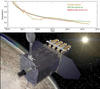
The primary degradation process in EUVL tools and satellite instruments begins by the adsorption of water or carbonaceous molecules from the vacuum environment onto the optic surface. The optic is damaged if the molecule undergoes photon-stimulated decomposition before it can (reversibly) thermally...

Department of Homeland Security Response Robot Performance Standards

Ongoing
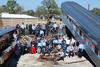
The Intelligent Systems Division of the National Institute of Standards and Technology is conducting an ongoing project, sponsored by the Department of Homeland Security Science and Technology Directorate and the National Institute of Justice, to produce a comprehensive set of standard test methods...

Deployable Doppler Thermometry

Ongoing
Accurate temperature measurements are essential to many industrial processes, including petrochemical or pharmaceutical production and nuclear power generation. Typical process control thermometers, such as resistance temperature detectors, are known to drift over time and degrade when subject to...

Design and Analysis of Key Comparisons

Ongoing
DESCRIPTION: With the recent signing of the Mutual Recognition Arrangement (MRA), National Metrology Institutes (NMI's) and Regional Metrology Organizations (RMO's) around the world have committed themselves to establishing the equivalence of their measurement standards. Currently, however, there is...

Design Fires for Structures Project

Completed
By 2016, this project aims to develop (1) measurement science for characterizing and measuring repeatable structurally significant fires for large-scale experiments, and (2) a performance-based design framework linking fire intensity with expected structural performance objectives.

Design Methods for Resilient Community Systems

Completed
Objective - To advance design and assessment methods for buildings and infrastructure to improve their ability to support the social and economic functions they support and community resilience. What is the technical idea? Quantitative approaches to identify and evaluate the performance of the built...

Design for Tornadoes

Completed
Objective To advance tornado hazard mitigation through improved characterization of tornadoes and their interaction with buildings and structures, providing the technical foundation for improvements to tornado load design guidelines, standards, codes, and code adoptions. This includes research and...
Was this page helpful?